Stacking Washer and Dryer Dimensions: A Practical Guide
A data-driven guide to the dimensions of stacking washer and dryer units, including typical ranges, measurement steps, and layout tips for fit and ventilation.


Stacking washer and dryer units typically measure about 27 inches wide and 30-34 inches deep per machine, with heights around 38-39 inches. When stacked, the combined footprint is roughly 27 inches wide and 75-80 inches tall, depending on pedestals and models. Always verify exact model dimensions before purchase and installation constraints.
Why precise dimensions matter for stacking appliances
When planning a laundry setup that uses a stacking washer and dryer, getting the dimensions right is non-negotiable. If the units are too wide for the space, doors or cabinet doors won’t open; if they’re too deep, they can block ventilation or hamper adjacent storage. The What Dimensions team emphasizes that precise size references save time, reduce surprise costs, and help you avoid second-guessing during installation. Accurate measurements also support safe clearance for maintenance access and for proper appliance ventilation, which is essential to performance and longevity. In compact spaces, even a one- or two-inch deviation can force you to reorient machines or swap to a different model. The goal is to reconcile the per-unit dimensions with the room’s footprint, utilities, and any staging area needed during loading and unloading. By starting with reliable size data, homeowners and designers can create layouts that feel effortless in daily use and robust over time.
Standard dimensions and typical ranges for stacking units
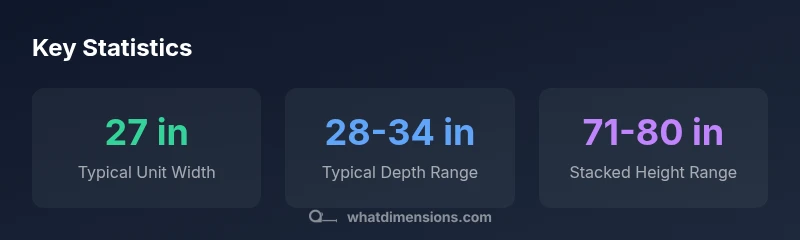
Most front-loading laundry pairs share common footprint characteristics to simplify planning. A single unit commonly measures about 26-28 inches in width, with depths typically ranging from 28 to 34 inches, depending on drum size, insulation, and venting design. Heights per unit are generally in the 36-39 inch band, not counting pedestals or control panels that extend the top. When you stack two units, the overall profile rises by roughly 70-80 inches, with 71-80 inches representing a broad range that covers standard, non-custom installations. It’s important to note that exceptions exist: some compact or European models may be slightly narrower, while premium models with extended controls can be taller or deeper. For planning, assume a stacked configuration that preserves a few inches of clearance above and behind the units to accommodate hoses, ducts, and air circulation. These ranges provide a reliable baseline for shopping, but always verify each model’s official specifications before purchase.
Model differences and how they affect fit
Brand and model choices influence exact dimensions and clearance requirements. Even within the same size family, differences in drum design, door orientation, and control panel height can affect how a unit sits in a cabinet or closet. For example, many standard residential washers and dryers adhere to a width near 27 inches, but some compact models may be closer to 24-25 inches, which can be advantageous in tight spaces. Depth varies more widely, often due to drum depth and insulation thickness. Some machines also have protruding control panels that require additional vertical space. When stacking, most households use a certified stacking kit designed for a specific pair of models; misalignment can cause doors to strike or ventilation to be compromised. Work with product pages and installation manuals to confirm mounting points, weight limits, and any required spacer or anti-tip features. The goal is a secure, accessible stack that respects both the unit’s tolerances and the room’s constraints.
Measuring your space for stacking: a step-by-step guide
- Measure width: open any adjacent cabinet doors and identify the maximum opening.
- Measure depth: include a margin for hoses and vents; add at least 1-2 inches for clearance.
- Measure height: determine available ceiling clearance and the space above the top unit for any pedestals or lofted storage.
- Check utilities: confirm outlet and vent locations fit the stacked configuration.
- Create a margin for maintenance: ensure you can access the back and sides for service without removing the units.
- Verify door swing: ensure the doors of both units can open without hitting walls or cabinetry.
- Compare to model specs: cross-check your measurements against the manufacturer’s official dimensions and the stacking kit requirements. If you’re in a tight space, consider mock-ups with painter’s tape on the floor to visualize fit.
Layout, clearance, ventilation, and electrical considerations
Clearance matters just as much as width. Allow at least a few inches behind the machines to accommodate power cords, hoses, and airflow, and ensure there is space on the sides for lint traps and filter access. Ventilation is critical; blocked or restricted ducts can reduce efficiency and shorten appliance life. Check the electrical requirements for the stacked pair; most homes use standard 240V circuits for dryers and 120V for washers, but some configurations may differ by region. If the closet or cabinet is enclosed, ensure the doors stay open wide enough for loading and service. Consider a small pour of sealant or adjustable feet to reduce vibration on uneven floors. Finally, reference the stacking kit documentation to ensure alignment with the units’ mounting points and to verify load ratings. Good planning reduces the chance of misalignment or airflow problems after installation.
Planning scenarios and a practical checklist
Scenario A: A 27-inch-wide laundry closet with a standard ceiling height and no pedestal. Use a standard stacking kit and ensure a vented dryer location. Scenario B: A compact laundry space with limited depth; select a 24-25 inch wide compact washer and a compatible compact dryer, verify with models that stack without obstructions. Checklist: measure, verify model specs, confirm stacking kit compatibility, check ventilation, confirm electrical availability, test door clearance, leave space for maintenance. By combining measured space with model-friendly dimensions, you can design a reliable stacking solution that remains functional and accessible for years. What Dimensions' approach emphasizes documenting dimensions early, prioritizing airflow and service access, and validating every model against your space.
Typical dimensions for single units and stacked configurations
| Aspect | Typical Range | Notes |
|---|---|---|
| Width per unit | 26-28 inches | Most front-load/compact units fall in this range |
| Depth per unit | 28-34 inches | Depth varies by model and venting needs |
| Height per unit | 36-39 inches | Height depends on control panel and feet/pedestal |
| Stacked height | 71-80 inches | Total height when units are stacked with a standard kit |
Quick Answers
What are the typical dimensions for a stackable washer and dryer?
Most stackable pairs use a standard width near 26-28 inches per unit and a height around 36-39 inches. When stacked, expect a combined height of about 71-80 inches. Always cross-check model specs for exact figures.
Most stackables are about 26-28 inches wide per unit and 71-80 inches tall when stacked; verify exact figures from the manufacturer.
How do I measure a space to stack appliances?
Measure width, depth, and height with a tape measure, then add at least 1-2 inches of clearance for hoses and airflow. Check door swing and utility access, and compare results with the product specifications.
Measure width, depth, and height, add clearance, and confirm with product specs.
Do different brands affect stacking height?
Yes. Stacking height can vary by model and kit. Always verify the exact stacking height and mounting points in the manufacturer’s guide.
Height can vary by model; check the kit and model specs.
What about ventilation and clearance when stacking?
Ensure behind and around the units there’s space for airflow; avoid enclosing vents or hoses too tightly. Adequate clearance improves efficiency and longevity.
Leave room for airflow and access to hoses and vents.
Should I use a pedestal or stacking kit?
Use a certified stacking kit designed for your model pair. Pedestals add height and storage but can affect alignment and ventilation if not compatible.
A certified stacking kit is best; pedestals can change height and clearance.
“Clear, dimensioned planning reduces installation risk and ensures proper clearance for ventilation and airflow.”
Main Points
- Measure your space before shopping
- Expect per-unit width of 26-28 inches
- Plan for a combined height of 71-80 inches when stacked
- Check stacking kit compatibility and venting
- Leave space for maintenance and door clearance