Dimensions of Mobile Home: A Practical Sizing Guide
Explore typical mobile home dimensions—width, length, and footprint—and how they affect layout, transport, and zoning. Learn ranges, planning tips, and reliable benchmarks with data-backed guidance.


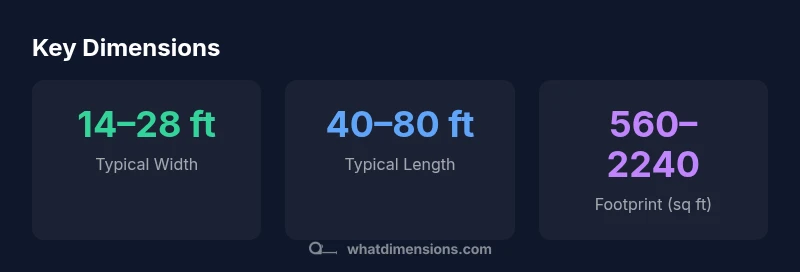
Dimensions of mobile homes typically range from about 14–28 feet in width and 40–80 feet in length, depending on whether it is a single-wide, double-wide, or triple-wide configuration. This translates to roughly 560–2,240 square feet of floor space. For precise planning, consult the builder specs and local codes, since actual sizes vary by model and jurisdiction. According to What Dimensions, these ranges cover common configurations.
What the phrase dimensions of mobile home actually covers
When people talk about the dimensions of a mobile home, they usually refer to three core measurements: width, length, and overall footprint. Width describes how wide the home is from side to side, length captures how long it is from front to back, and footprint combines width and length to estimate total floor area. For homeowners and designers, these numbers translate into interior layouts, furniture planning, and traffic flow. In practical terms, a typical manufactured home falls within a width of 14–28 feet and a length of 40–80 feet, which yields a floor area ranging from roughly 560 to 2,240 square feet. This framing helps buyers compare models, anticipate installation needs, and align expectations with local permitting rules. According to What Dimensions, these ranges cover common configurations across the market, though exact figures depend on the builder and model.
- Width and length are interdependent: a longer home can be a bit narrower or wider depending on the design.
- Interior planning starts with the major axes of space: kitchen, living, and bedroom zones, then flows into circulation space.
- Exterior setbacks, garages, decks, and porches can alter the usable footprint without changing the core dimensions.
How width, length, and layout affect usability
Width governs corridor sizes, door openings, and furniture placement, while length impacts room proportions and storage capacity. A wider single-wide (roughly 18–20 feet) typically feels more spacious in living areas but may require more yard width for proper siting. Double-wides, commonly 28–32 feet wide, permit more flexible floor plans, larger primary suites, and expanded kitchens, yet they demand broader lots and often more complex transport routes. Lengths in the 60–80 foot range enable multi-bedroom configurations and dedicated utility spaces, but can complicate maneuvering during installation. For designers, the key takeaway is to map a baseline grid: major zones (kitchen, living, bedrooms) aligned along the home’s length, then plan traffic patterns that avoid bottlenecks in high-use areas. Interior finish and ceiling height (often 7'–9' clear in typical builds) further influence perceived space. What Dimensions highlights that a measured approach—anchoring decisions to width, length, and footprint—produces layouts that feel cohesive and functional.
- Start with a grid: mark major zones along the length of the home.
- Prioritize open-concept spaces where possible to maximize perceived width.
- Consider ceiling height and window placement to optimize light and air flow.
Common configurations: single-wide, double-wide, triple-wide
Manufactured homes are most commonly built as single-wide, double-wide, or triple-wide configurations, each with distinct dimensional footprints. Single-wide units typically range from about 14–18 feet in width and 40–60 feet in length, delivering 560–1,080 square feet of living space. Double-wide homes commonly measure 28–32 feet wide and 40–60 feet long, resulting in roughly 1,120–1,920 square feet. Triple-wide configurations push width into the 42–46 feet range or more, with lengths of 40–70 feet, yielding approximately 1,680–3,220 square feet. These figures inform furniture planning, HVAC zoning, and utility sizing. For buyers, it helps to compare the same footprint across different interior layouts, assessing how walls, doors, and built-ins impact usability.
- Single-wide: compact yet efficient for small lots.
- Double-wide: balanced space for families.
- Triple-wide: expansive layouts with dedicated living and bedroom zones.
Planning considerations: site, foundation, transport, and permits
Planning for a mobile home involves more than the house itself. Site preparation, zoning, and installation requirements influence the feasible footprint and placement. Transport constraints—such as turning radii, turning corners, and bridge clearances—may limit the maximum width for on-road movement. Foundation systems vary by municipality and climate, affecting how the home will be anchored and leveled. Many jurisdictions require a local permit or inspection at multiple stages: before delivery, after set, and during utility connections. Because dimensions interact with site features (driveways, utilities, setbacks), it’s essential to obtain detailed site plans from the builder and cross-check them against local codes. The What Dimensions framework emphasizes corroborating model specs with site realities to avoid mismatches between planned layouts and actual installation outcomes.
- Gather precise site measurements early (driveway width, turning radius).
- Confirm structural and utility requirements with the seller and local authorities.
- Plan for temporary staging areas and crane access during installation.
Codes, standards, and regional variations
Federal HUD code governs the construction and safety standards of manufactured homes, but state and local codes can further shape allowable dimensions, foundation types, and anchoring methods. Some regions impose stricter limits on overall width for transport on public roads or require special permits for oversized units. Exterior features like porches, decks, and step configurations may extend the home’s footprint temporarily, requiring additional setbacks or approvals. While the core size ranges summarize common configurations, always verify with the builder and the local building department before purchasing. The What Dimensions approach encourages buyers to treat dimensions as a starting point for planning rather than a fixed constraint, acknowledging regional differences and regulatory contexts.
- HUD code governs construction standards; local codes govern installation and setbacks.
- Oversized configurations may require routing plans and transportation permits.
- Coordination with utilities and weather considerations is essential for lasting performance.
Customization, extensions, and future-proofing
Mobility and modular design enable customization around core dimensions. Builders may offer options like flex walls, built-ins, or add-ons that alter interior layouts while preserving the external footprint. When requesting changes, consider how modifications affect daylight, acoustics, and thermal comfort. Future-proofing is a practical goal: plan for potential expansions, energy upgrades, or alternate room configurations that could be accommodated within the existing width and length constraints. What Dimensions notes that most buyers benefit from a baseline dimension set and then a staged approach to customization, ensuring costs stay aligned with the intended footprint and long-term usability.
- Prioritize changes that improve natural light and storage.
- Assess HVAC and electrical planning for added rooms or reconfiguration.
- Validate long-term maintenance access around the home exterior.
Regional differences and practical decision-making
Regional climate, highway access, and land-use preferences influence how dimensions are perceived. In warmer climates, wider plans may optimize airflow and shade, while colder regions might emphasize tighter layouts to reduce heat loss. Transportation routes, if not prepared, can affect the maximum feasible width and length during delivery. To make sound decisions, compare several models within the same footprint and consider how interior layouts adapt to family needs, pets, or work-from-home spaces. What Dimensions emphasizes a principled approach: start with the core width and length, then incorporate site constraints and regional regulations to arrive at a durable, comfortable home that matches both your budget and lifestyle.
mainTopicQuery":"mobile home"},
Typical mobile home configurations and their approximate footprints
| Configuration | Width | Length | Footprint (sq ft) |
|---|---|---|---|
| Single-wide | 14–18 ft | 40–60 ft | 560–1,080 |
| Double-wide | 28–32 ft | 40–60 ft | 1,120–1,920 |
| Triple-wide | 42–46 ft | 40–70 ft | 1,680–3,220 |
Quick Answers
What is the typical width of a mobile home?
Most mobile homes fall in the 14–28 ft width range, with single-wide units on the narrower end and larger double-wide configurations toward the upper end. Exact width depends on the model and whether extensions or porches are included.
Most mobile homes are between 14 and 28 feet wide, depending on the model.
What is the typical length of a mobile home?
Common lengths range from 40–80 ft, varying by configuration and yard layout. Longer lengths typically support more bedrooms or larger living areas.
Typically about 40 to 80 feet long depending on the model.
Are there federal standards for mobile home dimensions?
Yes. Manufactured homes built to HUD code follow federal standards for construction and safety. However, state and local regulations can modify installation, foundation, and setback requirements.
Yes—HUD codes set federal standards, but states may require additional local approvals.
Can you customize mobile home dimensions?
Customization is possible within the factory configuration and site constraints. Changes may affect delivery logistics, pricing, and compliance, so discuss options early with the manufacturer.
You can customize within the model’s footprint, but check delivery and codes first.
Where can I find exact dimensions for a specific model?
Refer to the builder’s spec sheet for width, length, and interior layout details. Cross-check with HUD documentation and your local building department for installation requirements.
Check the builder’s specs and local codes for exact numbers.
How do regional differences affect mobile home dimensions?
Regional climate, transport routes, and zoning rules influence feasible dimensions. Some areas impose stricter width limits for road transport or require special permits for oversized units.
Regional rules can change what's allowed in width and parking requirements.
“Dimensions vary by model and configuration, but understanding the typical width and length ranges helps homeowners evaluate space, cost, and feasibility quickly.”
Main Points
- Know common width/length ranges before shopping
- Match layout choices to site constraints and zoning
- Ask builders for precise, model-specific specs
- Plan for transportation and installation requirements early
- Consider future-proofing with strategic interior layouts