Dimensions for Mobile Homes: Precise Sizing Guide
Discover exact mobile home dimensions for beds, sofas, and layouts. A practical sizing guide from What Dimensions helps you design spaces that fit and flow.


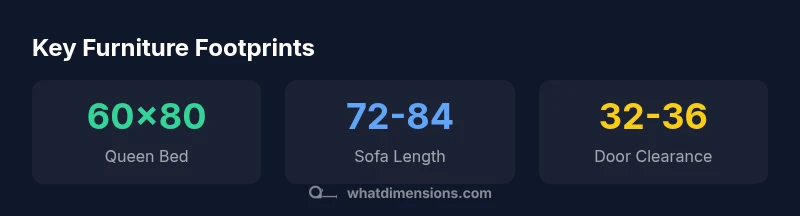
For mobile homes, start with exact footprints for every item you’ll place. A queen bed is typically 60 inches wide by 80 inches long, and standard sofas often range 72–84 inches in length. What Dimensions Analysis, 2026, recommends measuring every doorway, hallway, and corner to ensure each piece fits and leaves comfortable circulation. Use these dimensions as the basis for a room-by-room layout before buying furniture.
Why precision matters for mobile home dimensions
In compact living spaces like mobile homes, precise dimensions are not a luxury—they determine whether a room can be used at all. When you plan around exact footprints, you minimize dead space, avoid door clashes, and preserve clear circulation. What Dimensions's methodology emphasizes verifying footprints for every major piece (beds, seating, storage) before ordering or moving in. This approach pays off in the long run by enabling flexible rearrangement as needs change.
Precise sizing also helps with financing and insurance assessments, since insurers and lenders often require a clear, organized plan of your space. By starting with dimensions you can trust, you create a baseline that makes it easier to add or resize later, without the need for costly remodeling. Throughout this guide, the emphasis is on measurable accuracy—no assumptions, no vague estimates.
Standard footprints you should know before shopping
Knowing standard footprints helps you compare options quickly and avoid buying pieces that won’t fit. A queen bed footprint is commonly 60 inches by 80 inches, and most sofas come in lengths from about 72 to 84 inches. Cabinets, wardrobes, and dining sets should be matched to available wall and hallway space. Always cross-check measurements with real-world doors, windows, and passageways. When you combine these footprints with a precise room sketch, you get a dependable baseline for purchases.
Remember to account for movement space around each piece; most designers recommend at least 24–30 inches of clearance for primary traffic routes.
Common measurement pitfalls and how to avoid them
Common mistakes include measuring from the wrong edge, neglecting door swing, and ignoring the thickness of walls or trim. Always measure in multiple directions and use the longest dimension for clearance planning. When possible, measure with the same tool (tape measure or laser) to ensure consistency. If a piece is borderline, consider a modular or compact version that can be reconfigured. Document all measurements in a shared floor plan so anyone in the household can refer to them.
A practical tip: measure the footprint of each item in its intended orientation, then compare to door widths and hallway clearances to verify a smooth transition.
Bedroom sizing: fit for a comfortable night's sleep
Bedrooms in mobile homes benefit from simplified layouts that prioritize flow and privacy. Start with the bed footprint (for a queen, 60x80 inches) and plan at least 30 inches of walking space on each side if possible. Incorporate storage that tucks against walls rather than encroaching on walking paths. Consider under-bed storage or vertical solutions to minimize floor clutter. A well-dimensioned bedroom should feel larger than its actual footprint due to thoughtful spacing and furniture placement.
Living room and passage layout
Living areas must balance seating, appetite for natural light, and safe circulation. Use modular sofas that can be rearranged without heavy lifting. Aim for 36–60 inches of aisle width between seating and other furniture to maintain clear paths. If a hallway section tolerates a door swing, reorient furniture to avoid openings colliding with passage flow. Visualizing the layout with a scaled floor plan helps you anticipate issues before you buy.
Kitchen and dining: practical footprints
Compact kitchens reward efficient footprints. A standard dining height table might be 28–30 inches tall and 48–60 inches long for a small family setup. In mobile homes, you may rely on foldable or wall-mounted dining solutions to preserve counter space. Measure appliance widths, cabinet depths, and door entry clearance to avoid bottlenecks. Ensure appliance doors can open fully without hitting adjacent furniture or walls.
Tools and methods for precise measurements
Use a sturdy tape measure and, where possible, a laser measure to capture long distances quickly. Create a simple digitized floor plan or a written inventory of footprints for quick reference during shopping trips. Double-check measurements for accuracy and include door swings, window alcoves, and wall thickness. A well-documented measurement process reduces misfit risk and speeds up decision-making.
Case study: a sample 2-bedroom mobile home layout
This example demonstrates how precise footprints support a clear, flexible plan. Room-by-room planning starts with the queen bed footprint, then accounts for doorway clearances and walkway space. The living room uses a modular sofa within a 72–84 inch footprint, positioned to maximize traffic flow from the entry to the dining nook. The kitchen island is sized to keep a 36-inch aisle, allowing easy movement while cooking. The result is a livable space that adapts to changing needs with minimal rearrangement.
Quick-start checklist: dimensions mobile home in practice
- List all major pieces with footprints (bed, sofa, storage, dining).
- Measure every doorway and corridor for clearance.
- Sketch a room-by-room layout before purchasing.
- Choose modular or multi-functional furniture for flexibility.
- Validate your plan with a final walk-through in real space.
Common furniture footprints for mobile home layouts
| Item | Footprint (inches) | Notes |
|---|---|---|
| Queen bed | 60x80 | Standard footprint |
| Sofa (modular) | 72-84 long | Length varies by configuration |
| Doorway clearance | 32-36 | Recommended |
| Kitchen island length | 48-60 | Depends on layout |
Quick Answers
What is the single most important measurement when planning mobile home dimensions?
Doorways and circulation space, plus footprints of large furniture, drive the initial plan. Verifying these early helps prevent bottlenecks in tight spaces.
Focus on doors, hall clearances, and furniture footprints to guide your layout.
Which furniture sizes work best in mobile homes?
Modular and compact pieces that can reconfigure balance function and space. Prioritize items with smaller footprints than the room allows.
Choose modular, compact pieces to maximize flow.
How can I verify furniture fits through doors?
Measure door width and height, then compare with the furniture footprint including any handles or protrusions.
Measure the door and item to ensure a smooth through-flow.
What tools help with dimension planning?
A tape measure, a laser distance measurer, and floor-plan apps for quick layout testing.
Use a tape measure, a laser, and a layout app.
Are there standard room sizes in mobile homes?
Room sizes vary widely; start with footprint mapping and adapt as you measure and compare.
Room sizes vary; begin with precise footprint mapping.
How do I handle irregular corners or alcoves?
Document irregularities and adjust layouts with flexible furniture or trims as needed.
Draw the irregular area and adapt with flexible furniture.
“Accurate dimensioning isn't optional—it's the foundation of a livable mobile home layout. When every piece fits to exact footprints, you unlock flexible design and safer circulation.”
Main Points
- Measure every piece before buying
- Prioritize clearance in doorways
- Choose modular furniture for flexibility
- Map layout room-by-room first
- Verify transitions through hallways