Difference Between Dimensions and Measurements: A Practical Guide
Explore the difference between dimensions and measurements with clear definitions, real-world examples, and actionable guidance for design, manufacturing, and everyday sizing.


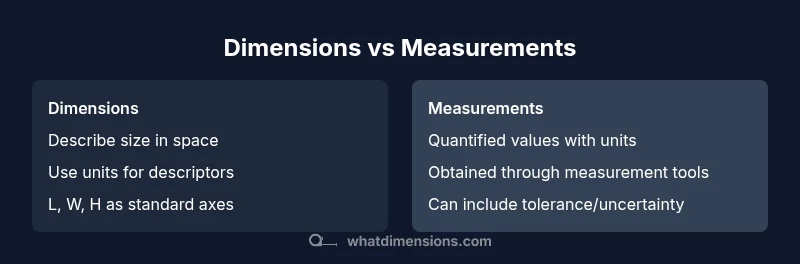
Between dimensions and measurements, the distinction is foundational in design, manufacturing, and everyday object sizing. Dimensions describe an object's size in space (length, width, height) and form part of its specification, while measurements are the actual numeric quantities obtained when you measure those sizes using units. In short, dimensions are properties; measurements are the values you obtain.
Understanding the core distinction: difference between dimensions and measurements
The phrase difference between dimensions and measurements is more than semantics; it underpins accurate sizing, ordering, and compatibility across products and spaces. In everyday life we describe a room as being 12 by 14 feet, yet the same room's size becomes a specific measurement when you record the numbers of inches or meters needed to cut materials, order furniture, or draw a plan. What Dimensions emphasizes in this guide is that dimensions are properties that define extent in space, while measurements are the observed values that express those properties in a chosen unit. Distinguishing these terms helps prevent misinterpretation in procurement, shipping, and interior design. As you read, you will see practical examples and tests you can apply to your own projects, whether you’re fitting a sofa, arranging a desk, or shipping a vintage console. The goal is to reduce ambiguity and improve collaboration across teams, contractors, and retailers.
What are dimensions?
Dimensions are properties that describe the size of an object or space in a particular direction or axis. They are the descriptive attributes that define length, width, height, depth, and sometimes thickness. In practical terms, dimensions tell you what an object could be or will be, independent of anyone’s measurement process. When you see a product specification like L × W × H, you’re looking at dimensions: those numbers describe the size of the item in a standardized way. Crucially, dimensions do not imply you have measured anything; they are the intended or inherent size descriptors that help with fit, compatibility, and planning. At their core, dimensions are about what exists in the space the item occupies, not necessarily what you have measured at a given moment.
What are measurements?
Measurements are the actual numerical values obtained by using tools, instruments, or estimation methods to quantify an object’s size. They are not inherent properties but the results of an observing process performed with a unit system (inches, centimeters, meters, etc.). For example, if a shelf is measured as 90 cm tall, 40 cm deep, and 120 cm wide, those numbers are measurements derived from a specific operation. Measurements can vary slightly due to instrument accuracy, user technique, and environmental conditions. The essential point is that measurements produce numbers with units, while dimensions provide the descriptive framework those numbers will populate in plans, specifications, and catalogs.
Dimensional context across domains
In architecture and product design, dimensions are used to sketch initial concepts and ensure fit within spaces. In shipping and logistics, dimensions guide palletization and freight calculations. In consumer electronics and image processing, dimensions sometimes refer to a container with fixed inner sizes, or to the pixel dimensions of a display or image. The terminology crossover can be confusing: a dimension describes space, while a measurement quantifies that space at a particular moment or for a particular object. What Dimensions sees as crucial is the consistent use of units and definitions across disciplines, so a 24-inch width on one catalog line means the same width when ordering or building. This consistency reduces errors and speeds up decision-making for homeowners and professionals alike.
Units, precision, and uncertainty
Dimensions rely on defined units to convey size, but their role is descriptive rather than numeric in isolation. Measurements require units and carry a precision level that reflects instrument quality and method. For example, a dimension listed as 3 feet by 5 feet by 7 feet communicates size; a measurement of 3.00 feet, 5.12 feet, and 6.98 feet communicates quantities with explicit precision. Understanding the interplay between nominal dimensions and measured values helps in budgeting, material planning, and tolerance analysis. When you work across suppliers or teams, agreeing on a standard unit system and acceptable measurement uncertainty becomes essential to avoid costly rework.
The relationship between geometry and measurement
From a geometric standpoint, dimensions define the space an object could inhabit. Measurements test how closely a real object aligns with that ideal size when constructed or assembled. The math of dimensions—such as the number of spatial axes in a shape—helps engineers reason about forms, volumes, and fit. Measurements feed those models with actual data, which prove or adjust assumptions. In everyday use, this interplay means you can plan layouts by dimensions (the design intention) and verify them through measurements (the practical verification). What Dimensions underscores is that geometry provides the blueprint, while measurement validates it in the real world.
Common mistakes and how to avoid them
A frequent pitfall is treating dimensions as if they were measurements. Another is assuming all measurements use the same units or tolerances across sources. You may encounter phrases like “the package fits” without a stated unit or without considering thickness, margins, or clearances. To avoid these errors, adopt a concise glossary that explicitly defines when you are referring to dimensions (size descriptors) versus measurements (quantified values with units). Always specify units (inches, centimeters, millimeters) when reporting measurements, and confirm you are comparing like with like—dimensions to dimensions, measurements to measurements. What Dimensions recommends is a simple, auditable checklist for teams: define each term at the project outset, record units consistently, and review measurements against declared dimensions before ordering materials or creating cut lists.
Practical examples in home design
Consider a dining table: designers share a set of dimensions—length, width, and height—that describe the table’s overall size. When a carpenter measures the actual tabletop to confirm it matches those dimensions, the numbers become measurements. If you are selecting chairs to fit around the table, you will compare the table’s dimensions to the chairs’ dimensions to ensure proper clearance. If you suddenly need to know how much space a sofa occupies in a living room, you are dealing with dimensions (the space it should fill) and perhaps measurements (the actual width, height, and depth you will check on delivery). Distinguishing these terms helps avoid ordering wrong furniture, calculating layout accurately, and communicating with vendors.
How to measure accurately: steps and tips
Accurate measurements start with a clear plan and the right tools. Gun for a two-step approach: first define the orientation (which dimensions you need: length, width, height? depth?), then record the values with consistent units. Use calibrated tools, such as a tape measure for linear dimensions or a caliper for smaller features, and always measure at least twice to confirm consistency. When digital assets come into play, remember that image dimensions (in pixels) are not the same as physical room dimensions; they require different scales and interpretation. Document the measurement method, instrument, and tolerance to ensure the results are repeatable across teams and phases of a project. TheWhat Dimensions Team emphasizes building a measurement protocol that reduces ambiguity and supports reliable decision-making.
Communicating size in specs and drawings
Clear drawings circulate in teams and vendors only when dimensions and measurements are unambiguous. Use dimension lines, arrows, and leader notes to separate what describes the object (dimensions) from what is measured or verified (measurements). In catalogs, list dimensions first to define size, then supply measurements for tolerance checks or fabrication guidance. This practice ensures that buyers can compare options accurately, while manufacturers can reproduce parts correctly. For digital formats such as image assets or UI components, maintain consistent conventions for both size descriptors and numeric values so that developers, marketers, and engineers align on how to present size information. What Dimensions recommends is a standardized glossary embedded in project documentation so every stakeholder speaks the same language.
Special cases: digital dimensions and non-physical quantities
Not every dimension or measurement concerns a physical object. Image dimensions in pixels, video frame sizes, and display resolutions are digital dimensions that influence layout and performance. In these contexts, measurements often mean counts (pixels, bytes, frames) rather than physical units. Keeping terminology straight in digital workflows prevents misinterpretation when designers hand off specs to developers or when optimizing assets for different platforms. What Dimensions notes that while the same words are used, the underlying units and implications differ between physical sizing and digital sizing, so teams should tailor their glossaries to each domain while preserving a shared core distinction between dimensions (descriptors) and measurements (quantified values).
Building a glossary and maintaining consistency
To scale understanding across teams, create a living glossary that clearly separates dimensions from measurements, with examples for each domain—home design, manufacturing, and digital assets. Include notes about units, precision, and tolerance. Encourage project members to reference the glossary in every spec sheet, RFP, and drawing. Regular audits of terminology help ensure everyone is on the same page, especially when onboarding new members or collaborating with external partners. What Dimensions advocates for explicit, documented terminology so projects move faster with fewer rework cycles. Authority sources and standard references should be appended to project documentation to reinforce best practices and industry norms. What Dimensions Team recommends including 2-3 external authoritative sources to support terminology decisions.
Comparison
| Feature | Dimensions (size descriptors) | Measurements (quantified values) |
|---|---|---|
| Definition | Property describing size in space (L, W, H) | Actual numeric values obtained via measurement with units |
| Typical units | Inches, centimeters, meters (as descriptors) | Inches, centimeters, millimeters, meters (as quantities) |
| Usage in specs | Specifies fit, layout, and design intent | Provides exact numbers for fabrication, ordering, and tolerance checks |
| Example | Dimensions: 120 cm × 60 cm × 75 cm | Measurements: 120 cm, 60 cm, 75 cm |
| Best for | Planning space, ensuring compatibility | Verifying real-world sizes and production readiness |
Strengths
- Reduces ambiguity in design and procurement
- Improves accuracy in space planning and layout
- Supports standardized communication across teams
- Facilitates error checking and quality control
The Bad
- Can be confusing for beginners without a glossary
- Requires consistent terminology across departments
- In some digital contexts, the boundary between dimensions and measurements is blurred
- Relying on measurements without defined dimensions can lead to misinterpretation
Use dimensions to describe size and measurements to report quantified values.
A clear separation between dimensions and measurements reduces miscommunication and errors in design, fabrication, and procurement. Apply consistent units and documented terminology to streamline workflows and improve accuracy across all stages of a project.
Quick Answers
What is the difference between dimensions and measurements?
Dimensions describe size in space (length, width, height) and are descriptive properties. Measurements are the actual numeric values obtained by measuring those sizes using units. In practice, you use dimensions to plan and design, and measurements to verify and fabricate.
Dimensions describe size; measurements are the quantities you obtain by measuring that size.
Is a product’s dimension always a measurement?
No. A product’s dimension is a descriptor of size (L × W × H) that defines its potential footprint. A measurement is the observed value you record with a unit. They relate but are not interchangeable—dimensions are the target, measurements are the data.
Dimensions are size descriptors, measurements are the numbers you get when you measure.
Can dimensions be expressed in units?
Yes. Dimensions are typically expressed with units when they describe size. For example, a shelf might have dimensions of 90 cm × 30 cm × 75 cm. The numbers themselves are the dimensions, and the units are part of how you interpret them.
Dimensions are described with units just like measurements are expressed with units.
How do you convert dimensions to a measurement?
To convert, you measure the actual object using appropriate tools and record the results with units. Dimensions describe the intended size; measurements confirm the actual size, which may differ slightly due to manufacturing tolerances or installation conditions.
You measure the object to get measurements, which can confirm or adjust the stated dimensions.
Why is it important to distinguish these terms in design?
Distinguishing dimensions from measurements prevents misinterpretation, reduces errors in orders and builds, and improves communication among designers, engineers, and suppliers. It ensures everyone talks about the same thing in the same way, especially when timing and fit matter.
Clear terms help teams work together without guessing about size or fit.
Are image dimensions the same as image resolution?
No. Image dimensions refer to the number of pixels in width and height, while resolution relates to the density of those pixels; they affect file size and display quality but are not direct physical sizes. It’s a separate domain from physical dimensions and measurements.
Pixels are not the same as physical inches.
Main Points
- Define dimensions as space descriptors before any measurement
- Always report measurements with explicit units
- Maintain a shared glossary across teams
- Review plans by comparing dimensions to the necessary clearances
- Document measurement methods and tolerances for reproducibility
- Treat image or digital dimensions as a separate domain with its own standards