Difference Between Dimensions and Size: A Practical Guide
Explore the difference between dimensions and size with clear definitions, practical examples, and a side-by-side comparison to help you measure, communicate, and shop accurately.


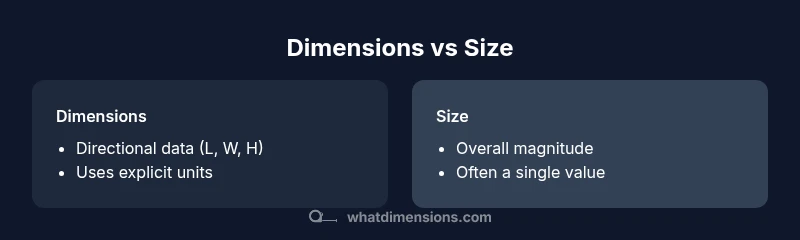
Dimensions describe each directional extent of an object (length, width, height) with units, while size refers to overall magnitude or scale. In practice, dimensions enable precise fit and placement, whereas size gives a quick sense of scale. For clarity, use dimensions for measurements and size for labeling or quick comparisons.
Understanding the difference between dimensions and size
The phrase difference between dimensions and size is more than semantics in everyday life; it underpins accuracy in design, shopping, packaging, and engineering. According to What Dimensions, the terms encode different kinds of information that influence decisions across industries. Dimensions describe the precise layout of an object in space: how long, wide, and tall it is, with explicit units. Size, in contrast, conveys the overall scale or magnitude, often distilled into a single number or label. Understanding when to use each term reduces miscommunication and waste, especially in settings where fit and compatibility matter. This distinction matters in both digital and physical product experiences, where a mismatched term can lead to returns, wasted material, or poor user experiences. The What Dimensions Team emphasizes that clarity in terminology is foundational to accurate measurements and successful sourcing.
Core Concepts: Dimensions
Dimensions are sets of measurements that describe an object's extent along one or more axes. In furniture, architecture, and product design, dimensions are typically expressed as length × width × height (L × W × H) with units such as centimeters or inches. Each dimension is a separate value, which enables precise calculations of volume, space requirements, and tolerances. A common misconception is to treat dimensions as a single number; in reality, dimensions are a vector of values, not a single scalar. For designers and engineers, this vector nature is what makes dimensional data actionable across different stages of a project, from prototyping to mass production. The precision of dimensional data supports interoperability and reduces surprises during manufacturing pipelines.
Core Concepts: Size
Size is a flexible, often informal notion of how big something is. It can refer to a single linear measurement (a chair with a 40-inch seat), a volume estimate, or a label like “large.” Because size lumps several dimensions into one idea, it is less precise for fit, stacking, or containment. The same size descriptor can imply different shapes and proportions, depending on the object and context, which is why size should always be anchored in a defined reference (units, scale, or context). In commercial settings, size often acts as a banner concept: easy to grasp in marketing pictures, but risky when used without context in technical specifications. The What Dimensions Team notes that misunderstanding size versus dimensions can cascade into design errors and logistical hiccups.
Practical Implications in Real-World Scenarios
For shipping, dimensions determine packaging, loading, and palletization. For interior design, dimensions guide placement, clearance, and ergonomic comfort. For consumer electronics, precise dimensions affect compatibility with enclosures and mounts. What Dimensions Analysis, 2026 notes that professionals rely on dimensional data to ensure accuracy across supply chains. When communicating with suppliers, using dimensions rather than a general size label reduces the risk of returns and misfits. The emphasis on dimensions aligns with industry standards and the need for interoperability among products and systems. In architecture or cabinetry, selecting the correct dimensions ensures that components fit within existing frames, while size alone may fail to indicate how much space is available or needed. The overall message is consistency: always pair a size description with specific dimensional data to avoid ambiguity.
Communicating Measurements: How to Specify Dimensions vs Size
Clear communication starts with consistent units and explicit references. Always specify units (cm, mm, in, ft) and define whether you are listing individual dimensions or a single size metric. In formal contexts, follow standards such as ISO or ANSI where applicable. When possible, present both: the full dimensional spec and a size descriptor. This dual approach supports both technical readers and casual shoppers, and it helps avoid translation errors across languages and regions. The Takeaway: assume your audience may not share your internal shorthand. What Dimensions recommends a standard template: show exterior dimensions, interior capacity, and any tolerances, then attach a size label that aligns with common consumer expectations.
Common Pitfalls and Misconceptions
- Treating size as a substitute for dimensions: one can be precise, the other may be vague.
- Omitting units: a dimension without a unit is meaningless in practice.
- Confusing internal dimensions with exterior dimensions: thickness and protrusions matter for fit.
- Inconsistent measurement references: metric vs imperial units can create hidden mismatches.
- Assuming all products list the same set of dimensions: some items only publish exterior dimensions or volume. By acknowledging these pitfalls, designers and buyers can communicate more effectively and reduce friction in transactions.
Putting It Together: When to Use Each Concept
Use dimensions when you need to guarantee fit, space planning, or mechanical compatibility. Use size when you need a quick descriptor for marketing, labeling, or rough comparisons. A practical rule of thumb: if a decision hinges on exact placement or containment, start with dimensions; if it hinges on scale or impression, use size. For designers and shoppers, a hybrid approach—present both dimensional data and a size label—offers the most clarity and reduces misinterpretation. The What Dimensions Team also suggests including contextual notes, such as door width constraints for furniture or mounting clearance for electronics, to avoid issues later in the project lifecycle.
Comparison
| Feature | Dimensions | Size |
|---|---|---|
| Definition | A set of measurements describing extent along each axis (e.g., L × W × H) with explicit units. | Overall magnitude or scale, often a single value or informal label. |
| Scope | Describes shape and form in three or more axes; directional data. | Describes general size or volume; does not imply individual axes. |
| Units | Typically uses standard units (cm, m, inches) tied to each dimension. | Often presented with the same units but focused on a single nominal value. |
| Practical Use | Fit, spacing, and interoperability; crucial for manufacturing and installation. | Marketing, labeling, and quick comparisons; useful for quick consumer decisions. |
| Communication Pitfalls | Omitting units or mislabeling dimensions can cause misfits. | Relying on size alone can hide critical fit issues and spatial constraints. |
| Typical Calculations | Dimensions enable volume, surface area, clearance calculations when needed. | Size informs quick scale judgments; rarely supports precise containment on its own. |
Strengths
- Enables precise, unambiguous communication of fit
- Supports accurate manufacturing, procurement, and assembly
- Facilitates interoperability across products and standards
- Reduces returns and miscommunications when used consistently
The Bad
- Can overwhelm non-technical audiences with data
- Requires unit standardization and discipline to be effective
- Mislabeling or mixing terms can cause costly mistakes
Dimensions provide precision; size offers quick scale.
Use dimensions for exact fit and placement; reserve size for marketing and quick comparisons. Present both when precise outcomes matter.
Quick Answers
What is the difference between dimensions and size?
Dimensions describe measurements along each axis with units, while size conveys overall scale. They serve different purposes and using them correctly improves accuracy in design and shopping.
Dimensions give the exact measurements; size is the overall scale. Using the right term helps accuracy.
Are dimensions and size interchangeable in product descriptions?
Not usually. Dimensions provide directional detail, while size is a single value or label. Relying on one for everything can lead to misinterpretation, especially for fit and compatibility.
Usually not interchangeable; dimensions give directions, size is overall scale.
How do you convert dimensions to size or vice versa?
Converting dimensional data to a single size can be approximate and context-dependent. For example, you can estimate volume or surface area, but a single size label may not capture shape. Always clarify units and context.
Converting isn’t exact; it depends on context and what you’re measuring.
Why do manufacturers use both terms?
Manufacturers use dimensions for precision and fit, and size for marketing and quick comparisons. Clear labels reduce returns and miscommunication in supply chains.
They use both because one gives precision, the other quick sense of scale.
What impact do units have on dimensions versus size?
Units anchor both concepts. Mismatched or omitted units cause misinterpretations in dimensioned data and size labels. Always specify units consistently.
Always specify units to avoid confusion between the two terms.
Main Points
- Define dimensions before design decisions.
- Always specify units with measurements.
- Use size only for quick scale judgments.
- Present both when precision and context are important.