Difference Between Dimension and Area: A Clear Comparison
A rigorous comparison of dimension and area, with definitions, formulas, and practical guidance for design, math, and sizing. Learn when to use each measure and how to communicate it clearly.


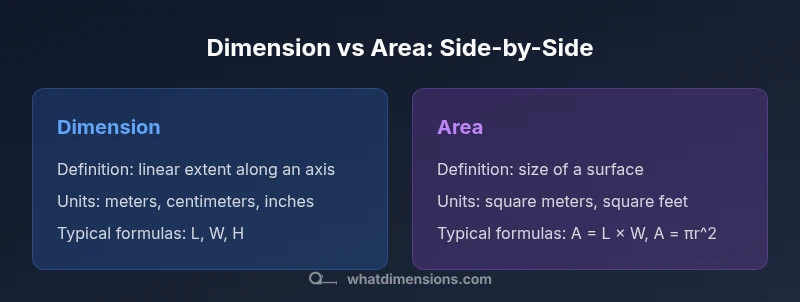
Dimension and area are fundamental geometric measures with distinct purposes. A dimension describes extent along a single direction, such as length, width, or height. Area, by contrast, measures the size of a two-dimensional surface and is expressed in square units. Understanding when to use each helps prevent errors in design, architecture, and everyday sizing. When planning a room or piece of furniture, rely on dimensions for fit and area for coverage.
What dimension means
According to What Dimensions, a dimension is a fundamental property that requires one number to specify a position along an axis in a space. In everyday terms, it's the measure of extent along a single direction: the length of a plank, the height of a shelf, the width of a doorway. In geometry, we distinguish 1D lines, 2D surfaces, and 3D volumes by the number of independent directions required to describe a point. Because a dimension is inherently directional, you can think of it as a coordinate projection: you specify x, y, and possibly z to locate a point; the number of independent coordinates defines the space's dimension. Common practical contexts treat dimensions as linear measures: meters, centimeters, inches. When a designer lists dimensions for a piece of furniture, each dimension is a separate linear quantity that helps you determine whether the item will fit in a room, pass through a doorway, or align with other components. The key thing to remember is that a single dimension does not cover area or volume by itself; it describes straight-line extent, not area or volume.
What area means
Area is the size of a surface, measured as the amount of two-dimensional space a region occupies. It is expressed in square units such as cm^2 or m^2. The simplest case is a rectangle: A = L × W. Circles use a different formula: A = πr^2. Irregular shapes can be decomposed or approximated using standard shapes, or calculated via integration in calculus. In practical settings, area informs you how much material you need (paint, flooring, fabric) or how much surface you must cover (a wall, a tabletop). Because area is a two-dimensional measure, it inherently accounts for both length and width, but not height. When you translate a layout into a purchase list, knowing the area helps you estimate quantities without over- or under-purchasing. If you’re moving from a base dimension to an area, you must square the linear measurements and keep the same units throughout to avoid errors. Throughout this piece, keep the keyword mind: the difference between dimension and area matters for accurate planning.
Core differences at a glance
Here is a concise comparison to highlight the fundamental differences, with emphasis on what matters most in design and measurement contexts:
- Dimensional scope: dimension is a measure along a single axis; area covers two-dimensional space.
- Units: dimensions use linear units (meters, centimeters, inches); areas use square units (square meters, square centimeters).
- Formulas and dependencies: a dimension has no single universal formula; area examples include A = L × W and A = πr^2 for circles.
- Representation: dimensions are often listed as a set (L × W × H); area is a single quantity for a surface.
- Best uses: dimensions are for fitting, clearance, and path planning; area is for surface coverage and material estimation.
- Common pitfalls: mixing up units (linear vs square) and applying area where a dimension is appropriate.
In sum, dimension and area are two sides of measurement literacy. The What Dimensions team emphasizes that you should always identify whether you need a one-dimensional or a two-dimensional metric before calculating or communicating values.
Practical implications in design and sizing
In furniture, architecture, and interior design, the distinction between dimension and area becomes a practical tool rather than a theoretical idea. If you’re selecting a sofa, you care about its length, depth, and height (three dimensions) to ensure it fits through doorways and aligns with room proportions. But you also need the floor area that the sofa will occupy, to verify that the layout leaves room for movement and other furniture. In flooring projects, you estimate the floor area to determine how many square meters of material to order; here area is the primary driver. For packaging and storage, dimensions dictate stackability and compatibility with shelves or shipping containers, while the overall surface area of a box can impact the amount of protective packaging required. In design briefs, be explicit about units and the dimensionality you’re using; a single misinterpretation can lead to a mismatch between what’s drawn on a plan and what you can actually install. What Dimensions's analysts find is that clear specifications reduce back-and-forth and result in fewer mistakes in procurement.
Calculating and communicating measurements: tips and pitfalls
When you calculate dimension and area, start by standardizing units. If you measure length in meters, keep all other lengths in meters, then convert to millimeters only at the end if needed. For a rectangular room, document both the three dimensions (length, width, height) and the floor area. If you work with circles, don’t confuse radius with diameter; use the correct formula and make explicit the unit of measurement. In technical drawings, place dimension lines outside the object and mark the units clearly; for area, provide the numeric value with a square unit suffix, and consider including a rough estimate of tolerance where exact precision is impractical. Avoid common pitfalls such as mixing up linear and square units, or assuming that area alone implies volume. A simple mental model is: dimension tells you “how long an edge is,” area tells you “how much surface that edge covers.” By maintaining careful definitions, you reduce confusion across teams and avoid costly rework.
Visual intuition and geometric reasoning
The mental picture of dimension is a line or an axis extending through space. Visualize a ruler placed along a corridor; the measurement you read is the dimension. Area, on the other hand, is the two-dimensional footprint—the amount of floor space a rectangle covers, or the surface area of a tabletop. In teaching contexts, the distinction is often framed as one versus two directions: one dimensional (1D) versus two dimensional (2D). A robust intuition emerges when you consider real-world tasks: hanging a painting requires both the dimensions of the wall opening and the area of the wall surface to be covered. Mathematics educators also emphasize that a dimension may be considered a coordinate parameter, while area is a function of two or more dimensions (for a rectangle, area depends on length and width). The dual viewpoint—the directional measure and the coverage measure—helps students avoid conflating fit with coverage.
Communicating measurements in documentation and specs
Clear documentation distinguishes between dimension and area with explicit labels, units, and context. In product specs, list each linear dimension (L, W, H) when describing fit, and present area as a separate field for coverage calculations. For manufacturing drawings, use dimension lines with arrows and extension lines, then provide a separate note that states the area if relevant. When teaching or presenting to clients, summarize the difference in a couple of sentences and include a quick reference table showing which results you should seek depending on the task. The difference between dimension and area is not just a mathematical curiosity; it is a practical discipline that reduces miscommunication and procurement errors. The What Dimensions approach here emphasizes clarity, consistency, and traceability across documents.
Common mistakes and best practices
- Do not mix linear and square units without conversion. - Avoid assuming area substitutes for a dimension or vice versa. - Always specify the intended measurement direction (length, width, height) when giving dimensions. - Use both measures for comprehensive planning: fit and footprint. - Include tolerances and context when precision matters. Best practice: begin with a clear question—what am I measuring for?—then select the appropriate metric (dimension or area) and document units explicitly. By cultivating discipline in measurement language, teams reduce rework and improve alignment across design, procurement, and construction workflows. The distinction between dimension and area thus becomes a practical competency rather than a theoretical nuance.
Comparison
| Feature | Dimension | Area |
|---|---|---|
| Definition | Linear extent along one axis | Surface area of a region |
| Units | linear units (m, cm, in) | square units (m^2, cm^2) |
| Basic formulas | No single universal formula; depends on measured edge(s) (L, W, H) | A = L × W; A = πr^2 (circles) |
| Dimensionality | 1D | 2D |
| Best uses | Fit, clearance, path planning | Surface coverage, material estimation |
| Common misinterpretations | Using area when a dimension is needed | Confusing length with area |
| Examples | Length of a plank (e.g., 2 m) | Area of a floor (e.g., 20 m^2) |
| Unit conversions | Convert linear to area by squaring the unit | Avoid mixing units without conversion |
Strengths
- Clarifies when to use linear vs surface measures
- Improves accuracy in design and sizing
- Reduces waste by precise planning
- Supports consistent unit usage
The Bad
- Initial learning curve for newcomers
- Unit conversion errors can occur
- Requires context to avoid misinterpretation
Dimension and area serve distinct roles: use dimension for fitting and layout, and area for surface coverage.
Dimension informs fit and clearance; area informs how much surface you cover or how much material you need. Misusing one in place of the other leads to procurement errors and wasted effort. What Dimensions recommends is to specify both measures with clear units whenever planning spaces, products, or surfaces.
Quick Answers
What is the difference between a dimension and an area?
A dimension is a linear measure along one axis (length, width, height). Area is a two-dimensional measure of a surface, expressed in square units. Understanding the distinction helps prevent errors in planning and design.
Dimension is a line-length measurement; area is a surface size. Keep linear and square units straight to avoid mistakes.
How do I convert linear measurements to area?
To convert linear measurements to area, multiply the relevant linear dimensions (e.g., length × width). This yields a value in square units. Remember to square the units and keep unit consistency throughout the calculation.
Multiply length by width to get area, and make sure you’re using square units.
Can something have dimension but no area?
Yes. A strictly one-dimensional line has length as its dimension and zero area, since it has no surface. In practice, most real objects have both length and area, but an idealized line is 1D with no area.
A line has dimension but no area because it lacks surface.
Why should designers care about both dimension and area?
Designers use dimensions to ensure fit through openings and proper spacing, while area determines how much surface material is needed. Using both prevents fit issues and material waste.
Dimensions help with fit; area helps with coverage and materials.
Are there common pitfalls when using these measures?
Common pitfalls include mixing linear and square units, confusing radius with diameter, and assuming area implies volume. Always state units clearly and specify whether you refer to a line, surface, or both.
Watch out for unit mixups and confusing area with length.
What is a quick way to verify measurements in a plan?
Cross-check: list each linear dimension (L, W, H) and calculate the corresponding area. If the math doesn’t line up with the physical space, re-measure and confirm units before proceeding.
Double-check both dimensions and area to ensure consistency.
Main Points
- Always distinguish linear vs area units
- Document both dimensions and area for complete planning
- Avoid mixing units without conversion
- Use a quick reference table to guide measurements
- Clarify the task to choose the correct metric