Bifold Closet Doors Dimensions: How to Size Your Closet Doors
Learn how to size bifold closet doors with practical ranges, measurement steps, and design tips. This guide covers standard vs custom sizes, panel configurations, and installation considerations for precise sizing.


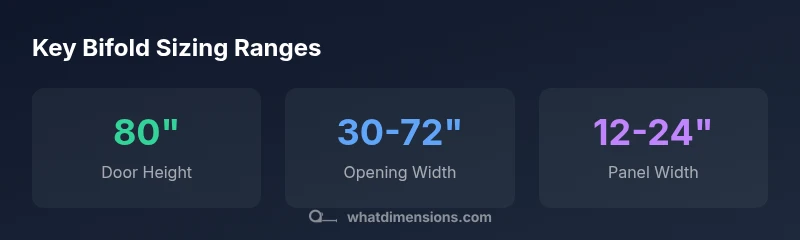
Typical bifold closet doors dimensions center on a standard 80-inch tall opening with total widths commonly ranging from 30 to 72 inches. For two-panel sets, each panel is usually 15 to 36 inches wide, depending on the opening. At What Dimensions, we see these ranges as starting points for most residential closets, with custom sizes used for nonstandard openings.
What bifold closet doors dimensions describe and why they matter
According to What Dimensions, bifold closet doors dimensions describe the overall size of the opening and the arrangement of folding panels that determine how the door moves, how much light is blocked, and how much clearance is needed. In real rooms, the critical numbers you’ll encounter are the door height, the total opening width, and the width of each panel. These measurements influence whether the doors swing smoothly, clear baseboards, and fit within trim. Beyond basic fit, dimensions affect the perceived room size, balance with nearby furniture, and resale value. When you start planning, identify your opening height first, then the total width, and finally how many panels the kit will have. A precise starting point reduces back-and-forth with suppliers and installers.
Standard vs. custom sizes: what's typical in the market
Most bifold door kits aim for a few standard combinations that cover common closet openings. Height is often 80 inches, with a few products stepping up to 84 inches for taller ceilings. Total widths tend to span from compact 30 inches to more expansive 72 inches. Panel counts typically range from two to four, with two panels being the most common for small to medium closets. Market offerings—both stock and semi-custom—cater to this spectrum, while fully custom doors are available for nonstandard openings or design-driven projects. When choosing between stock and custom, weigh install complexity and lead time against the benefits of an exact fit.
How to measure opening height, width, and depth for bifold doors
Accurate measurements are your best friend. Start by measuring the width at three points: top, middle, and bottom, then record the smallest width as the opening width. For height, measure from the finished floor to the underside of the ceiling or crown molding at three points and use the shortest reading to guide cut-to-fit panels. Don’t ignore depth: track mounting depth and wall surface thickness can affect the door’s path, especially if you’re installing in a retrofit. Always account for trim, baseboards, and flooring that could encroach on clearance. Keep a notebook or digital sheet handy and double-check before you order.
Panel configurations: two, three, or four-panel bifolds
Panel configuration affects both aesthetics and operation. Two-panel bifolds are common for smaller openings and typically fold to one side, occupying less wall space when open. Three-panel setups can cover moderately wide openings while maintaining a compact fold, offering a balance between width and panel size. Four-panel configurations work well for very wide openings but require more wall space when open and may demand longer tracks. When sizing, consider not only the opening width but also how the panels will stack and whether you want a single stack or multi-stack arrangement for furniture clearance and traffic flow.
Impact of doorway framing, trim, and floors on final dimensions
Door framing, trim, and even floor finishes can shave or add to the effective width and height. If your opening sits flush with plaster or drywall, you’ll likely end up with a snug fit that needs precise rail placement. Thick baseboards or decorative trim may require trimming the door panels or selecting a door kit with a narrower panel width. Floor finishes, especially if you plan to install flush with the threshold, can influence vertical clearance and track alignment. In renovations, plan a small tolerance (a fraction of an inch) for these elements to ensure smooth operation and a clean finish.
Choosing the right height for ceilings and floor-to-ceiling openings
Ceiling height drives your door choice. In homes with standard 8-foot ceilings, an 80-inch door height matches typical foreroom clearance. For taller spaces, 84 inches or higher options become practical, particularly if you want a continuous look from ceiling to floor. If ceilings are unusually low, you may prefer shorter doors to maintain proportional balance. Floor-to-ceiling openings might require custom length panels or a hybrid system that uses a taller rail. In all cases, verify that the track system and layering align with your ceiling and flooring materials for uninterrupted operation.
Practical sizing tips and common compromises
When confronted with nonstandard openings, let ticket-like constraints guide your choice. For example, if you’re between 34 and 36 inches wide, a two-panel 18-inch-per-panel design can work with some trimming. If you have an extra-wide opening, a three-panel kit can keep each panel reasonably sized for smooth operation. If rough framing or uneven walls appear, consider a semi-custom solution that accommodates irregularities with adjustable tracks or shims. Always check the product’s minimum clearance requirements and verify that your chosen hardware and rollers are rated for the door weight and panel count.
Budget considerations: stock vs custom, installation costs
Stock bifold doors provide a fast, budget-friendly route for many projects, with standard heights, widths, and panel counts ready to ship. Custom doors unlock exact fit for unique openings but typically come with longer lead times and higher costs. Installation costs vary by opening complexity, track type, and whether you’re converting a hinged door opening to bifolds. If you’re working with a contractor, request a line-item estimate that separates hardware, tracks, and labor. A well-planned budget anticipates potential trimming or refinishing needs after installation.
Maintenance and long-term adjustments: keeping dimensions true
Over time, humidity and use can cause minor door warp or track misalignment. Periodic inspection of the track, rollers, and fasteners helps preserve precise dimensions and smooth operation. If you notice binding or rubbing, perform a quick alignment check, adjust rollers evenly, and confirm the panels aren’t sagging. For homes with shifting foundations or heavy foot traffic, consider checking the clearance annually and re-tightening mounting screws. A simple routine keeps doors operating as designed and preserves the dimensional integrity of your space.
Case study: sizing a small studio closet
A compact studio closet presented a 34-inch wide opening with an 80-inch ceiling. A two-panel, 17-inch-per-panel bifold door was selected to balance width coverage and zero-swing clearance into adjacent living space. The installer accounted for the baseboard thickness and installed a slightly longer track to ensure smooth operation. The result was a clean, functional entry that preserves floor space and respects the room’s proportion. This example demonstrates how precise measurements and panel width calculations lead to a practical, aesthetically pleasing result.
Typical bifold door sizing configurations by opening width
| Opening width (inches) | Door height (inches) | Panel count | Typical panel width (inches) |
|---|---|---|---|
| 30-36 | 80-84 | 2 panels | 15-18 |
| 36-60 | 80-84 | 3 panels | 12-20 |
| 60-72 | 80-84 | 4 panels | 15-18 |
Quick Answers
What are standard bifold doors dimensions?
Most common configurations feature an 80-inch door height with total openings ranging from 30 to 72 inches. Panels typically measure 12 to 24 inches, with two, three, or four panels depending on the width. These defaults help many projects move quickly, while still accommodating minor room variations.
Common sizes include about 80 inches tall and 30 to 72 inches wide, with panel widths of 12 to 24 inches.
How do you measure for bifold closet doors?
Measure the opening width at three points (top, middle, bottom) and use the smallest measurement. Measure height at three points (left, center, right) and use the shortest. Check depth for track clearance and account for trim, baseboards, and flooring.
Measure width at top, middle, bottom; height at left, center, right; mind the trim and flooring.
Can bifold doors be customized for nonstandard openings?
Yes. Many manufacturers offer custom widths/heights, especially for awkward openings. Expect longer lead times and potentially higher costs, but you’ll get a precise fit.
Yes, but plan for longer lead times and higher costs.
What affects final dimensions besides opening size?
Trim, casing, and floor finishes can alter effective clearance. Track depth and mounting must align with walls. Consider shims and careful installation to preserve space for door movement.
Trim and track depth can change the effective size; plan accordingly.
Are there height-adjustable bifold doors?
Some models include adjustable tracks or spacers for minor height differences. Confirm product specs and installation guidance, especially when retrofitting into existing frames.
Some models offer adjustable tracks, but check specs first.
“Starting with a standard 80-inch height and a 36–72-inch opening covers most living spaces; customize only after precise measurements.”
Main Points
- Measure accurately before ordering to avoid fit issues
- Start with standard 80 inches height for most homes
- Choose panel width based on total opening width and desired stack
- Account for trim and flooring when planning clearance
- Stock options are usually sufficient, but custom doors fit nonstandard openings