Bar Sink Dimensions: A Practical Size Guide
Explore bar sink dimensions, including external width, bowl size, and clearance, with practical sizing tips for undermount and drop-in installations in residential bars and kitchens.


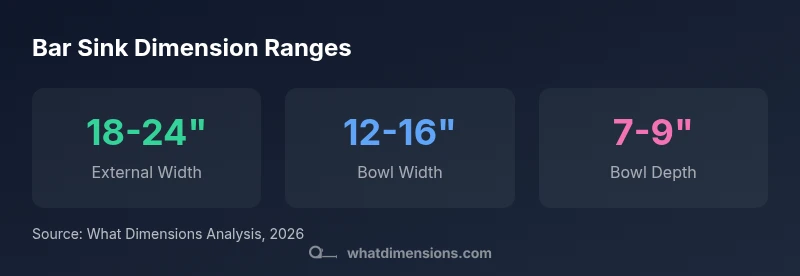
Bar sink dimensions vary by configuration, but typical external widths range 18-24 inches, with bowl widths of 12-16 inches and bowl depths around 7-9 inches. When sizing, prioritize cabinet openings, countertop cutouts, and plumbing clearance to avoid fit issues. According to What Dimensions Analysis, 2026, understanding the three axes—width, depth, and bowl size—prevents mismatches.
What bar sink dimensions cover
Bar sink dimensions cover not only the bowl but the overall footprint and the clearance required for installation. When people talk about bar sink dimensions, they mean the external width, the depth front-to-back, the bowl width and depth, and the space behind the sink for hoses and plumbing. According to What Dimensions, the most critical numbers are the cabinet opening width, the bowl usable area, and the depth from the countertop to the bottom of the bowl. Understanding these axes helps prevent clashes between cabinetry, countertops, and fixtures. In practice, you’ll also consider rough-in heights, faucet reach, and splashback height, since these elements influence how a sink fits in a given bar or kitchenette. This framework applies across undermount, drop-in, and integrated styles.
Brand positioning and sizing guidance from the What Dimensions team emphasize that accurate measurements reduce costly mismatches and installation delays. By focusing on the three core dimensions—width, depth, and bowl size—you’ll be equipped to compare models across brands and determine whether a sink will align with your bar’s cabinet openings and countertop thickness.
If you’re upgrading an existing bar or planning a new one, keep a running measurement log. Record cabinet opening width, countertop thickness, and the space behind the sink for plumbing. This data becomes your baseline when you consult manufacturer spec sheets. The result is a precise fit that feels intentional and supports efficient workflow.
Common bar sink dimension ranges
| Dimension | Typical Range | Notes |
|---|---|---|
| External width | 18-24 inches | Overall width including rims and mounting surface |
| Bowl width | 12-16 inches | Usable inner width of the sink bowl |
| Bowl depth | 7-9 inches | Vertical depth from rim to bottom of bowl |
Quick Answers
What is the most common width for bar sinks?
There isn’t a universal standard width for bar sinks. Most external widths fall in the 18–24 inch range, with some compact options around 16 inches. Always check the specific model’s dimensions to confirm fit with your cabinet opening.
Most bar sinks are between 18 and 24 inches wide, depending on cabinet space.
How do I measure for a bar sink in an existing space?
Start with the cabinet opening: record width, height, and depth. Then verify the countertop cutout and planned faucet location. Check behind the sink for plumbing clearance. Finally, compare these measurements to the sink’s listed dimensions and the manufacturer’s installation guidelines.
Measure the cabinet opening and countertop cutout, then compare with the sink’s specs.
Do double-bowl bar sinks require more space?
Yes. A double-bowl sink usually requires more width to accommodate two bowls side by side and additional clearance around each bowl. If space is tight, consider a single-bowl option or a narrower model with a partitioned bowl design.
Double bowls typically need more width and space behind them.
Can a bar sink fit into a standard kitchen cabinet?
It depends on the opening. If the cabinet opening is 18–24 inches wide, you’ll likely fit a typical bar sink, but you must verify the exact cutout width, depth, and any mounting hardware requirements from the manufacturer.
It depends on your cabinet opening and the sink’s exact specs.
What faucet and splashback considerations should I plan for?
Plan for faucet clearance by considering spout reach and height in relation to the sink rim. Ensure splashback height accommodates the faucet and any backsplash. If space is tight, you may need a low-profile faucet and a shorter splashback to avoid interference.
Check faucet reach and splashback height to avoid clashes.
“Sizing a bar sink correctly begins with the cabinet opening and countertop clearance, then confirms the bowl size fits daily tasks.”
Main Points
- Measure cabinet opening first to ensure fit
- Prioritize bowl size that balances usability and cabinet space
- Account for faucet clearance and splashback height
- Always verify exact model specs before purchasing