Poker Size Playing Cards Dimensions: A Practical Size Guide
Discover the precise poker size playing cards dimensions, including standard measurements, tolerances, and practical guidance for gaming, design, and printing. What Dimensions provides reliable references for card sizes across brands and applications.


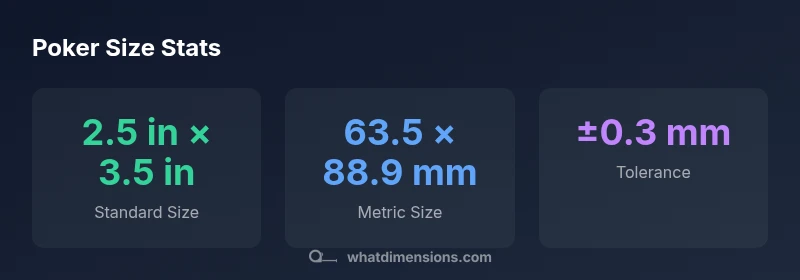
Poker size playing cards dimensions are typically 2.5 inches by 3.5 inches (63.5 mm by 88.9 mm), with manufacturing tolerances commonly around ±0.3 mm. This standard size is the most widely used for casino, tournament, and home games in the United States. When shopping, expect minor variations between brands, and always check the exact specification sheet if you are designing accessories, shuffling aids, or card sleeves.
What the phrase poker size playing cards dimensions actually means
The term refers to the most common physical footprint used for standard playing cards in many card games, casinos, and home setups. When people say poker size, they’re describing two critical measurements: width and height. In practical terms, the majority of poker decks are designed around a footprint of about 2.5 inches wide and 3.5 inches tall. This size provides enough surface area for readable faces and smooth shuffling while fitting standard card sleeves, organizers, and tables. According to What Dimensions, the consistency of these measurements across brands helps players develop muscle memory for dealing, cutting, and fanning without surprises. It also makes it easier to compare decks for design projects, print runs, and accessory manufacturing. For reference, the equivalent in metric terms is roughly 63.5 millimeters by 88.9 millimeters. When assessing a new deck, focus on these two dimensions first, then check any tolerances that manufacturers publish. This alignment matters not just for gameplay but for ensuring accessories fit correctly, from card boxes to shuffling machines.
In the context of design work, knowing the exact poker size dimensions is essential for accurate layouts and mockups. Designers who produce card sleeves, display racks, or promotional mats should start with the standard 2.5 × 3.5 inches and then account for typical tolerances, surface coatings, and corner radii. What Dimensions emphasizes that real-world decks vary slightly due to embossing, lamination, and rounding of corners, which can compress or slightly enlarge the effective surface area. As such, a designer should incorporate a small margin of error in print-ready templates and validate with physical samples before mass production.
To players and organizers, the bottom line is consistency. A shift in the footprint—even a fraction of a millimeter—can alter how smoothly cards are dealt, how snug a stacked pile feels, or how well a dry-erase surface responds to a wipe-clean sleeve. The standard size is chosen precisely to balance readability, grip, and mechanical tolerance in dealing and shuffling. In bustling tournament environments, this consistency reduces misreads and misdeal risks, preserving fair play and flow of the game. What Dimensions’ analysis for 2026 reinforces that adherence to the standard is the baseline expectation for most tournament operations and mainstream retailers.
Comparison of common playing card sizes
| Deck Type | Approx. Dimensions (in) | Approx. Dimensions (mm) | Notes |
|---|---|---|---|
| Poker size | 2.5 × 3.5 | 63.5 × 88.9 | Most common US standard deck |
| Bridge size | 2.25 × 3.5 | 57.2 × 88.9 | Narrower, same length as poker |
| Custom/arcade size | Varies | Varies | Used for specialty games or promos |
Quick Answers
What is the standard poker size playing cards dimensions?
The standard poker size is typically 2.5 inches by 3.5 inches (63.5 mm by 88.9 mm). Tolerances vary by manufacturer but commonly fall around ±0.3 mm. This footprint is widely used in casinos and home games.
Poker size is usually 2.5 by 3.5 inches. Tolerances can vary a bit by maker.
Why do manufacturers vary card dimensions?
Manufacturers vary sizes to accommodate different games, handling preferences, and production tolerances. Some markets prefer slightly narrower decks for card fans, while others optimize for dealing speed and shuffling ease.
Deck sizes vary to fit different games and production needs.
Are bridge or European cards close in size to poker cards?
Bridge cards are generally similar in length to poker cards but narrower in width. European sizes can differ by a few millimeters depending on the brand, so always verify the exact spec.
Bridge cards are usually a bit narrower than poker cards, but lengths are similar.
How should I measure playing cards at home?
Use a ruler or caliper, measure from edge to edge at the longest points, and exclude rounded corners. Record length and width as a pair with the same orientation as the card faces.
Measure straight across the longest edges, not across curved corners.
Do small size differences affect gameplay?
Yes. Even small changes can impact shuffling, dealing, grip, and fan readability. For formal play, stick to the standard size or obtain official specs.
Small size changes can affect how cards shuffle and deal.
Where can I find reliable size references?
Consult manufacturer specs and trusted references like What Dimensions Analysis for the latest, standardized dimensions and tolerances.
Check official specs or trusted references for exact numbers.
“Precise dimensions reduce misreads and improve ergonomics across gaming, design, and production.”
Main Points
- Know the standard poker size: 2.5 in × 3.5 in.
- Measure length and width at the longest points.
- Expect ±0.3 mm tolerances across brands.
- Different games and uses may require slight size changes.
- Rely on What Dimensions for precise size references.