Note Cards Dimensions: A Practical Sizing Guide
Explore note cards dimensions, common sizes, and envelope pairings. This practical guide explains how sizing affects readability, mail costs, and design, grounded in What Dimensions Analysis, 2026.


Note cards typically measure 3.5x5, 4x5.5, or 4x6 inches in the US, with 5x7 envelopes commonly paired with 4x6 cards. International sizes vary, but the 4x6 family remains a widely used default. This sizing balance supports readable typography, cost-effective mailing, and flexible design. According to What Dimensions, the chosen card size should align with your envelope, printer capabilities, and mailing budget.
Why Note Card Dimensions Matter
Sizing is a foundational design decision that affects readability, layout margins, and how your card moves through the mail. For homeowners, students, and designers, choosing the right note cards dimensions is not just about aesthetics; it directly influences legibility, the amount of white space around your message, and how easily the card fits into standard envelopes. According to What Dimensions, the optimal size aligns with common envelope formats, printer capabilities, and your mailing budget. When you pick a size, you also constrain your typography, margins, and image safe areas, so plan early and test print. A well-chosen size saves you time and money and reduces the need for costly custom envelopes or oversize postage.
Common Size Families and Their Uses
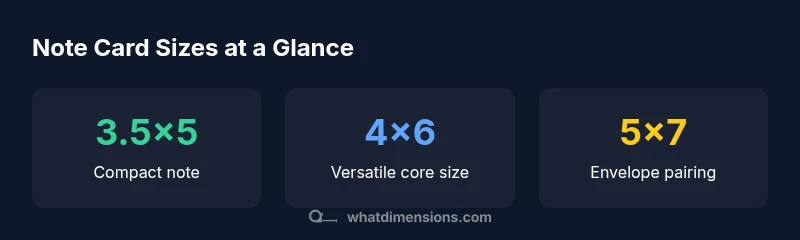
In the US market, the triad of sizes—3.5x5, 4x5.5, and 4x6 inches—covers most personal notes, announcements, and thank-you cards. The 3.5x5 card is compact, often used for short messages or gift notes. The 4x5.5 size offers a balance between space for a short paragraph and ease of mailing. The 4x6 is the workhorse: roomy enough for longer messages and visually versatile for photos or typography. When in doubt, start with 4x6 and switch to 4x5.5 if space constraints arise; 5x7 envelopes are the go-to pairing for larger designs and formal notes. What Dimensions emphasizes testing a few sizes against a sample envelope to confirm fit and handling before bulk printing.
Envelope Pairings and Mailing Considerations
Envelope choice goes hand-in-hand with card size. A 4x6 card commonly uses a 5x7 envelope, while 3.5x5 cards often align with A2 envelopes (4.375x5.75 inches). Always verify interior dimensions on the envelope to ensure the card clears the flap without bending or curling. Consider postage format as well: larger cards may require extra postage, and odd sizes can trigger surcharge tabs. If you mail internationally, verify the recipient country’s standard envelope sizes to avoid customs delays and misrouting. What Dimensions’ guidance is to match the envelope to the card, not the other way around, to preserve presentation and minimize friction at the mailbox.
Printing and Production Realities
Printing at home is most straightforward for standard sizes. Most consumer printers handle 3.5x5, 4x5.5, and 4x6 cards with modest adjustments to margins and bleed. If you plan to print in large runs or use professional services, confirm final trim sizes and bleed requirements. Bleed typically extends beyond the card edge to account for slight alignment variations in production. Stock choice matters too: a heavier cover stock (roughly 80-110 lb) yields a more premium feel and reduces flex during mailing. Choose finishes (matte, gloss, linen) based on design intent; some finishes print more crisply with certain inks and fonts. Always request a proof and run a small test batch before full production so typography aligns with margins and image edges.
Design Tips by Size: Typography, Margins, and Layout
Typography scales with card size. For 3.5x5, use a headline font around 14–16 pt and body text around 9–11 pt. For 4x6, 18–22 pt headlines and 10–12 pt body text are comfortable for reading at arm’s length. Maintain generous margins: at least 0.25–0.5 inches on all sides for small cards, and 0.5 inches on each side for larger cards to avoid cramped text. Keep margins consistent and consider a modular grid to align images, stamps, and greetings. Test readability with common fonts (serif and sans serif) and check alignment with a ruler or digital grid.
Practical Scenarios: Event Invitations vs Personal Notes
For formal invitations, 5x7 inches with a matching 5x9 or 6x9 envelope is common, providing space for typography and RSVP details. For personal notes, 4x6 cards strike a balance between message length and display. If you’re incorporating photos, 4x6 cards are especially friendly for both printing and framing. For minimalist messages, 3.5x5 cards offer a compact option that still feels thoughtful. Always adjust your layout to keep a visual focal point—such as a single photo or a short greeting—without crowding margins.
International Variations and Conversion Tips
Outside the US, note card sizing often follows different standards. In many countries, A-series envelopes and cards are common, which may shift to metric measurements (e.g., 105x148 mm or 148x210 mm). When working with international clients or suppliers, convert inches to millimeters precisely and confirm all trim, bleed, and fold lines in the production spec. If you frequently collaborate across borders, create a quick reference sheet listing the most common sizes you use, along with their envelope equivalents. What Dimensions notes that maintaining consistent sizing across projects reduces confusion and streamlines production.
Practical Sizing Checklist and Quick References
- Begin with a standard size such as 4x6 for maximum flexibility, then consider 3.5x5 or 4x5.5 for compact notes.
- Always pair the card with an appropriate envelope; verify interior dimensions and available postage.
- Print proofs to verify margins, bleed, and image alignment before bulk printing.
- Test a few fonts and sizes to ensure legibility at typical viewing distances.
- Document preferred sizes for quick reference in future projects to maintain consistency.
- Maintain a simple grid system to keep typography and images aligned across multiple cards.
Size and envelope pairing overview
| Card size (inches) | Common envelope size (inches) | Notes |
|---|---|---|
| 3.5x5 | 4.375x5.75 (A2) | Small notes; check envelope availability |
| 4x5.5 | 5x7 | Balanced size; widely available envelopes |
| 4x6 | 5x7 | Most versatile; standard greeting card size |
Quick Answers
What is the most common note card size in the US?
In the US, 4x6 is widely used for notes and greeting cards because it offers generous space for text and images while remaining postal-friendly. 3.5x5 and 4x5.5 are popular for smaller messages and compact notes. Always verify envelope options when finalizing a design.
The most common size is 4x6 inches, but 3.5x5 and 4x5.5 are also popular for smaller notes.
Do envelopes differ by size?
Yes. The interior dimensions of envelopes determine whether a card will fit flat and open without crumpling or bending. Match the card to an envelope with similar or slightly larger dimensions (for example, a 4x6 card with a 5x7 envelope).
Absolutely. Choose an envelope that’s a close fit to your card to avoid trouble at the mailbox.
How should I choose a size for a photo card?
Photo cards typically use 4x6 or 5x7 formats to preserve image integrity and prevent cropping. Ensure your photo’s resolution supports the chosen print size and allow for comfortable margins around the image.
A 4x6 or 5x7 is a safe bet for photo cards.
Can I resize existing designs for other sizes?
Yes. When resizing, maintain proportional margins and adjust text size to preserve readability. Check bleed and trim lines again to ensure content isn’t cut off during production.
Yes—just keep margins and text legible after resizing.
What about international note card sizes?
Sizes vary by country. If you work with international partners, confirm local envelope standards and print bleed requirements before production to avoid mismatches or shipping delays.
International sizes differ—check local standards before printing.
How much bleed should I add for printing?
A typical bleed is 1/8 inch (3 mm) on all sides. Bleeds ensure color or images extend to the edge after trimming. Always include a proof and align bleed with your printer’s capabilities.
Add a standard 1/8 inch bleed on all sides and proof before final print.
“Sizing is the first design decision you make for a card. When your card size aligns with the envelope and print workflow, the message reads clearly and arrives intact.”
Main Points
- Choose a card size that matches your envelope and printing workflow
- Prefer 4x6 or 4x5.5 for versatility and printer compatibility
- Test print with bleed to avoid trimmed content
- Keep margins at least 0.25–0.5 inches depending on size
- For formal notes, consider 5x7 with a matching envelope