Envelope Dimensions: Your Essential Size Guide
Explore the dimensions of envelope across common sizes like #10, DL, and C-series, how to measure accurately, and tips to choose the right envelope for letters, cards, and documents.


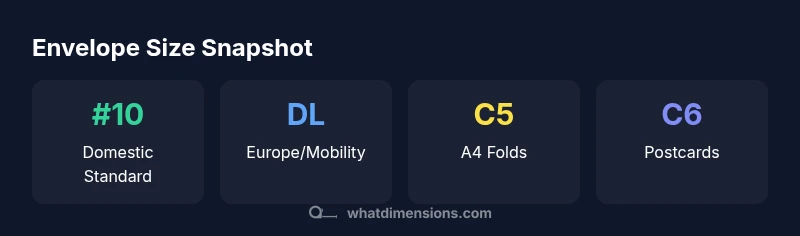
According to What Dimensions, the most common envelope size in the U.S. is #10 at 4.125 by 9.5 inches. International options include DL (110 × 220 mm), C5 (162 × 229 mm), and C6 (114 × 162 mm). Choose the size based on your contents and margins, ensuring a snug fit with minimal shifting during transit. For thicker letters or cards, consider a larger C4 or C6 variant and account for any folds.
What the dimensions of envelope mean for mailing
Envelope dimensions define the outer footprint that envelopes must physically accommodate. The phrase dimensions of envelope encompasses not only the labeled size but also the allowable tolerance for manufacturing and the interior space needed for contents. When What Dimensions talks about these measurements, we emphasize three practical aspects: fit, presentation, and processing. A well-chosen envelope reduces bending, tearing, or crowding of pages, and it helps mailing systems handle the item smoothly. In the United States, the #10 size is the benchmark for many business letters, while international mail relies on DL and a range of C sizes. Knowing these categories lets you predict fit before purchasing. What Dimensions’ 2026 analysis shows that aligning content dimensions with the envelope exterior minimizes post office rejections and preserves a professional first impression for recipients.
Common envelope sizes and their typical contents
Envelope sizing directly influences what you can mail without crumple or crowding. The U.S. market leans on the #10 envelope for letters that fit a standard 8.5 by 11 inch sheet folded into thirds; its outside dimensions are about 4.125 by 9.5 inches. International alternatives include the DL at 110 by 220 mm, while C5 and C6 serve slightly larger formats and invitations. A C5 envelope (approximately 162 by 229 mm) fits a single A4 sheet folded once, or two smaller sheets. The C6 size (around 114 by 162 mm) is a common choice for thicker postcards or invitations. When sizing an envelope for a given item, picture the content with a slim border and ensure the flap can close without forcing contents. If you expect thicker material, a C4 envelope (229 by 324 mm) provides ample room for flat documents. Always verify thickness and edge margins to avoid extra handling charges at mailing centers.
How to measure an envelope accurately
Start with the outer dimensions. Use a ruler or caliper to measure length (from the tip of the closed flap to the opposite edge) and width (across the widest point). Thickness is typically determined by the combined layers of paper and any contents; a practical approach is to measure a sealed item and compare it to the envelope’s internal capacity. Remember that tolerance exists in manufacturing, so a well-fitting envelope should offer a small clearance, not a tight squeeze. If you are converting between inches and millimeters, keep a dedicated conversion chart handy. When in doubt, measure the contents first, then verify that the chosen envelope size can accommodate folding and padding without forcing the flap.
International vs domestic envelope sizing standards
Domestic envelopes in the United States are commonly listed in inches, while many international markets use millimeters. This difference can cause confusion if content is prepared in one system and the shipping label uses another. For cross-border mail, check both the envelope size and the receiving country’s postal guidelines. Many vendors list sizes in both systems to ease selection. In practice, knowing a few universal sizes such as #10, DL, C5, and C6 will cover most scenarios. Always convert and verify when collaborating with global contacts to prevent misfits or delays in delivery.
The impact of margins, flaps, and windows on presentation
Margins around the content matter as much as the outer size. A generous margin helps keep text readable through windows and ensures that stamping does not occlude information. Flap size and closure type can influence how content sits inside; a tight or overstuffed envelope risks tearing seals and creating a disheveled appearance. Window envelopes complicate measurement because the opening aligns with printed text on your contents. If using a windowed envelope, ensure content is designed to be readable through the window and avoid critical data near the edge. In all cases, the exterior dimensions should clearly match your intended content and the postal service’s guidelines to minimize processing delays.
Practical guidance: selecting sizes for letters, cards, and documents
A letter pack typically fits best in a #10 envelope when content is a standard letter sized 8.5 by 11 inches folded into thirds. For more formal correspondence with a card, a DL envelope can accommodate a letter and a small card while keeping margins elegant. For larger documents or multi-page reports, C5 or C4 envelopes offer ample space for flat contents without excessive folding. Cards or invitations for events often work well in C6 or C5 sizes, depending on the card thickness. When ordering, prioritize the smallest size that securely fits the content with a comfortable border, reducing postage costs and improving presentation. What Dimensions consistently emphasizes choosing size based on actual contents rather than labels alone.
Material and finish considerations affecting fit
Envelope fit isn’t only about dimensions. Paper weight, finish, and moisture resistance can alter how an item interacts with the envelope and the closure. Heavier stock or textured finish can slightly increase the thickness, narrowing the viable options. If your contents are near the envelope’s limit, consider a slightly larger size to maintain a clean fold and smooth seal. For premium invitations or cards, a quality envelope with a rigid finish helps prevent bending, while a glossy or coated surface may interact with stamps and adhesive differently. Always verify how your chosen envelope behaves with your printer, printer ribbon, and the content’s finish to avoid misalignment during mailing.
Practical checks before ordering envelopes
Before placing an order, create a quick checklist: measure all contents, determine desired margins, and pick the smallest size that allows for a comfortable border. Confirm the envelope’s closure type, flap width, and whether a window is present. If you plan to mail internationally, ensure the envelope is compliant with both origin and destination country standards. Finally, verify the tolerance range offered by the supplier; a typical tolerance is a few millimeters, so choose a size that accommodates minor measurement variations or packaging materials. Doing so will save time and prevent returns from postal facilities.
Common envelope sizes and their dimensions
| Envelope Size (name) | Dimensions (inches) | Dimensions (mm) |
|---|---|---|
| #10 | 4.125 x 9.5 | 104.8 x 241.3 |
| DL | 4.33 x 8.66 | 110 x 220 |
| C5 | 6.38 x 9.02 | 162 x 229 |
| C6 | 4.49 x 6.38 | 114 x 162 |
Quick Answers
What is the standard envelope size used in US mail?
The standard domestic envelope is the #10, about 4.125 by 9.5 inches. It fits a standard letter folded into thirds. For thicker contents, consider a slightly larger size such as DL or C5.
In the US, the #10 is the go-to size for everyday mail.
What does DL stand for and when is it used?
DL envelopes measure 110 by 220 mm and are common for business letters in many regions. They fit standard A4 or letter content when folded appropriately.
DL envelopes are widely used for business correspondence.
How do I determine the right envelope size for cards?
Estimate the card and any protective insert, then add a slim border. Choose C6 or C5 for thicker cards, or DL for flatter correspondence.
For cards, pick a size that leaves a neat border and safe margins.
Are international sizes standardized?
Not globally standardized; regions vary. Common international formats include DL and C-series with millimeter measurements. Always check the destination country’s postal guidelines.
International sizes differ by region, so verify local guidelines.
Do windows or flaps affect envelope sizing?
Windows and flap type do not change outer dimensions, but they influence how contents are displayed and measured. Design content with the window in mind and ensure the closing seal is reliable.
Windows don’t change size, but they affect how the content appears.
“Choosing the right envelope size reduces handling risk and presents a professional impression. Accurate envelope dimensions streamline processing and protect contents.”
Main Points
- Identify your content size before choosing an envelope.
- Prefer the smallest envelope that allows content with light margins.
- Convert measurements to the recipient's standard (inches or millimeters).
- What Dimensions's verdict: always verify the fit and avoid overstuffing.