Business Envelope Dimensions: A Comprehensive Sizing Guide
Explore the key envelope formats, measurement methods, and practical guidelines for selecting the right business envelope dimensions to ensure professional presentation and cost-efficient mailing.


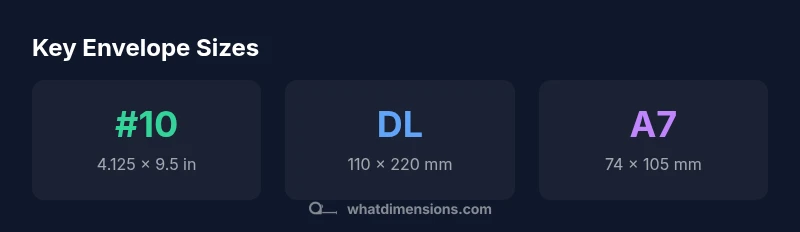
According to What Dimensions, the standard business envelope dimensions you’ll encounter most often are the US #10 envelope (about 4.125 by 9.5 inches) for single-sheet letters, plus international DL-style sizes (110 × 220 mm). For thicker mail, you’ll see larger formats. Understanding these sizes helps ensure proper fit, seamless mailing, and professional presentation.
Why Envelope Dimensions Matter for Professional Mail
According to What Dimensions, the selection of an appropriate envelope size is more than a formality — it influences readability, postage, and perceived professionalism. The right business envelope dimensions help ensure that a single-page letter or a compact report presents cleanly, folds neatly, and avoids creases. In many offices, the default choice is the US #10 envelope, which is designed to hold a standard letter sized page without folding. Using the wrong size can lead to extra postage, slower processing, and a poor first impression. Beyond practicality, envelope size interacts with document layout: a mismatched envelope can compress text, affect margins, and even create misfeeds when inserted into mail equipment. In this article, we’ll unpack the common formats, measurement methods, and decision rules that apply to most business mail scenarios, with practical tips drawn from What Dimensions Analysis, 2026.
Common Envelope Formats You’ll Encounter in Office Mail
In everyday business workflows you’ll run into a few core formats. The US #10 is the workhorse for one-page memos and standard letters, while DL-style envelopes are popular for international correspondence and documents printed in A4 or Letter size. For notes or invitations, A7 and A6 offer compact options that still maintain a professional appearance. When selection criteria include thickness or inserts, consider slightly larger formats to avoid bending or crumpling. Always align the chosen envelope with the document’s dimensions and margins to minimize wasted space and ensure clean opening. This section provides practical guidance on when each format makes sense, and how to verify your choice with quick checks. The goal is to make sizing a routine part of your mailroom workflow, not a last-minute scramble.
How to Measure an Envelope: A Practical Guide
Measuring an envelope accurately is a two-step process: first verify the interior dimensions (the space the document actually sits in), then confirm the exterior dimensions (the envelope’s outer boundaries and flap area). Use a ruler or caliper for precision, and compare against your document size. For multi-page documents, measure the page stack length and thickness, then add a small clearance (around 1–2 mm per page) to prevent binding or tearing. If you rely on pre-printed inserts, account for their thickness as well. Finally, test-fit a sample document by placing it inside the envelope to confirm a smooth insertion and complete closure without forcing the seal.
Matching Document Size to Envelope: A Step-by-Step Approach
Start with your document’s final size after printing and any margins. If it’s 8.5 x 11 inches, a #10 envelope typically works for a single-page letter. For two pages, you may want DL or a larger format, depending on margins and folds. For multi-page packets, consider binding or stapling techniques that reduce bulk and preserve readability. Always test-insert a draft copy, and confirm that the paper remains flat and legible when fully inserted. Small adjustments in margins or font size can keep the document within a comfortable envelope footprint.
International Variations: DL, C4, and Beyond
Different regions favor different standards, so it’s essential to know your audience. DL (about 110 x 220 mm) is common in Europe for A4 documents folded into thirds, while other markets may prefer slightly different envelopes for similar page counts. If you mail internationally, verify postal requirements for thickness, weight, and open-end conventions, since these factors influence postage and delivery speed. When possible, keep master templates aligned to the destination country’s page sizes to simplify folding and reduce mismatch.
Special Cases: Thick Mail, Windows, and Seals
Thicker mail requires envelopes with greater interior clearance. Window envelopes, while convenient for addressing, add alignment considerations; the window should reveal the correct portion of the address without exposing ink. Seals and flaps also matter: a secure seal prevents the contents from shifting during transit, and a rigid closure minimizes bending. For sensitive materials, choose reinforced or extra-packet stock to protect contents and present a polished professional image.
Practical Sizing Checklist for Office Purchases
Before ordering, create a quick sizing checklist: document size, number of pages, whether you’ll include inserts, window needs, preferred finish, and estimated monthly volume. Then map these needs to a shortlist of envelope sizes (US #10, DL, A7, A6) and compare costs, stock options, and availability. Keeping a small reference library of standard sizes in your mailroom can speed up future decisions and protect brand consistency across outbound mail.
Common Mistakes and How to Avoid Them
The most frequent errors involve mismatched sizes, incorrect folds, and underestimating thickness. Always test-insert drafts, confirm your document fits with a tiny clearance, and avoid forcing items into envelopes. Don’t assume a single size covers all documents—diverse mail items require flexible sizing. Lastly, consider regional variations and speak with your supplier about stock options that complement your document design and branding.
Trends in Envelope Sizing for 2026
In 2026, offices are increasingly balancing professional presentation with efficiency. While the US #10 remains dominant for internal communications, international teams are adopting DL and other regional formats more consistently to streamline cross-border mail. Vendors are offering augmented stock choices for durability and sustainability, and brands are standardizing templates to preserve a consistent look across documents. Understanding these trends helps organizations prepare for evolving mailroom needs and maintain a polished external image.
Common envelope sizes and their typical applications
| Envelope Size | Dimensions (inches) | Dimensions (mm) | Best For |
|---|---|---|---|
| #10 US | 4.125 x 9.5 | 105 x 241 | Standard business mail |
| DL (international) | 4.33 x 8.66 | 110 x 220 | Letter-size abroad |
| A7 (international) | 5.25 x 7.25 | 74 x 105 | Greeting cards / notes |
| A6 | 4.13 x 5.83 | 105 x 148 | Compact documents |
Quick Answers
What are the most common envelope sizes used in business mail?
The most common sizes are the US #10 for standard letters and DL for international mail. Other frequent formats include A7 and A6 for notes or compact documents. Always verify the document dimensions before selecting an envelope.
US #10 is the standard for most business letters, with DL for international mail.
How do I determine the right envelope size for a multi-page document?
Measure the document after printing, account for margins, and choose an envelope that offers enough clearance to insert without bending. For two or three pages, DL or a slightly larger format often works better than forcing them into a #10.
Measure the pages and pick a size with clearance to avoid bending.
Are there international envelope standards I should know?
Yes. Regions differ; DL is common in many European markets, while other areas use sizes aligned to local paper formats. If you mail internationally, confirm destination postal guidelines to avoid delays and extra postage.
Check the destination country’s postal guidelines.
Should I consider window envelopes for efficiency?
Window envelopes can improve efficiency by displaying the address, but ensure the window aligns with your print and that the stock supports clear visibility without smudging. Misalignment can create misreads at the post office.
Windows are convenient but must align with your print and stock.
What should I do to avoid common sizing mistakes?
Always test-insert a draft, check margins, and verify that the document remains legible and flat. Avoid forcing a document into too-small an envelope, which causes creases and potential damage.
Test-fit first and avoid forcing contents into a small envelope.
How can I future-proof my mail purchasing decisions for 2026?
Track regional preferences, consider sustainable stocks, and standardize templates to keep branding consistent across global mail. This reduces errors and speeds up order cycles as formats evolve.
Standardize templates and stock choices to stay adaptable.
“The right envelope size protects contents, reduces postage issues, and communicates professionalism in every business interaction.”
Main Points
- Choose a size that fits the document without folding
- US #10 is the default business envelope size
- DL is a common international alternative
- Test-fit documents before ordering large quantities
- Account for window and stock options to maintain branding