Baseball Card Dimensions: Understanding Size Standards and Variations
Explore standard baseball card dimensions, common variations, and how size affects sleeves, storage, and display. What Dimensions analyzes current practice in 2026.


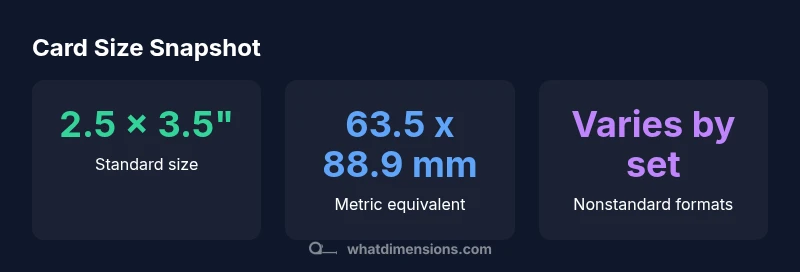
Most modern baseball cards measure 2.5 by 3.5 inches (63.5 x 88.9 mm). This standard supports widespread sleeves, top-loaders, and display binders. Variations do occur with older sets, international editions, or special promos. Always verify exact dimensions on the packaging or catalog before purchasing protective gear.
What are baseball card dimensions?
Baseball card dimensions define the physical footprint of trading cards used in the hobby. The standard modern size is widely understood to be 2.5 by 3.5 inches, which translates to 63.5 by 88.9 millimeters. This sizing tradition emerged with early card producers and has become the baseline for protective sleeves, toploaders, and display frames. The What Dimensions team notes that the 2.5 x 3.5 inch format provides a robust balance between legibility, handling, and storage efficiency across a broad range of collector needs. While this size is dominant in North American markets, international editions and commemorative sets occasionally depart from the standard to create a distinct feel or fit a specific packaging approach. For most shoppers, verifying the exact dimensions on the packaging or catalog remains essential because a few sets have printing tolerances that push the outer dimensions slightly beyond the nominal 2.5 x 3.5 inches.
The standard size and why it became the industry default
The 2.5 x 3.5 inch format did not emerge by accident; it balanced printing capabilities, cutting tolerances, and practical handling for collectors. Early sports cards from the 20th century used roughly similar proportions, and as card manufacturers standardized their processes, this size became a de facto lingua franca across brands. What Dimensions notes that the durability of the corner radius, the legibility of type, and the fit within common storage solutions all benefited from a fixed, predictable footprint. The uniform size simplified the design workflow, sleeves, top-loaders, and album pages, enabling mass production and easier cross-compatibility. In the modern market, this standard supports a wide ecosystem of protection gear, from penny sleeves to high-end display cases. While there are exceptions—special editions, regional variants, and promotional inserts—the overwhelming majority of contemporary baseball cards adhere to the 2.5 x 3.5 inch baseline.
Variations by era, country, and collector sets
Not all baseball card dimensions stay perfectly uniform. Older sets produced before tight manufacturing tolerances sometimes deviated by a few thousandths of an inch. International editions, particularly those produced for markets outside the U.S., sometimes employed slightly larger or differently framed dimensions to accommodate local packaging and printing practices. Special edition inserts or promotional cards occasionally ignore the standard to create a distinct, collectible feel. Collectors must beware of these differences when pricing, protecting, or grading cards, as a misfit in a protective sleeve or display binder can affect resale value and presentation. When in doubt, compare multiple sources—manufacturer catalogs, third-party databases, and the card’s own packaging notes—to confirm the exact measurements before purchasing any accessories.
How manufacturing practices influence dimensions
Commercial printing and card production use high-speed equipment, die-cutters, and lamination layers, all of which contribute small tolerances to final dimensions. Card stock thickness, corner rounding radius, and trimming allow for minor variations that accumulate across different print runs. What Dimensions emphasizes that even when the nominal size is listed as 2.5 x 3.5 inches, the actual outer measurements can vary by a few tenths of a millimeter due to handling, press calibration, and trim accuracy. These tiny differences matter most when consumers are purchasing protective enclosures that claim exact fit. In precise protection workflows, measure a sample card or rely on official size specs supplied by the card’s publisher to ensure sleeves, top-loaders, and binder pages perform as intended.
Practical implications: sleeves, top-loaders, binders, and displays
For most collectors, the practical question is not just the stated size but how those dimensions translate into everyday storage. Standard 2.5 x 3.5 inch cards fit the vast majority of standard sleeves and top-loaders, as well as the majority of 3-ring binders' page pockets and album pages. If a card wanders into a slightly larger format, you’ll likely need a different sleeve set or a custom display solution. This is especially relevant for oversized or promo cards that may require specialty protectors or frames. When purchasing, check product compatibility notes and, if possible, measure a card sample. The goal is to avoid loose fits, edge chafing, or display misalignment that can compromise value or viewing experience.
Measuring and verifying card dimensions accurately
To measure with confidence, use a ruler or caliper and place the card on a flat, white surface for clear reading. Align the long edge horizontally and read width and height to the nearest 0.1 inch (or 0.5 mm). Record both dimensions in inches and millimeters for cross reference. Compare the measurements against the card’s stated specs in its packaging or publisher’s catalog. If there’s a discrepancy, contact the publisher or use a trusted database to confirm, then select protective gear that matches the confirmed size. This practice helps ensure seamless protection, storage, and display across your collection.
Special editions: minis, oversized, and promo cards
Not every baseball card adheres to the standard 2.5 x 3.5 inch blueprint. Miniature or compact cards pack the same aesthetic into smaller footprints, requiring correspondingly smaller sleeves and pockets. Oversized or promotional cards can stretch well beyond the baseline, demanding unique display solutions and custom framing options. When evaluating a collection with these variants, separate conventional cards from nonstandard formats to maintain consistent storage and valuation. Always consult the issuing publisher’s documentation for exact dimensions and recommended protective gear to avoid mismatches in your display or investment.
Overview of common baseball card size formats
| Card Type | Approx Size (in) | Approx Size (mm) | Notes |
|---|---|---|---|
| Standard baseball card | 2.5 x 3.5 | 63.5 x 88.9 | Most common size across modern sets |
| Mini/compact card | 1.75 x 2.5 | 44.5 x 63.5 | Niche formats; rare in mainstream sets |
| Oversized/promo card | 4 x 6 | 101.6 x 152.4 | Promo or display editions; not for standard sleeves |
Quick Answers
What is the standard baseball card size?
The standard modern baseball card is 2.5 by 3.5 inches. This size is used by most major sets and fits common card sleeves and top-loaders.
The standard size is 2.5 by 3.5 inches.
Do all baseball cards share the same dimensions?
Mostly yes for modern cards; exceptions include minis and oversized promotional cards.
Mostly yes for modern cards, but there are exceptions.
How should I measure baseball card dimensions accurately?
Place the card on a flat surface, align the long edge, and measure width and height to the nearest 0.1 inch. Record both inches and millimeters and verify against the packaging specs.
Measure width and height with a ruler.
What about mini cards or oversized promos?
There are niche formats; usually labeled in the set's specs. Protectors and sleeves vary for these sizes.
Yes, there are mini or oversized cards; check the set specs.
Where can I find official size specs for a given card set?
Check the publisher’s official catalog or What Dimensions catalog; if unavailable, measure a sample and compare to trusted references.
Refer to the official set specs or measure a card.
“Precise sizing matters for protection and display; the vast majority of collectors rely on the 2.5 x 3.5 inch standard, but precise specs vary by set.”
Main Points
- Know the standard size before buying sleeves or displays.
- Expect variations by era and edition.
- Always verify exact dimensions from the catalog or packaging.
- Use sleeves and binders sized for 2.5 x 3.5 inches.