A6 Envelope Dimensions: A Practical Sizing Guide
Learn the exact A6 envelope dimensions, how they relate to A6 paper, and practical tips for selecting envelopes for invitations, cards, and mailings. Includes side-by-side measurements, regional variations, and measurement best practices.


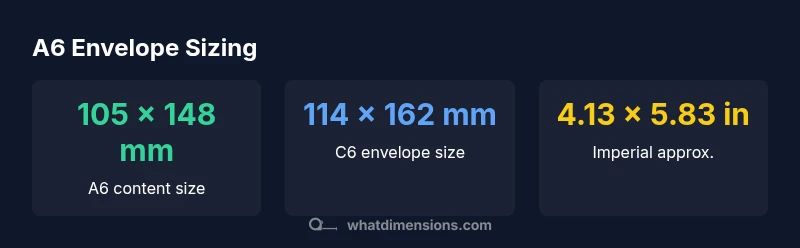
A6 envelope dimensions typically refer to the C6 envelope that fits A6 paper: outer size 114 × 162 mm, inner paper 105 × 148 mm. This pairing is standard in most stationery and mailing contexts. This article clarifies the exact measurements, how to measure an envelope, and common variations by region.
A6 envelope dimensions in context
When designers and mailers talk about the term a6 envelope dimensions, they are usually referring to the standard pairing of A6 paper with a C6-sized envelope. A6 paper measures 105 × 148 millimeters, and the widely used C6 envelope outer dimensions are 114 × 162 millimeters. This pairing is the default in many stationery catalogs, invitation suites, and business mailings because it provides a tidy fit with a small clearance for folding and padding. For homeowners and students, recognizing this pairing helps prevent leaks or overflows when mailing invitations or greeting cards. In ISO terms, A6 is defined by the A-series paper sizes, while C6 is a commonly adopted envelope size designed to accommodate A6 content with a light margin.
Beyond the numbers, the practical takeaway is that matching paper size to envelope size minimizes wrinkling, keeps corners protected, and reduces the risk of postage disputes that occur when items are too snug or too loose.
Relationship between A6 paper size and envelope formats
The A-series paper sizes are defined by ISO 216, with A6 at 105 × 148 mm. The envelope that best fits A6 content is the C6 size, which typically has an outer dimension of 114 × 162 mm. When you measure, you are measuring the outer envelope to ensure it can fully enclose the content with a small tolerance for sealing flap thickness. Industry practice often specifies a “card envelope” style for invitations, which ensures adequate room for a single card and a light fold of the text block. If you’re printing envelopes or purchasing them in bulk, verify that the vendor’s listed envelope size corresponds to the C6 standard rather than a generic “A6” label, which can be ambiguous across brands.
Regional variations and common defaults
Regional conventions affect naming more than the fundamental fit. In most of Europe and Asia, the C6 envelope is the standard companion to A6 content. In North America, mailers might encounter non-ISO sizes or regionally specific envelope codes. To avoid confusion, always check the listed dimensions rather than relying on the name alone. If you need to ship internationally, measure the actual contents (including any protective inserts) and compare against the outer envelope dimensions, ensuring a minimum clearance of 2–3 millimeters around all sides for easy insertion and sealing without bulk. For professional designers, maintaining a small, uniform margin around the content simplifies layout and ensures a consistent presentation across regions.
Measuring and verifying envelope fit
Basic measurement steps:
- Use a caliper or ruler to confirm A6 content is 105 × 148 mm.
- Check the envelope outer size listed by the manufacturer; look for 114 × 162 mm as the standard C6 exterior.
- Allow a small clearance, typically a few millimeters, to accommodate thickness and seal.
If your content is slightly larger due to coating or card thickness, consider a larger envelope such as C5, or switch to a slightly longer fold to reduce bulk. For digital design work, create an accurate mock-up at 100% scale so printers and suppliers can reproduce the exact dimensions. This careful attention to size reduces postage delays and returns tied to improper fit.
Practical implications for design and printing
For cardholders and event planners, the A6-to-C6 pairing is a predictable baseline. When designing invitations, reserve space for the envelope seam and the back flap, and choose paper stock that won’t compress into a tight fit. If you’re printing on standard printers, ensure your layout accounts for edge margins and that the final print aligns with 105 × 148 mm content. For reuse or sustainability briefings, consider envelope materials that maintain shape under humidity, since swelling can affect a 2–3 mm clearance. Finally, order proofs from your supplier to confirm a precise fit before committing to a large run.
Postage considerations and mailability tips
Postage rules often hinge on the envelope’s overall size and weight. The A6/C6 pairing is commonly accepted for standard letter parcels in many countries, which helps maintain consistent postage pricing. If your envelope is unusually thin or heavy, consult your local postal guidelines since weight thresholds sometimes adjust the rate. Labeling with clear recipient address and a visible return address aids scanning equipment and reduces misdelivery. For nonstandard inserts (like multiple cards or photos), you may need a slightly larger envelope (e.g., C5) to avoid crease lines or misalignment during sorting.
Design tips for invitations and greeting cards
- Use a clean, contrasting ink color to maximize readability against the envelope exterior.
- Keep the interior content within a safe margin that won’t fold into the seam.
- Consider a translucent liner or a light, white interior to make the content pop when opened.
- For formal invitations, pair A6 content with a slightly heavier stock to maintain a premium feel while staying within the C6 envelope’s tolerances.
Durability and material choices for A6 envelopes
Envelope durability depends on material thickness and coating. A standard 100–120 gsm paper with a light gloss or matte finish is sufficient for most everyday uses. Heavier stock (e.g., 160–220 gsm) can be used for premium invitations but may require stiffer mail handling and a sturdier seal approach. If you anticipate rough handling or moisture exposure, consider a lined or waterproof envelope, which slightly increases exterior dimensions but protects the contents. Always verify single-card thickness to ensure it fits within the intended envelope style and avoid bulging that could affect sealing.
Case scenarios: when to swap to a larger size
- If including more than one card or additional inserts, switch to C5 or a slightly larger envelope to maintain a neat presentation.
- For bulky wraps (like a stitched invitation), verify if a slightly larger outer envelope improves mail acceptance and preserves the design integrity.
- If you’re delivering content by hand, the standard A6-to-C6 pairing remains convenient for pocket storage and quick handoffs, reducing the risk of creasing or tearing content.
Comparison of A6 paper vs C6 envelope sizing
| Item | A6 size | C6 envelope size |
|---|---|---|
| Paper size (mm) | 105 × 148 | 105 × 148 |
| Envelope outer size (mm) | N/A | 114 × 162 |
| Fit clearance (mm) | N/A | 3–5 |
Quick Answers
What is the standard A6 paper size in millimeters?
A6 paper size is defined as 105 × 148 millimeters under the ISO A-series standard. This is the content size that most envelopes labeled as A6 are designed to contain.
A6 paper is 105 by 148 millimeters, which is the standard content size for A6 envelopes.
Which envelope size fits A6 content?
The standard envelope that fits A6 content is commonly labeled C6, with outer dimensions of 114 × 162 millimeters. This pairing provides a comfortable clearance for padding and folding.
Use a C6 envelope for A6 content to ensure a proper fit.
Can I use a larger envelope for A6 content?
Yes, you can use a larger envelope (e.g., C5) if your content is bulkier or if you want extra padding. Ensure the postal service accepts the larger size for your mailing class.
If the content is bulky, a larger envelope can be appropriate.
What is the imperial equivalent of A6 dimensions?
A6 size converts to approximately 4.13 × 5.83 inches for the content. The envelope dimensions, 114 × 162 mm, convert to about 4.49 × 6.38 inches.
A6 is roughly 4.13 by 5.83 inches.
How should I measure an envelope to check fit?
Measure the outer envelope size and compare it with the content size, allowing a small clearance (typically 2–5 mm) to accommodate thickness and sealing adhesive.
Check the outer size and content size, with a small clearance.
Do postal services require exact envelope dimensions?
Postal requirements vary by country and service level. Most standard domestic mailings accept the C6/A6 pairing, but larger or heavier items may incur different rates or require a different envelope size.
Check your local postal guidelines for precise rules.
“Accurate envelope sizing reduces fit issues, postage delays, and damaged contents. Verify measurements against the vendor’s specs and run a physical mock-up for confidence.”
Main Points
- Understand that A6 content best fits a C6 envelope (114 × 162 mm).
- Use 105 × 148 mm for content size and maintain a small clearance in the envelope.
- Verify exact dimensions with suppliers to avoid mismatches.
- Convert to inches if needed: ~4.13 × 5.83 in for A6 content.
- Always test-fit by printing a mock-up before ordering in bulk.