Queen Bed Dimensions vs King: A Detailed Size Guide
Compare queen vs king bed dimensions, understand standard measurements, space needs, and practical guidance to pick the right bed size for bedrooms of different layouts and budgets.


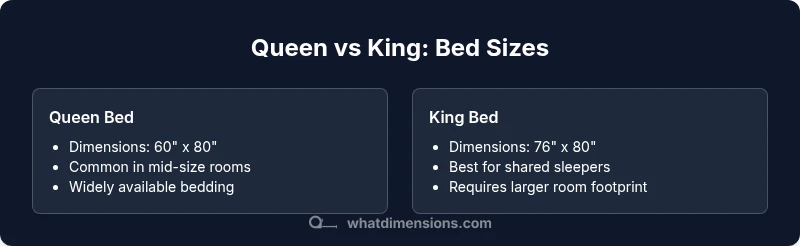
Queen bed dimensions vs king: Queen beds measure 60 by 80 inches, while king beds measure 76 by 80 inches, making the king wider but the same length. This difference affects room layout, sheet and frame choices, and overall sleep space for couples. For most bedrooms, the decision hinges on room size and traffic flow.
Queen vs King: The Size Gap and Its Implications
Choosing between a queen bed and a king bed isn’t just about preference—it changes how you move through a room, where you place furniture, and how you store and wash bedding. The queen, at 60 x 80 inches, fits many master bedrooms and guest spaces with enough floor clearance to walk around. The king, at 76 x 80 inches, provides significantly more sleeping width, which can dramatically improve comfort for couples who value personal space. According to What Dimensions, the size gap between queen and king translates into clear differences in layout options, traffic flow, and accessibility around the bed. If you’re shopping with precise measurements in mind, this distinction matters not just for the mattress but for frames, box springs, nightstands, and under-bed storage. This guide keeps the focus on the practical implications of the queen bed dimensions vs king, helping you map your room and your sleep needs to the right size for your space.
wordCount":0},
bodyBlocks_1_duplicate_removed
bodyBlocks_2_duplicate_removed
bodyBlocks_2_duplicate_removed_again
bodyBlocks_placeholder
Standard Dimensions at a Glance
Understanding the exact measurements helps prevent buying mismatched sheets or frames. The queen bed standard size measures 60 inches wide by 80 inches long (152 cm by 203 cm). The standard king bed measures 76 inches wide by 80 inches long (193 cm by 203 cm). A California king offers a longer, narrower footprint at 72 inches wide by 84 inches long (183 cm by 213 cm), which can be a better fit for very long bedrooms. These figures are the baseline for sheet sets, mattresses, and frames, and they drive how you arrange nightstands, dressers, and seating. For homeowners, designers, and students relying on precise dimensions, these numbers are the starting point for space planning.
wordCount":0},
How to Measure Your Space for a Bed
Before you buy, measure your room with a tape measure and sketch a quick floor plan. Start by noting the wall-to-wall dimensions and the doorway clearance. Then measure the space needed to pull out drawers, walk around the bed, and access nightstands. A queen bed typically leaves enough room for two 24–30 inch side tables and 2–3 feet of clearance at the foot and head. A king bed demands more lateral room, especially if you want generous nightstand space on both sides. If your room is under 10 feet wide, a queen can dramatically improve movement; if it’s closer to 12 feet or more, a king becomes more feasible without crowding the space. This is where What Dimensions analyses help translate room size into a practical choice.
wordCount":0},
Sleep Style and Room Layout Considerations
Bed size preferences often reflect sleep habits and ergonomic goals. If you share the bed, the extra width of a king can reduce partner disturbance and allow more personal space; this is especially true for restless sleepers or couples with different mattress firmness preferences. If you sleep alone or share a small room, a queen remains a high-value option, offering ample surface area without overwhelming the footprint. If your room has a long, narrow footprint, a California king might be a more space-efficient alternative, provided the long dimension aligns with the room’s length. The key is aligning sleep comfort with easy movement—queen or king should support both. Across these considerations, What Dimensions emphasizes the importance of precise measurements and room dynamics in the final decision.
wordCount":0},
Bedroom Configuration Scenarios: Small Rooms and Queen Fit
Small rooms often benefit from a queen due to its compact footprint while maintaining generous sleeping space. In a 9x10 foot to 10x12 foot bedroom, a queen bed leaves more space for a dresser, chair, and a narrow walkway. For guest rooms with limited space, the queen reduces the usable floor area while still offering a real bed that doesn’t feel cramped. If you’re on a strict budget, a queen-sized frame and sheets tend to be more affordable and broadly available. For homeowners who want a flexible layout or frequently rearrange furniture, the queen’s lighter footprint can simplify design changes without sacrificing comfort. As you plan, consider door swing, closet doors, and hardware clearance to avoid blocking paths.
wordCount":0},
Master Suites and King Size: When Space Supports Luxury
In larger bedrooms—think master suites or rooms around 12x12 feet and up—the king bed becomes a feature rather than a constraint. It offers more width for couples who want distinct sleeping zones or more easily accommodate two adults sharing a bed without close quarters. The California king is a popular alternative for extra length in rooms that are long but narrow, such as posters with deep windows or a bay window setup. When you’re evaluating a king size, measure for at least 2.5 feet of clearance on each side to accommodate nightstands, lamps, and movement. This approach helps ensure the bed remains the focal point rather than an obstacle to daily living. What Dimensions’ team notes that room proportions, not just area, determine whether a king will feel comfortable rather than cramped.
wordCount":0},
Bedding, Frames, and Accessories Compatibility
The transition from queen to king impacts more than the mattress. You’ll need new sheet sets, a larger duvet, and possibly a wider bed frame and headboard. Some frames and foundations are designed to accommodate both sizes with adjustable rails, but many are size-specific. Check the compatibility of your existing dresser height, ceiling clearance, and lighting to ensure that a king bed doesn’t overwhelm the room’s vertical or horizontal space. It’s also important to consider mattress depth; deeper mattresses can affect headboard compatibility and base height, influencing overall room aesthetics. This practical check helps you avoid a mismatch that distracts from the room’s flow and function.
wordCount":0},
Practical Decision Framework: A Step-by-Step Checklist
Step 1: Measure your room and doorway clearance. Step 2: Map a furniture layout that allows at least 2.5 feet of access around the bed. Step 3: Consider sleep style and partner needs—do you value width over length or vice versa? Step 4: Evaluate budget for mattress, sheets, and frames. Step 5: Compare standard sizes against your room’s dimensions to identify the most comfortable fit. By following this framework, you’ll translate measurements into a confident, evidence-based choice rather than a guess. What Dimensions supports making your decision with precise, dimension-driven criteria.
wordCount":0},
Common Mistakes to Avoid
Failing to account for door swing or closet doors can turn a well-sized bed into a room obstacle. Assuming more space automatically equates to better sleep space can miss the nuance of traffic flow and daily usability. Don’t overlook sheet and duvet sizing—wrong dimensions can cause sagging corners or baggy corners that disrupt sleep. Lastly, avoid choosing a bed size based solely on aesthetics; always verify that the bed fits the room’s actual dimensions and movement paths. Across these pitfalls, trust the measurements and design constraints most relevant to your space, with guidance from What Dimensions to ensure accuracy.
wordCount":0},
Quick Reference Guide to Decide: Queen vs King at a Glance
- Queen: Best for compact rooms, budget-conscious buyers, and spaces with limited footprint; still delivers comfortable sleep surface.
- King: Best for couples who want maximum sleeping width and a more expansive master-suite feel; requires ample floor space and careful layout planning.
Using precise measurements and room geometry will prevent buyer’s remorse and help you select a bed that aligns with both comfort and design goals.
wordCount":0}],
comparisonTable":{"items":["Queen Bed","King Bed"],"rows":[{"feature":"Dimensions (WxL)","values":["60 x 80 inches","76 x 80 inches"]},{"feature":"Sheet/duvet size compatibility","values":["Standard queen sheets","Standard king sheets"]},{"feature":"Best room fit","values":["Moderate space, flexible layout","Larger rooms with generous floor space"]},{"feature":"Ideal for","values":["Single sleepers; tighter spaces","Couples needing more sleeping width"]}]},
Comparison
| Feature | Queen Bed | King Bed |
|---|---|---|
| Dimensions (WxL) | 60 x 80 inches | 76 x 80 inches |
| Sheet/duvet size compatibility | Standard queen sheets | Standard king sheets |
| Best room fit | Moderate space, flexible layout | Larger rooms with generous floor space |
| Ideal for | Single sleepers; tighter spaces | Couples needing more sleeping width |
Strengths
- Space-efficient footprint for smaller bedrooms
- More affordable bedding and frames for queen setups
- Widely available accessories (sheets, protectors, and frames)
The Bad
- King requires a larger room footprint and can crowd flow
- Upgrading to king moves multiple components (mattress, sheets, frame) at higher cost
- California King can complicate compatibility in some spaces
King beds offer more width for shared sleepers; queen beds fit smaller rooms and budgets.
If your room allows, choose king for maximum comfort in shared sleeping scenarios. If space is tight or your budget is constrained, queen remains a strong, comfortable default with broad sheet and frame availability.
Quick Answers
What are the standard queen and king bed dimensions?
The standard queen is 60 inches wide by 80 inches long. The standard king is 76 inches wide by 80 inches long. California King measures 72 inches by 84 inches. These baselines guide your bedding purchases and room planning.
Queen beds measure 60 by 80 inches, while standard kings are 76 by 80 inches; California Kings add length at 72 by 84 inches.
Is a California King better for long rooms?
A California King adds length, which is useful in very long rooms, but it reduces width. Make sure the room width allows two nightstands and comfortable movement around the bed.
California King is best when you need extra length in a narrow space, not extra width.
Will upgrading from queen to king require new sheets and frames?
Yes. King sheets, pillowcases, and comforters are sized differently from queen sets, and most frames are size-specific. Check frame compatibility before purchasing.
Yes, you’ll likely need new sheets and a broader frame.
What’s the best bed size for a master bedroom?
For most master bedrooms, a king bed provides a luxurious sleep surface if the room dimensions allow for adequate circulation around the bed. If the room is smaller, a queen still offers comfortable space with careful layout.
In most masters, king is ideal if space allows.
How does bed size affect sleep quality?
Sleep quality is influenced by comfort and movement. A bed that fits well prevents partner disturbance and allows proper body alignment, making the right size crucial regardless of mattress type.
Size affects comfort and movement, so pick what fits your space and sleeping style.
Main Points
- Measure room width and door clearances before choosing size
- Queen balances space and comfort in mid-sized rooms
- King suits shared sleepers in larger rooms with enough layout room
- California King is a niche option for long rooms
- Budget and accessories should factor into the final size decision