Full Bed Dimensions vs Queen: A Practical Comparison
Compare full and queen bed dimensions, space needs, bedding, and layout considerations. Learn which size fits your room and budget with precise measurements and practical tips.


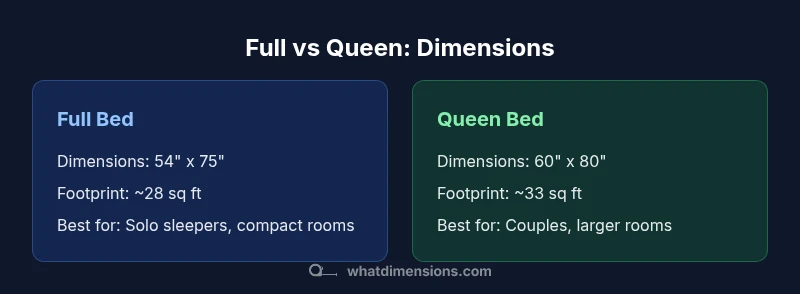
According to What Dimensions, full bed dimensions are 54 by 75 inches, smaller than a standard queen at 60 by 80 inches. The queen offers nearly 30 inches of width for two sleepers and more legroom. In compact rooms, a full bed saves floor space; for couples or longer-term comfort, a queen is usually the better choice.
What are full and queen bed dimensions?
Full bed dimensions, often called a double, measure 54 by 75 inches (about 137 by 191 cm). A standard queen bed is 60 by 80 inches (about 152 by 203 cm). The practical difference is 6 inches in width and 5 inches in length, which translates to about 25% more sleeping surface on a queen. In square inches, a full sleeping area is roughly 4,050 sq in, while a queen offers about 4,800 sq in. The terminology can vary by region, but these are the sizes most manufacturers use. According to What Dimensions, these are the standard measurements you’ll see when comparing mattresses, sheets, and bedding accessories, making side-by-side shopping straightforward.
Space planning: how much room does each size need?
A bed’s footprint is only part of the story. You’ll also need clearance for moving around, making the bed, and opening doors or drawers. For comfort, aim for at least 2 feet (0.6 m) of clearance on both sides and at least 2 feet (0.6 m) at the foot of the bed in tight rooms; larger rooms benefit from 2.5–3 feet (0.75–0.9 m) of side clearance. In practice, a full bed fits well in rooms as small as 9x9 feet, but a queen starts to feel cramped if the floor plan doesn’t leave space for movement. What Dimensions’ analysis shows that even small adjustments in layout can affect perceived space, so measure before you buy.
Comfort and sleeping arrangements: who benefits from each size?
Two adults sharing a bed generally prefer a queen for the extra width, which reduces chances of contact at night and provides more sleeping surface if one partner moves around. A full can work for one sleeper who wants more floor space or a guest room where a second bed isn’t practical. Consider body types and sleeping styles: bigger individuals benefit most from the queen’s surface area, while lighter sleepers in compact rooms may prioritize floor space and ease of access.
Bedding, sheets, and accessories: sizing matters
Sheet sets, comforters, and duvet covers come in standard sizes aligned to the mattress dimensions. Full sheets fit 54×75 beds, while queen sheets fit 60×80 beds. If you own a mix of beds or plan to rotate rooms, buying sheet sets with universal fit or separate top/bottom sheets can simplify future transitions. Always verify pocket depth for fitted sheets—the longer the mattress, the deeper the pocket needed to avoid slipping corners.
Room layout and furniture pairing: optimizing the footprint
When placing a bed, consider nightstands, dressers, and lighting. A queen bed will dominate a room more than a full, so ensure there’s room for a dresser on at least one side and that doorways aren’t blocked. In smaller rooms, choose slimmer nightstands and wall-mounted shelving to maximize walking space. The goal is to maintain a balanced visual proportion while preserving practical clearance.
Real-world scenarios: small apartments vs shared bedrooms
In a small studio or efficiency, a full bed can maximize usable space, leaving room for a compact sofa or desk. For a couple sharing a space in a mid-sized apartment, a queen bed improves comfort and flexibility for future needs. If you anticipate frequent guests, a queen bed may offer better resale value and a smoother transition to a larger room later on. What Dimensions’ insights emphasize planning around both current use and future needs.
Cost considerations and value: upfront vs long-term
Queen beds generally cost more upfront than full beds, not only for the mattress but also for bedding and frames. If budget constraints are tight or you’re prioritizing living space now, a full bed can be the sensible choice. Remember that the long-term value depends on lifestyle changes, room growth, and whether you’ll upgrade to accommodate a partner or family later.
How to measure your space and verify dimensions before buying
Start with a ceiling-to-floor measurement for the bed area, then map the path from the doorway to the bed. Use painter’s tape to visualize the bed footprint, ensuring door clearance and path width for movement. Check ceiling height and any under-bed storage. Finally, confirm your mattress and bedding dimensions with the retailer to avoid mismatches in production tolerances.
Comparison
| Feature | Full bed | Queen bed |
|---|---|---|
| Dimensions (inches) | 54 x 75 | 60 x 80 |
| Sleeping surface area | ~4,050 sq in | ~4,800 sq in |
| Best for | Solo sleepers or tight rooms | Couples or shared rooms with space |
| Bedding compatibility | Fits standard full sheets/duvet covers | Fits standard queen sheets/duvet covers |
| Room clearance | Moderate clearance on sides; tight in small spaces | Requires more side clearance for comfortable movement |
Strengths
- Queen beds maximize sleeping space for couples.
- Full beds save floor space in small rooms.
- Both sizes have broad compatibility with standard linens.
- Resale and multi-room flexibility can favor queen in some layouts.
The Bad
- Full beds can feel cramped for two adults.
- Queen beds require more room clearance and careful furniture planning.
- Moving a queen bed can be harder in tight apartments.
Queen bed generally wins for couples and mid-to-large rooms; full is best for compact spaces or solo sleepers.
For shared spaces, choose queen to maximize comfort. If space is the priority, or you frequently host guests in a smaller room, a full bed remains a practical choice.
Quick Answers
Is a queen bed bigger than a full bed?
Yes. A queen bed measures 60 by 80 inches, while a full bed measures 54 by 75 inches. The queen offers more sleeping space, which is beneficial for couples or those who move a lot at night.
Yes, the queen is larger—60 by 80 inches versus 54 by 75 inches, which means more room for two people.
Will a queen bed fit in a small bedroom?
A queen bed can fit in many small bedrooms, but it leaves less walking space. If the room is very tight, consider full or use space-saving furniture to maximize clearance.
Yes, but it tightens movement space. In very small rooms, you might prefer a full or clever layout.
Do queen sheets fit a full bed?
No. Queen sheets are sized for 60 by 80 inches, while full sheets fit 54 by 75 inches. Using the wrong size can cause slipping corners and poor fit.
No, queen sheets won’t fit a full bed properly.
Can I reuse a full bed frame if I upgrade to a queen later?
Some bed frames are adjustable or allow a queen-compatible headboard and foundation. In many cases, you’ll need a new frame or compatible rails after upgrading to a queen.
It depends on the frame; many require a new setup for queen.
Which bed size is best for a single occupant with frequent guests?
A full bed offers compact space for a single sleeper and can work well in guest rooms where occasional guests stay. If guests are common, a queen can accommodate more comfortably.
For guests often, a queen can be more comfortable; for rare guests, a full works.
Main Points
- Measure your room before choosing bed size.
- Choose queen for couples or when space allows.
- Opt for full in tight spaces or guest rooms.
- Plan for bedding and linen availability.
- Consider future room reconfiguration when selecting size.