Dimensions of a Double Bed vs Queen: A Practical Comparison
A detailed comparison of full/double vs queen bed dimensions, with room planning tips, bedding options, and layout considerations from What Dimensions.


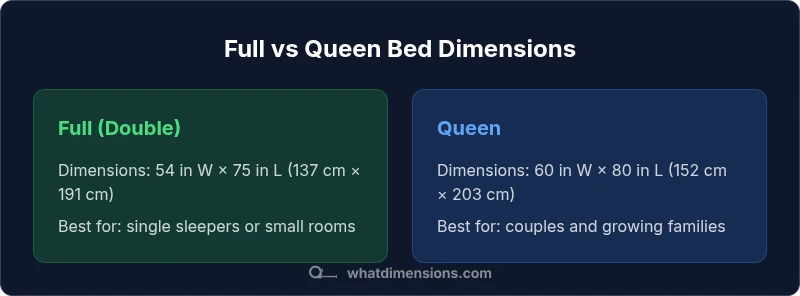
In most bedrooms, a queen bed provides more sleeping space per person than a double (full), but fits better in larger rooms. The dimensions of a double bed (Full) are 54 inches wide by 75 inches long, while a queen measures 60 inches wide by 80 inches long. In metric terms, that's roughly 137 cm by 191 cm for the Full and about 152 cm by 203 cm for the Queen. For couples sharing space, the queen is typically recommended.
Dimensions in Practice: Full (Double) vs Queen
Understanding the exact numbers helps you plan a room without surprises. This section covers the dimensions of a double bed vs queen in practical terms, including standard measurements and how they translate into real space. The dimensions of a double bed (also called Full) are 54 inches wide by 75 inches long, while a queen bed is 60 inches wide by 80 inches long. In metric terms, that's roughly 137 cm by 191 cm for the Full and about 152 cm by 203 cm for the Queen. These sizes influence how many nightstands you can fit, how much clearance you have to walk around the bed, and what other furniture can coexist in the same room. According to What Dimensions, ensuring you pick the right size reduces mismatched layouts and post-purchase regret. For reference, most standard sheets and duvet covers come in both Full/Double and Queen sizes, but you should verify exact fit with your preferred brand. The rest of the article uses these baseline numbers to explore space planning, accessories, and layout.
Room Planning: How Much Space Do You Need
In practice, size is only one part of the equation. The queen's extra width and length affect walking space, dresser placement, and door clearance. A typical small bedroom (roughly 10x10 feet) can often accommodate a queen with careful arrangement; however, you may feel cramped with two large nightstands and a dresser. Conversely, a full/double bed occupies less floor space and can leave room for a larger wardrobe, a desk, or seating area. When planning, measure the room rectangle, subtract door swing corners, and map the bed footprint plus a walkway around it. A common rule of thumb is at least 2 feet (60 cm) of clearance on each side and at the foot of the bed, and at least 2.5 feet (75 cm) of clearance at the head for comfortable entry and exit. What Dimensions finds that the best choice aligns with the room's layout and your lifestyle—especially if you have pets or frequent guests. Use room planning apps or graph paper to sketch to-scale layouts.
Bedding and Accessories: Sheets, Comforters, and More
Choosing bedding by size is essential when you switch from a double to a queen. Full/Double sheets are common and affordable, but a queen requires a longer fitted sheet and typically deeper pockets to accommodate the extra depth of many mattresses. Comforters and duvet covers also differ in length and width; mixing sizes can create uneven drape or weight distribution. If you already own quilts, you may need to adjust the length or add a bed skirt to maintain a balanced look. When shopping, check pocket depth (especially if you have a pillow-top or thick mattress), and confirm anchor features like straps or elastic corners that keep the sheets in place. If you are decorating on a budget, consider reversible duvet covers or duvet insert choices to minimize wardrobe changes. What Dimensions recommends verifying the exact measurements on the product page and choosing sheets labeled as Queen or Full/Double accordingly.
Real-World Layout Scenarios: Small Rooms and Shared Bedrooms
In tight spaces, a queen feels spacious enough for two people yet requires careful planning around closet doors, windows, and entrances. In a small bedroom, you may place the bed against a wall with a slim nightstand on one side to preserve walking space. In a shared early-bedroom or guest room, a double bed can maximize floor area for a sofa or seating area. For larger rooms, a queen can promote a comfortable flow with open pathways and multiple seating zones. Always consider door swing, window clearance, and the path to reach storage or a dresser. What Dimensions emphasizes testing layouts with graph paper or a digital floor planner to avoid awkward angles and cramped corners.
Quick Planning Checklist
- Measure the room before choosing a bed size.
- Sketch a to-scale layout to compare both sizes.
- Ensure at least 24 inches of clearance around all sides.
- Check that your chosen bed fits with existing nightstands and dressers.
- Confirm bedding sizes (Full/Double vs Queen) before purchase.
Comparison
| Feature | Double (Full) | Queen |
|---|---|---|
| Mattress dimensions (inches) | 54 in W × 75 in L | 60 in W × 80 in L |
| Dimensions (cm) | 137 cm W × 191 cm L | 152 cm W × 203 cm L |
| Sleeping surface area | 28.1 sq ft | 33.3 sq ft |
| Best for | Single sleepers or small rooms | Couples or shared bedrooms |
| Sheet sizing availability | Full/Double sheet sets common | Queen sheet sets widely available |
| Recommended room fit | Smaller footprint; easier in tight spaces | Requires more floor space; better for larger rooms |
Strengths
- Queen bed maximizes sleeping space for couples
- Double bed fits smaller bedrooms more easily
- Sheet sets and accessories are widely available for both sizes
- Transitional layouts allow flexible furniture placement
The Bad
- Queen requires more floor space in small rooms
- Moving the bed around furniture is harder in tight spaces
- Upgrading bedding costs more for queen sets
Queen is typically the better all-around choice for couples or shared rooms; double fits compact spaces.
Choose queen if you share your bed or value extra sleeping space. Opt for double in very small rooms where floor space is at a premium.
Quick Answers
What are the standard dimensions of a full/double bed vs queen?
A full/double bed measures 54 inches by 75 inches (approximately 137 cm by 191 cm). A queen bed measures 60 inches by 80 inches (approximately 152 cm by 203 cm). These are the standard, widely accepted dimensions used by most brands.
Full bed is 54 by 75 inches; Queen is 60 by 80 inches.
Will a queen size bed fit in a small bedroom?
Yes, with careful planning. If the room width is around 9–10 feet and you minimize bulky furniture, a queen can fit with proper clearance around the bed.
A queen can fit in a small room with careful planning.
Do I need new sheets when upgrading to a queen?
Yes. Queen sheets are sized differently from full/double sheets. Check fitted depths and ensure your sheets are labeled Queen to avoid gaps or fit issues.
Yes—queen sheets are different and you should buy queen sizing.
How much space should surround the bed for comfortable movement?
Aim for at least 24 inches (60 cm) of clearance on the sides and foot, and 2.5 feet (75 cm) at the head if possible for easy access.
Keep at least 2 feet around the bed, more if you can.
Are there between-sizes like Full XL?
Some brands offer Full XL (54×80 inches) options in select lines. Availability varies by manufacturer, so check product pages for exact dimensions.
Some brands offer Full XL, but check product pages for exact measurements.
Main Points
- Measure your room before choosing bed size
- Queen offers more sleep surface for couples
- Allow at least 2 ft of clearance around the bed
- Buy bedding sized to the bed (Queen or Full/Double)
- Plan furniture layout to avoid crowding