King vs Queen Bed Dimensions: A Practical Size Guide
Explore dimensions king vs queen bed to choose the right size for your space. This What Dimensions guide covers standard measurements, room fit, mattress compatibility, and practical layout tips for homeowners, students, and designers.


For most bedrooms, the king bed offers more surface area (76 in wide x 80 in long) than a queen (60 in wide x 80 in long), which reduces partner disturbance and increases comfort. However, a queen is typically the smarter choice for smaller rooms, tighter layouts, and budget-conscious plans. When you measure your space carefully, you’ll see that the extra width of a king translates into meaningful floor space that can affect nightstands, doors, and traffic flow.
Context: Dimensions that matter in king vs queen decisions
For many households, the choice between a king and a queen bed hinges less on fashion and more on precise size and layout. The difference is not just inches; it governs how you move around the room, how much space your nightstands require, and how the bed fits with doors, wardrobes, and windows. According to What Dimensions, standard king beds measure 76 inches wide by 80 inches long, while standard queens measure 60 by 80 inches. This 16-inch width difference translates into a substantial change in floor area and in the amount of square footage you must dedicate to the base, bedding, and surrounding clearance. In this article, we dissect the dimensions king vs queen bed, explain how to measure your space, and provide practical guidelines for designers, homeowners, and students who need precise size specs for planning, shopping, and interior layouts.
Key differences in physical dimensions
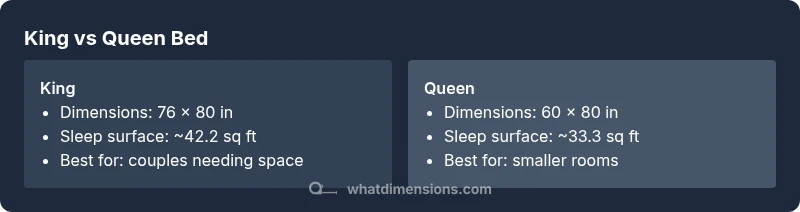
The most obvious distinction between king and queen beds is width. A standard king bed is 76 inches wide and 80 inches long, while a queen bed is 60 inches wide and 80 inches long. That means the king bed offers a sleeping surface roughly 16 inches wider than a queen, which translates into about 42.2 square feet of sleeping area versus 33.3 square feet for the queen. The extra width matters when two people share a bed; it reduces the likelihood of encroachment and makes it easier to spread out. However, both share the same 80-inch length, which means mattresses and bedding run similarly in length, with the main difference being horizontal space. For designers and homeowners, that 16-inch gap can influence nightstand sizes, wardrobe alignment, and the visual balance of the room. When you measure rooms, also consider door swings and traffic flow; even a seemingly large bed can block pathways if space around the headboard is constrained.
Room sizing and circulation: how to tell which fits
Room size recommendations vary, but the guiding principle is at least 24 to 30 inches of clearance on both sides of the bed and at the foot, when possible. In practice, queen beds typically fit comfortably in rooms as small as 10 feet by 10 feet (about 3.0 by 3.0 meters), leaving space for nightstands and a small dresser. King beds require more width, so a 12-by-12-foot room (3.7 by 3.7 meters) is a more forgiving starting point if you want open pathways and bedside access on both sides. If your room is narrower than 10 feet, the queen is usually the better choice to preserve usable floor space. Always map out the door swing, closets, and any built-ins; a king can feel cramped if the surrounding furniture doesn’t yield sufficient circulation. For multi-function bedrooms or guest spaces, many designers favor the queen for flexibility, then rotate furniture to maximize movement.
Mattress, foundation, and bed frame considerations
Sizing is only part of the equation; you must also ensure that the mattress, foundation, and bed frame align with your chosen size. A king bed requires a king-size mattress (76x80 inches) and a compatible foundation; a queen uses a 60x80 inch mattress. Some frames and foundations employ adjustable or split configurations; however, compatibility matters when upgrading or mixing accessories. If you’re upgrading from a full or twin bed, anticipate a transition period as you adjust to the larger footprint. Consider the depth of the mattress, as a deeper mattress adds to the overall bed footprint and may affect bedding fit and skirt drape. If you frequently rearrange the room or switch to guest bedding, a queen setup can be more adaptable with a more limited footprint.
Real-world layouts: budgeting and space planning
In modest master bedrooms (about 11x12 feet), a queen bed often delivers a comfortable balance between sleep space and room function; it leaves enough space for two nightstands, a dresser, and unrestricted movement. In larger master suites (12x14 feet or bigger), a king bed becomes a compelling centerpiece, giving couples ample surface area for two sleepers and easier bed-sharing without disturbing a partner. For multi-function rooms—home offices or guest rooms—choose a queen to preserve flexibility, and consider a bed with integrated storage to maximize space. Budget considerations include mattress quality, foundation type, and the quality of the frame; since prices vary by brand, it’s sensible to compare options across size tiers rather than fixating on a single model. What Dimensions analysis shows that most bedrooms can accommodate at least a queen, but space is required to maintain comfortable circulation around all four sides.
Comfort, longevity, and resale value
Beyond mere size, comfort depends on mattress firmness, support systems, and bedding choice. King beds often drive higher upfront costs due to larger dimensions and heavier frames; however, they can preserve resale value for buyers seeking extra space. Queens generally offer excellent longevity and broad availability at a lower initial price, making them a practical choice for growing households or rental properties. From a design perspective, larger beds may dominate a room’s focal point, influencing color schemes, window treatments, and ceiling height perception. For students and designers planning dorms, apartments, or shared spaces, the queen’s footprint allows more flexible layouts and easier relocation if future needs change. The What Dimensions team notes that layout efficiency and scale are central to satisfying both function and aesthetics, ensuring the room remains comfortable and balanced over time.
Common mistakes and myths to avoid
- Believing bigger is always better: in many bedrooms, a queen is the practical choice that leaves room for dressers and seating.
- Underestimating doors and traffic: a king can block closet doors or window access when door swings are not accounted for.
- Ignoring mattress depth and bed height: depth adds to the bed’s footprint and can affect under-bed storage or bed skirts.
- Assuming one bed fits all layouts: room dimensions and furniture layout often determine the optimal choice more than the bed size alone.
- Skipping professional measurement: a precise floor plan reduces the risk of purchasing the wrong size and needing returns or exchanges.
Decision framework and actionable steps
- Step 1: Measure your room length, width, and door margins; calculate a clear footprint for the bed plus a 24-30 inch perimeter.
- Step 2: Consider the number of inhabitants and sleeping preferences; if two adults share space, the king offers more room to move.
- Step 3: Compare approximate price ranges and confirm mattress compatibility; ensure your budget aligns with long-term comfort.
- Step 4: Sketch two layouts (king and queen) to compare ease of movement, closet access, and nightstand sizes.
- Step 5: Verify the presence of storage options or under-bed drawers that could influence the choice.
Yes, the queen generally fits more rooms, while king is ideal for couples who want maximum space.
Comparison
| Feature | King bed | Queen bed |
|---|---|---|
| Bed dimensions (W x L) | 76 in x 80 in | 60 in x 80 in |
| Sleep surface area | ~42.2 sq ft | ~33.3 sq ft |
| Minimum recommended room width | Typically 12 ft for comfortable king layouts | Typically 10 ft for queen-focused layouts |
| Best for | Couples who want maximum personal space | Smaller rooms or budgets; flexible layouts |
| Estimated price range (varies by brand) | Mid-to-premium (depends on features) | Budget to mid-range (depends on features) |
Strengths
- King beds offer significantly more sleeping surface for two adults.
- Better for couples who value personal space and less partner disturbance.
- In larger rooms, a king becomes a strong room focal point and can improve layout balance.
The Bad
- King beds require more floor space, not ideal in small rooms.
- Higher upfront and long-term cost due to size and heavier frames.
- May limit furniture layout flexibility in compact bedrooms.
Choose king for space where room size and budget allow; choose queen for better fit in smaller rooms and more layout flexibility
King beds excel in spacious bedrooms and for couples who value maximum comfort. Queen beds fit most bedrooms, offer better room circulation, and usually cost less upfront. Your choice should hinge on actual room dimensions and how you plan to use the space.
Quick Answers
What are the exact standard dimensions of a king bed?
A standard king bed is 76 inches wide by 80 inches long. This size provides the widest sleep surface available in the standard mattress market.
A king is 76 by 80 inches, giving you a wide sleeping area for two.
What are the exact standard dimensions of a queen bed?
A standard queen bed is 60 inches wide by 80 inches long. It offers substantial sleeping space with a smaller footprint than a king.
A queen is 60 by 80 inches, a common choice for many bedrooms.
Will a king fit in a small room?
A king can fit in a small room, but it reduces circulation space. In rooms around 11x12 feet or smaller, a queen is typically the safer choice for comfortable movement and furniture placement.
A king can fit in smaller rooms, but a queen usually works better for easy movement.
What should I consider besides size when choosing between king and queen?
Beyond size, consider mattress depth, bed frame compatibility, storage needs, and window/door placements. A well-planned layout often matters more than size alone.
Think about depth, frame type, and how you’ll arrange the room, not just the bed size.
Do bed sizes affect resale value or future flexibility?
Larger beds may appeal to buyers seeking space, but practical layouts and flexibility often drive long-term value. Queen beds generally offer broader appeal in varied spaces.
King beds can be desirable for space, but queens are versatile and easier to resell.
How much clearance should I leave around the bed?
Aim for at least 24 inches of clearance on each side and at the foot, where possible, to ensure easy movement and access to furniture.
Leave about two feet of space on each side for easy movement.
Main Points
- Measure your room before choosing bed size
- Queen beds fit more rooms and offer layout flexibility
- King beds maximize sleep surface for couples in larger spaces
- Account for door swings and clearance around the bed