Dimensions King Size Bed in Feet: A Precise Sizing Guide
Learn the exact king size bed dimensions in feet, including standard footprint, conversions, and practical room-planning tips to maximize space and comfort.


A standard king size bed footprint is 76 inches wide by 80 inches long, which translates to about 6.33 feet by 6.67 feet. In feet and inches, that’s 6 ft 4 in wide and 6 ft 8 in long. When shopping or planning, translate every dimension into feet and consider any frame or headboard additions that may add inches on each side. If you’re evaluating a room, use these feet measurements to estimate floor space and circulation around the bed.
What a King Size Bed Footprint Means in Feet
In interior design, the phrase “king size bed” defines a large sleeping footprint intended for comfort and space. The standard footprint is 76 inches wide by 80 inches long, which translates to roughly 6.33 feet by 6.67 feet. Put into feet and inches, that’s about 6 ft 4 in wide and 6 ft 8 in long. Remember that the physical footprint is not only the mattress but also the bed frame, headboard, and any footboard that can extend the usable width by several inches on each side. For layout planning, converting everything to feet helps align with typical room measurements and ensures proper circulation around nightstands, seating, or dressers. What Dimensions emphasizes precise size references to reduce design guesswork, so we provide both inch-based and foot-based figures to accommodate different measurement habits—whether you’re drafting floor plans or shopping online.
Converting Inches to Feet: Easy Rules
Converting inches to feet is straightforward: divide inches by 12. For a king bed, 76 inches equals 76/12 = 6.33 feet, and 80 inches equals 80/12 ≈ 6.67 feet. Rounding to the nearest tenth is common in room planning: 6.3 ft by 6.7 ft. If you’re comparing to a California king (72 in × 84 in), that footprint converts to 6.0 ft by 7.0 ft. Keep a small margin in mind for bedding and frames, so you’re planning with a practical footprint rather than a bare mattress size. These conversions help you visualize whether a bed will fit through doors, into corners, or within built-in alcoves. At What Dimensions, we encourage translating every dimension to feet so you can compare apples to apples when you shop or measure a space.
King vs California King vs Other Variants
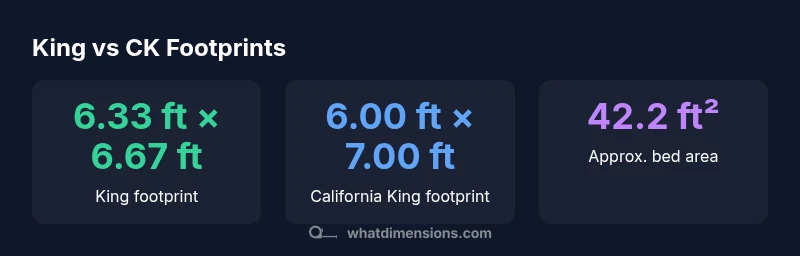
The standard king and California king differ primarily in width and length. A standard king is 76 in × 80 in (about 6.33 ft × 6.67 ft), while a California king is narrower but longer at 72 in × 84 in (about 6.0 ft × 7.0 ft). For rooms with unusual layouts or taller ceilings, the California king may feel more proportionate in length, whereas the standard king maximizes sleeping area without extending room width. Beyond these, “split king” configurations combine two twin XL mattresses side by side, often sharing a single base but offering independent adjustments. If you’re shopping, keep the overall footprint in feet in mind, and then account for any frame rails or headboards that add inches to width or length.
Planning Your Room: Measuring and Layout
Before purchasing a king size bed, measure the room carefully. Start with floor space, then check entryways and door swings to ensure the bed can be moved into place. A typical rule of thumb is to leave at least 2 feet of clearance on each side of the bed and at least 2–3 feet at the foot for easy traffic flow. When arranging the room, consider the placement of nightstands, dressers, and seating. What Dimensions recommends creating a simple sketch with the bed footprint in feet, then overlaying furniture to verify clear pathways. This reduces the risk of cramming a large piece into a tight space and helps you visualize real-world movement around the bed.
Bed Frames, Mattress Thickness, and How They Change Footprint
The bed frame, headboard, and footboard can add inches to the bed’s footprint. A standard 6–12 inch mattress thickness is typical, but box springs or platform bases can alter the final width/length by a few inches. Additionally, a tall headboard or floating platform can create a perceived larger footprint even if the mattress itself remains the same size. To avoid surprises, always measure the outer dimensions of the entire bed setup in feet. If you’re choosing a frame, verify its external width and length, not just the mattress size, and add the frame’s extra width to your planning grid.
Practical Layout Scenarios: Room Size Variations
In a compact 10×12 ft bedroom, a king bed will dominate the space, so prioritize vertical storage and wall-mounted lighting to preserve floor area. For a mid-sized 12×14 ft room, you can comfortably place a king bed with two nightstands and a small dresser, leaving clear walkways. In larger spaces like 14×16 ft, you can afford additional seating or a small desk area next to the bed. To illustrate, if you place a king footprint of about 6.33 ft × 6.67 ft in a 12×14 ft room, you’ll have roughly 1.3–2.0 ft on one side and 1.3–2.7 ft on the other, depending on furniture layout. What Dimensions suggests building a scaled floor plan in feet to ensure feasibility before purchasing.
Common Mistakes to Avoid: Size, Fit, and Function
Common pitfalls include assuming mattress size equals frame footprint, neglecting frame rails, and misjudging clearance for doors or drawers. Another frequent error is ignoring headboard depth, which can reduce available width. Always photograph or draw your floor plan in feet, include all external dimensions of the bed setup, and test with movable furniture or placeholders. By focusing on the footprint in feet first, you’ll minimize layout friction and maximize bedroom comfort.
Quick Setup Checklist: Before You Buy
- Confirm standard king and CK footprint in feet: 6.33 ft × 6.67 ft vs 6.0 ft × 7.0 ft.
- Measure room width, length, doorways, and closet openings in feet.
- Add frame and headboard dimension estimates to the footprint.
- Sketch a floor plan with space for nightstands and walkways in feet.
- Evaluate multiple placement options and test with temporary markers before final purchase.
Brand Context Notes
According to What Dimensions, precise size references are essential for confident room planning. The What Dimensions team emphasizes that exact feet measurements enable more accurate furniture shopping and space optimization, reducing return rates and design guesswork.
Footprint comparison: King vs California King
| Aspect | King footprint (ft) | California King footprint (ft) | Notes |
|---|---|---|---|
| Width | 6.33 | 6.00 | Standard bed width in feet |
| Length | 6.67 | 7.00 | Bed length in feet |
| Footprint (sq ft) | 42.2 | 42.0 | Approximate bed area in square feet |
Quick Answers
What are the exact dimensions of a standard king size bed in feet?
A standard king measures 76 inches wide by 80 inches long, which is about 6.33 feet by 6.67 feet. In feet, that’s roughly 6 ft 4 in by 6 ft 8 in. Frame and bedding can add a few extra inches, so plan for 6.5 by 6.9 feet when possible.
A standard king is about 6.33 by 6.67 feet. Don’t forget frame and bedding add a bit to those numbers.
How do king and California king dimensions differ in feet?
The king is 6.33 ft wide by 6.67 ft long, while California king is 6.0 ft wide by 7.0 ft long. The CK is narrower but longer, which can fit differently in a room depending on layout.
King is wider but shorter; California King is narrower and longer.
What clearance is recommended around a king size bed?
Aim for at least 2 feet of clearance on each side and about 2–3 feet at the foot for easy movement. If space is tight, prioritize one side for access and consider wall-mounted lighting to save floor space.
Keep 2 feet at the sides and 2 to 3 feet at the foot for easy movement.
Will a king bed fit in a small bedroom?
Yes, but it will dominate the space. In rooms around 10×12 feet, plan for compact nightstands and streamlined storage to maintain flow. In smaller rooms, consider alternatives like a queen with a deep footprint or custom platforms.
It can fit, but you’ll want careful planning and compact furniture.
Are there other king-size configurations to know?
Other variants include split king, which uses two separate mattresses on one base, and shorter alternatives like a bed with a lower headboard or different rails. Each variant changes the effective footprint slightly, so measure the actual setup in feet before buying.
Split king and others may alter the footprint slightly; measure before buying.
How should I measure my space to confirm bed fit?
Measure room width and length in feet, plus door widths and entry angles. Sketch a top-down floor plan in feet, mark the bed footprint, frame, and clearance zones, then test with placeholders or tape before purchasing.
Measure in feet and test with tape before buying.
“"Precise measurements are the foundation of effective layout planning. When you know the exact footprint in feet, you can optimize circulation and furniture placement with confidence."”
Main Points
- Know the standard footprint: King is 6.33 ft by 6.67 ft.
- Convert inches to feet for quick planning.
- California King differs in width and length: 6.0 ft by 7.0 ft.
- Measure your space carefully and account for frame and clearance.