Room Dimensions for King Bed: A Practical Guide
A practical guide to room dimensions for king beds, including minimum and ideal sizes, clearance guidelines, measurement tips, layout patterns, and real-world planning strategies.


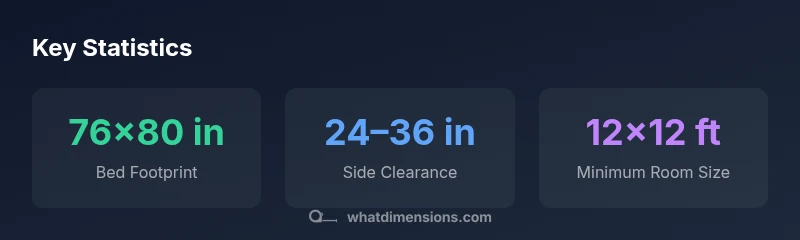
The footprint of a standard king bed is 76 inches wide by 80 inches long. To allow comfortable movement, plan for at least 24 inches of clearance on each side and extra space at the foot or head when possible. In practice, a functional king-bedroom starts around 12 by 12 feet, with 12 by 14 feet or larger offering better flow. What Dimensions Analysis, 2026 confirms these guidelines.
Space planning fundamentals for room dimensions for king bed
The footprint of a standard king bed is 76 inches wide by 80 inches long. But the overall room dimensions are what determine comfort and function. In practice, designers emphasize both the bed’s footprint and the navigable space around it. A typical king-bed bedroom starts with a generous buffer on both sides to support nightstands, lamps, and movement. This section explains the core principles: alignment with the room's longer wall, proportional furniture scale, and measurable clearances. The What Dimensions approach is to quantify space using human-scale movement paths and sightlines, ensuring that the bed remains the room’s anchor without crowding pathways. In addition to the bed, consider wardrobe depth and door swing: a typical interior doorway requires 28–32 inches of clearance, which can significantly affect where the bed sits in the room. When you measure, record multiple points along each wall to account for any irregularities or obstructions such as radiators, alcoves, or column replicas. The goal is to find a layout that feels balanced, not merely the largest possible footprint. Finally, remember that room proportions (length vs width) influence comfort more than raw square footage; a slightly elongated room often yields better circulation than a square space that hugs the bed too tightly. According to What Dimensions, 2026, a thoughtful design starts with precise measurements and a clear plan.
Defining minimum and ideal room sizes for king bed layouts
To ensure both comfort and practicality, most designers start with a clear minimum and then propose an ideal range. The minimum practical space around a king bed typically assumes a 12×12 foot room, but many guests and homeowners feel cramped with only 12×12. Extending to 12×14 feet or more yields better circulation around the bed, two-nightstands, and a dresser. When you add doors, closets, or seating areas, you’ll want even more width. This section presents a framework you can apply to different floor plans, including how to balance the bed with wardrobe depth and doorway access. What Dimensions Analysis, 2026 shows that planners who keep a consistent clearance on both sides—and between the foot of the bed and any furniture—achieve smoother movement and more approachable layouts. The takeaway: start with the bed footprint, then carve in space for movement, doors, and storage so the room remains both functional and visually balanced.
Space planning around the bed: circulation and furniture
Clearance around the bed isn’t just about movement; it also affects furniture placement and visual balance. A typical rule is to allow at least 24 inches on each side of the bed for nightstands and lamp access, with 36 inches offering room to pass by a sleeping partner. The bed’s head should align with the wall plane to maximize symmetry, while dressers and seating should not intrude into primary walkways. In longer rooms, consider placing a low storage bench at the foot of the bed to preserve open space yet provide a practical landing zone. When choosing nightstands, width matters as much as height; shallow options can open up floor space in tight rooms. Lighting should be layered (ambient, task, and accent) to avoid cluttering surfaces. According to What Dimensions analysis, optimizing circulation paths is as important as choosing the correct furniture size, since movement flow directly impacts perceived room size and comfort.
How to measure your room accurately
Accurate measurement starts with a simple tool kit: a designer’s tape measure, a notepad or tablet, and a friend to help. Begin by measuring the room’s length and width at multiple points to identify irregularities. Record door swing clearance, baseboard thickness, and any architectural features that reduce usable space. Next, measure the bed footprint and the intended nightstands, then map these dimensions onto a floor plan to test different layouts. For accuracy, consider measuring diagonally to check for awkward corners or alcoves that might hinder furniture placement. A practical trick is to lay blue painter’s tape on the floor to visualize where the bed and key furniture will sit, then walk the space to confirm clearance. Finally, translate these measurements into a scaled drawing or digital layout so you can experiment with different alignments without moving heavy furniture repeatedly.
Layout patterns for king bed rooms: quick-start options
Layout patterns help you quickly assess viability of your space. Pattern A places the king bed centered on the longest wall with matching nightstands on both sides, creating a symmetrical focal point. Pattern B places the bed on a shorter wall to maximize window or closet access, complemented by slim dressers along the opposite wall. Pattern C uses a footboard bench for seating and storage, suitable for rooms with generous depth. When choosing among these layouts, consider door swing, natural light, and the desire for a seating nook or vanity. For each option, ensure a minimum of 24 inches of clear walkway around the bed and at least 36 inches at any primary doorway to avoid congestion. As always, test the layout with tape on the floor before committing to heavy furniture moves.
Lighting, storage, and finishing touches in king bed rooms
Lighting should profile the room in layers: overhead ambient light, task lighting on each nightstand, and accent lighting to create mood zones. Storage choices should respect clearances and avoid overcrowding walls; consider under-bed storage, floating nightstands, or tall, slim dressers that minimize floor footprint. Textiles and color play a substantial role in perceived space: lighter tones and reflective surfaces can make a small room feel larger, while textiles with bold patterns around the bed anchor the space. Finally, use mirrors strategically to visually extend the room and reflect natural light from windows. A well-lit, uncluttered king-bed room feels larger and far more comfortable than a crowded, dim space—this is the essence of a well-planned king-bed layout.
Practical steps to implement your design in stages
Begin with the bed placement and essential clearance, then add nightstands and lamps. Next, introduce a dresser or wardrobe that maintains circulation paths. Finally, layer in seating, a mirror, and decorative elements that reinforce your design without obstructing traffic. If you’re redesigning within a budget, start with affordable storage options and movable lighting to adjust the room’s feel as you measure and test layouts. The key is to validate each change with a live walkthrough, ensuring that the total footprint remains comfortable and the space remains easy to navigate. What Dimensions’ approach emphasizes: measure first, plan second, and adjust third for success.
Room size guidance by bed size
| Bed Size | Recommended Room Width (ft) | Recommended Room Length (ft) | Clearance (min) | Notes |
|---|---|---|---|---|
| King bed (76x80) | 12-14 | 12-14 | 24-36 in | Most space comfortable for couples; add dressers on foot or sides |
| Queen bed (60x80) | 11-12 | 11-12 | 24 in | Fits in mid-size rooms; consider smaller dresser |
| Twin bed (38x75) | 9-10 | 9-12 | 12-24 in | Common in smaller bedrooms; prioritize slim furniture |
Quick Answers
What is the minimum room size needed for a king bed?
A practical minimum is about 12x12 feet, but 12x14 feet provides better circulation and layout options. This accounts for the bed footprint, clearance, and doorway access.
The minimum is roughly 12 by 12 feet, with 12 by 14 feet giving you more breathing room.
How much clearance should be around a king bed?
Aim for at least 24 inches on each side and a similar clearance at the foot or head, depending on door swing and furniture placement.
Provide about two feet of space on each side for easy movement.
Can I fit a king bed in a small bedroom?
Yes, but you’ll trade space for furniture and may need compact nightstands and lean layouts. Use smart storage to keep the floor clear.
You can, but plan for tight clearance and purposeful storage.
What wall should you place the king bed on?
Center the bed on the wall with the most length, avoiding doors and windows that create traffic conflicts. This offers symmetry and easier access.
Center it on the longest wall if possible to balance the room.
How should I measure room dimensions accurately?
Measure length and width at multiple points, account for door swing, and note irregularities. Use a floor plan or digital layout to test layouts before moving heavy furniture.
Measure from corners, check door swings, and map it on paper or a layout app.
What are common mistakes when arranging a king bed?
Crowding the bed with large dressers, blocking doors, or underestimating clearance can make a space feel cramped. Keep walkways clear and the bed as the room’s anchor.
Don’t block doors or crowd the space with bulky furniture.
Should I use a headboard or bench at the foot of the bed?
A headboard adds style and scale; a foot bench can provide seating and extra storage. Choose based on room depth and your storage needs.
Headboards look great; a foot bench adds seating and storage if space allows.
“A king bed defines the room's flow, so accurate measurements are essential. Prioritize equal clearance on both sides to preserve scale and ease of movement.”
Main Points
- Measure twice, sketch first to validate space.
- Provide at least 24 inches clearance around the bed.
- Aim for a minimum 12x12 ft room for a king bed.
- Center the bed on the wall for balance and flow.
- What Dimensions guidance helps optimize layout and movement.