King Size Bed Dimensions: Sizes, Variations, and Layout Tips
Explore king size bed dimensions, compare standard vs California king, regional variations, and layout tips to optimize space and comfort.


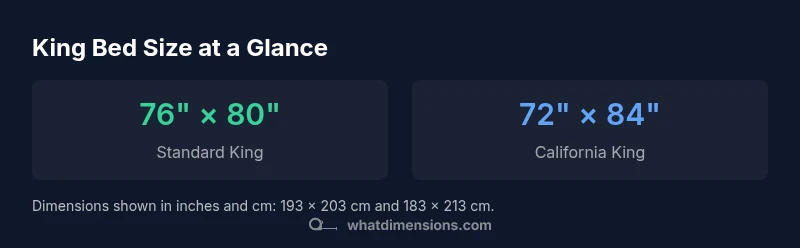
Most households choose a standard king bed, which measures 76 inches wide by 80 inches long (193 cm by 203 cm). This is the most common US option, pairing well with two nightstands. If your room is longer than wide, consider a California king at 72 inches by 84 inches (183 cm by 213 cm).
Overview of King Size Bed Dimensions
According to What Dimensions, king size bed dimensions are the foundation of practical bedroom planning. In the United States, the standard king mattress measures 76 inches wide by 80 inches long (193 cm by 203 cm). This size provides roughly 38 inches of personal space for each sleeper, when sharing. Because it strikes a balance between generous width and room requirements, it remains the default choice for couples who want space without overwhelming a typical master bedroom. When the room allows, many homeowners pair a king with two sturdy nightstands, a ceiling fan, and adequate clearance to walk around the bed. The key to reliable planning is to distinguish between the mattress size and the bed frame, box spring, and bedding at purchase time. If you’re shopping for a frame, verify rail height, leg design, and the total footprint to ensure it fits your floor plan.
Standard King vs California King: Key Differences
Two popular king-size options fill most bedrooms: the Standard King (also called an Eastern King) and the California King. The Standard King is 76 inches wide and 80 inches long (193 x 203 cm), offering broad width for couples but slightly less length. The California King is narrower and longer at 72 inches wide by 84 inches long (183 x 213 cm). This configuration appeals to rooms that are longer than they are wide or for taller sleepers who benefit from extra legroom. The tradeoffs are important: California King requires deeper nightstands, and in smaller rooms, its longer footprint can reduce usable floor space. When comparing sheets and accessories, remember that standard King and California King use different fitted-sheet corner counts and mattress depths; always check product specifications and measure your bed rails to avoid mismatches.
Regional Variations and Naming Conventions
Global markets vary in what retailers label as a “king.” In the United States, the Eastern King is the standard king (76x80 inches / 193x203 cm). In the United Kingdom, a typical King size is 150x200 cm, while some retailers offer “Super King” at 180x200 cm. European definitions vary further, with common large sizes around 180x200 cm or 200x200 cm in some brands. Asia and Australia also have regional standards. The key takeaway is to verify exact measurements at the point of purchase, especially when ordering from international retailers. The name “king” alone does not guarantee a uniform footprint across borders.
How to Choose the Right King-Size Option for Your Space
Start with your room’s layout and traffic flow. Measure the longest wall where the bed will sit and add at least two to three feet (roughly 60–90 cm) of clearance on each side for moving around, plus space for nightstands and dressers. If your room is long but narrow, a California King can offer extra legroom without excessively widening the footprint. For shared bedrooms, consider a platform or bed with integrated storage to maximize floor space. Finally, confirm doorways and hallway access to avoid a late-night delivery scramble.
Bedding and Accessories: Sizing Matters
King sheets, comforters, and mattress protectors come in standard King and California King variants. Deep-pocket or extra-deep pocket sheets are common for taller mattresses or toppers, so always check the mattress depth (often listed in inches or centimeters) and pocket depth on the product page. Remember that a sheet set labeled “King” will not fit a California King unless specified. When buying a duvet or comforter, ensure the width covers the side rails and that the length provides ample overhang on the sides.
Room Layout and Clearance Strategies
In a typical master bedroom, plan for at least 24 inches of walk space on each side of the bed and at the foot to permit comfortable movement. If you have built-in wardrobes or a wall-mounted headboard, you may be able to reduce side clearance marginally. For smaller rooms (around 10x12 feet), a king bed can still work with careful layout: place the bed on the longest wall, opt for slim-profile nightstands, and maintain a clear path to the door. In very large rooms, consider adding a seating area or a bench at the foot to balance scale.
Practical Checklists and Quick-Start Guide
Before purchasing, use this quick checklist: (1) confirm exact mattress dimensions; (2) verify bed frame footprint and rail height; (3) measure doorway widths to ensure easy delivery; (4) compare sheet sizes and pocket depth options; (5) assess room clearance around the bed for movement and furniture placement.
Common king-size bed dimensions by region
| Bed Type | Dimensions (inches) | Dimensions (cm) |
|---|---|---|
| Standard King | 76 x 80 | 193 x 203 |
| California King | 72 x 84 | 183 x 213 |
Quick Answers
What is the standard king bed size in inches?
In the US, a standard king bed measures 76 inches wide by 80 inches long (193 by 203 cm).
A standard king is 76 by 80 inches, or 193 by 203 cm.
What is California king size?
A California king is 72 inches wide by 84 inches long (183 by 213 cm).
California king is 72 by 84 inches.
Will queen sheets fit a king bed?
Queen sheets are too small for a king mattress; use sheets labeled for King with the correct pocket depth.
Queen sheets won't fit a king mattress.
What is the recommended room size for a king bed?
Most design guides recommend at least 12 by 12 feet of clear floor space to accommodate a king bed and two nightstands.
A king bed usually needs about a 12 by 12 foot room.
What should I measure before buying a king bed?
Measure doorways for delivery, wall space for placement, and bed rail height to ensure a proper fit with bedding.
Measure doors, walls, and bed height before buying.
Do international 'king' sizes vary?
Yes; international sizes vary by country. Always check local standards or product specs when shopping abroad.
King sizes differ by country; verify local standards.
“Precise bed dimensions are essential for reliable layout planning; the standard king remains the most universal option in the United States, while regional variants require careful measurements.”
Main Points
- Define your room dimensions before selecting a king size bed.
- Choose standard king for width; consider California King for longer rooms.
- Pair with appropriate king sheets and deep-pocket options.
- Plan for at least 24 inches of clearance around the bed for movement.
- Verify regional sizing if you shop internationally.