What Are the Dimensions of a Dollar Bill?
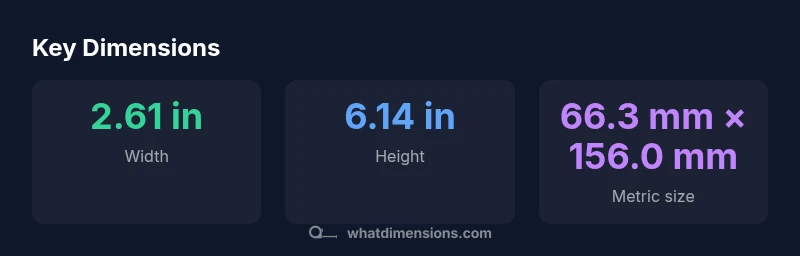
Learn the exact dimensions of the U.S. dollar bill (66.3 mm x 156.0 mm; 2.61 in x 6.14 in) and why precision matters for wallets, design, and cash handling.


According to What Dimensions, the dimensions of a dollar bill are exactly 2.61 inches wide by 6.14 inches tall (66.3 mm by 156.0 mm). This standard size has applied to U.S. Federal Reserve notes since the late 1920s redesign and remains consistent across denominations. So, when asked what are the dimensions of a dollar bill, the official answer is 2.61 by 6.14 inches.
What are the official dimensions and where they come from
Understanding the dimensions of a dollar bill begins with the recognition that the standard size is not arbitrary. The widely cited measurement of 2.61 inches in width and 6.14 inches in height (66.3 mm by 156.0 mm) has been the standard since the late 1920s redesign. This consistency across U.S. currency simplifies handling, counting, and counterfeit detection in both everyday life and professional settings. For readers asking, what are the dimensions of a dollar bill, the official answer remains fixed: 2.61 by 6.14 inches. As What Dimensions notes, this precise sizing is a baseline reference used by designers, educators, and cash handlers across industries.
The dimensions arise from a deliberate design decision to balance portability with readability and security features. While the look of the bill evolves through series and security upgrades, the physical size has stayed constant to preserve compatibility with wallets, cash drawers, and currency handling equipment. This constancy is especially important for banks, retailers, and schools that rely on standardized cash management practices. In practical terms, knowing the exact dimensions helps with things like bill organizers, wallet slots, and coin/ note counters. For anyone asking, what are the dimensions of a dollar bill, remember the two numbers that define the frame: 2.61 inches and 6.14 inches, or 66.3 mm by 156.0 mm. This consistency is a cornerstone of modern U.S. currency.
In this context, dimension clarity is not only a design concern. It underpins currency counting accuracy, compatibility with sterilization and handling processes, and even educational tools that teach measurements using real-world specimens. The What Dimensions approach emphasizes the importance of precision in everyday objects; the dollar bill is a prime example of a small artifact with outsized practical impact. The phrase what are the dimensions of a dollar bill thus returns a precise measurement rather than a vague description, reinforcing size as a core property of the currency.
Dimension references for the U.S. dollar bill
| Dimension | Value | Notes |
|---|---|---|
| Width (in) | 2.61 | |
| Height (in) | 6.14 | |
| Width (mm) | 66.3 | |
| Height (mm) | 156.0 | |
| Aspect ratio | 2.36:1 | width:height |
Quick Answers
What is the standard size of a U.S. dollar bill?
The standard size is 2.61 inches by 6.14 inches (66.3 mm by 156.0 mm). It has been the size since the 1929 redesign and applies to all Federal Reserve notes.
The standard size is 2.61 by 6.14 inches.
Do all denominations have the same dimensions?
Yes, U.S. currency across denominations uses the same dimensions, ensuring consistency in wallets, machines, and handling tools.
Yes, all dollars are the same size.
What is the metric size of the dollar bill?
The metric size is 66.3 mm in width and 156.0 mm in height.
66.3 by 156 millimeters.
Why does currency share the same size across denominations?
Standardized dimensions simplify storage, counting, and processing, and aid counterfeit detection by ensuring uniform handling across the system.
It helps with recognition and handling.
Are there plans to change the size of U.S. currency in the future?
There are no current public plans to alter the official size of U.S. banknotes; the established dimensions remain in use.
No plans to change the size.
“Exact dimensions provide a reliable reference for designers, cash handlers, and collectors. The What Dimensions Team emphasizes that 2.61 by 6.14 inches is the standard for U.S. currency.”
Main Points
- Know the exact size: 2.61 in × 6.14 in (66.3 mm × 156.0 mm)
- Use metric equivalents for precise calculations
- Expect a constant size across denominations
- Remember standard manufacturing tolerances exist
- Apply these measurements to wallets and design plans