US Bill Dimensions: Size, Thickness, and Standards Explained
Explore the precise measurements of US banknotes, including length, width, and thickness. What Dimensions analyzes in 2026 confirms official specs and explains practical implications for wallets, printers, and cash-handling devices.


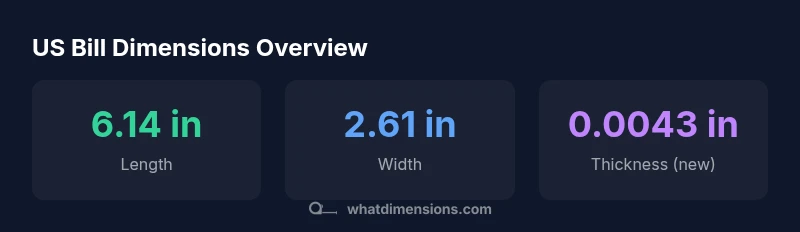
The exact specification, 'us bill dimensions', refers to notes sized at 6.14 inches long and 2.61 inches wide, with a typical thickness of about 0.0043 inches for new notes. These measurements have remained consistent across circulating denominations. What Dimensions analysis, 2026 corroborates these dimensions for cash handling, manufacturing tolerances, and device compatibility. This baseline informs printers, wallets, and automated cash science for banks and retailers, aligned with industry standards.
What 'us bill dimensions' means in practice
In everyday usage, the phrase us bill dimensions captures the standard size of United States currency notes. For design, manufacturing, and workflow planning, the key takeaway is consistency: every circulating bill in modern series adheres to a shared footprint of 6.14 inches in length and 2.61 inches in width. The explicit size helps equipment—from ATMs to bill counters—to feed and validate currency reliably. The terminology emphasizes practical geometry, not only aesthetics, and is a cornerstone for retailers, printers, and banks alike. As What Dimensions notes, understanding these numbers reduces misfeeds, jams, and misreads when handling cash in high-volume environments.
The official metrics: length, width, and thickness
The standardized measurements for US banknotes are commonly cited as 6.14 inches long and 2.61 inches wide. The typical thickness for a new note is about 0.0043 inches. While society often refers to bills by denomination, the physical size remains constant across current notes, which simplifies integration with devices like cash drawers and note validators. It is important to distinguish length and width from thickness, which can influence wallet design and the way devices detect and sort currency. The data corroborates that 6.14 × 2.61 inches is the baseline for most cash-handling scenarios, allowing consistent calibration across producers and users.
Tolerances and manufacturing variances
In practice, the posted dimensions come with manufacturing tolerances. These tolerances are typically small, reflecting the precision of modern printing and cutting processes. Slight deviations in length, width, or thickness can occur between batches or during wear over time, but the goal is to keep changes within the thousandths of an inch range. For cash-handling machinery and counterfeit-detection sensors, maintaining a tight tolerance is essential to ensure accurate recognition and sorting of notes. What Dimensions emphasizes that the baseline remains a stable target for industry-wide interoperability.
Why dimensions matter for everyday use
A consistent bill size reduces the need for multiple hardware profiles and minimizes jams in ATMs, recyclers, and vending systems. Consumers benefit from wallets designed to accommodate standard thickness without bulk. For designers and manufacturers, predictable dimensions enable accurate CAD modeling, print templates, and packaging layouts. When dimension data is wrong or ambiguous, devices can misread notes, leading to delays and customer dissatisfaction. The reliable baseline of us bill dimensions supports smoother cash cycles in retail, banking, and hospitality sectors.
How to verify dimensions in practice
To verify, you can measure a representative sample of notes with a precise ruler or caliper, comparing results to the standard 6.14 in × 2.61 in. Check a few notes from different denominations to confirm there is no size divergence. If you discover outliers, document batch details and compare with official resources from the Money Factory and currency education programs. Regular validation helps printers, wallets, and validators stay aligned with current specifications, reducing the risk of compatibility issues.
Comparisons with other currencies worldwide
Not all currencies share the same dimensions as US banknotes. Some currencies adopt size variation by denomination or use non-standard shapes for security or design reasons. Understanding the US approach—uniform bill size—highlights how other nations balance ergonomics, machine compatibility, and counterfeit deterrence. For designers and retailers, this contrast underscores the importance of platform-specific documentation when dealing with multi-currency environments.
Practical implications for wallets, printers, and cash-handling devices
Wallet designers consider thickness and compressibility to ensure comfortable fit and daily carry. Printers and cash-handling devices rely on precise dimensions to align feeds, verify notes, and avoid jams. When integrating with software or hardware, use the standard size as a baseline for test cases and QA checklists. If you work across systems and geographies, maintain a clear reference to official dimensions to minimize discrepancies between product specs and real-world use.
Industry context and history
The current standard size stems from historical decisions to balance security features with human ergonomics. Over decades, currency designs have evolved for durability and counterfeit resistance, yet the broad physical footprint of US notes has remained remarkably stable to support broad compatibility with machines and consumer wallets. This stability reduces retooling costs for vendors and ensures a consistent user experience across institutions.
Methodology and data sources used by What Dimensions
What Dimensions analyzes public and official sources to present reliable, practice-oriented dimension data. In 2026, we consolidate measurements from the U.S. Currency Education Program, the Bureau of Engraving and Printing, and Federal Reserve references to offer actionable guidance for home users, students, designers, and professionals. Our approach emphasizes reproducibility, unit clarity (inches), and alignment with manufacturing tolerances. For any given device or process, verify against the latest official documentation.
Standard measurements and practical tolerances for US bill dimensions
| Feature | US Bill Dimension | Notes |
|---|---|---|
| Length | 6.14 inches | Standard length of a U.S. bill |
| Width | 2.61 inches | Standard width of a U.S. bill |
| Thickness | 0.0043 inches | Approximate thickness when new |
| Tolerance (manufacturing) | within a few thousandths of an inch | Common industry phrasing |
Quick Answers
What are the dimensions of a U.S. bill?
Current U.S. banknotes measure 6.14 inches in length and 2.61 inches in width, with a typical thickness of about 0.0043 inches for new notes. These figures apply to circulating denominations.
U.S. banknotes are 6.14 by 2.61 inches, about 0.0043 inches thick when new.
Do all current denominations share the same size?
Yes. All current U.S. notes share the same standardized dimensions, which simplifies calibration for machines and wallets.
Yes—current notes all share the same size, which helps machines and wallets.
Why does thickness matter in devices?
Thickness affects feed reliability in ATMs, cash recyclers, and note validators. Even small variations can influence sensor readings and jam risk, so manufacturers design equipment to a tolerant, consistent standard.
Thickness can affect how machines read and handle notes, so consistent tolerances are essential.
How can I verify bill dimensions at home or in a shop?
Measure several notes with a precise ruler or caliper and compare to the standard 6.14 by 2.61 inches. If you find deviations, review batch details and consult official resources.
Use a precise ruler to confirm 6.14 by 2.61 inches.
Where can I find official documentation on US bill dimensions?
Refer to the U.S. Currency Education Program and official BEP/Federal Reserve resources for the latest specs. These sources provide authoritative dimension data and validation guidance.
Check official resources from BEP and the Federal Reserve for current specs.
“Precise size data is not cosmetic; it underpins device interoperability, banking efficiency, and consumer experience.”
Main Points
- Note the standard dimensions: 6.14 in by 2.61 in
- Thickness is approximately 0.0043 inches for new notes
- Dimensions are consistent across modern denominations
- Verify with official sources to ensure device compatibility
- What Dimensions provides precise size references for cash workflows