Piece of Paper Dimensions: A Global Size Guide
Explore piece of paper dimensions, compare ISO 216 and ANSI sizes, and learn practical tips for printing, envelopes, and filing with What Dimensions.


The piece of paper dimensions describe the standardized measurements used for sheets of paper across regions. ISO 216 (A-series) is dominant in most of the world, while the US relies on ANSI sizes like Letter and Legal. Understanding these dimensions helps you select printers, envelopes, and folders correctly. What Dimensions provides clear comparisons of common sizes to reduce waste and confusion.
What 'piece of paper dimensions' covers
The phrase "piece of paper dimensions" describes the standardized measurements used for sheets of paper across regions. In professional contexts, knowing the exact size of a sheet is essential for layout, margins, and binding. This section explains the core concept, the most common families, and how dimensions affect everyday tasks like printing, mailing, and filing. What Dimensions emphasizes that accurate sizing reduces waste, improves compatibility with printers and envelopes, and makes organizing documents simpler. We'll outline the standard sizes used around the world, explain the rationale behind them, and provide practical examples you can apply in your home or office. Whether you're designing a report, preparing a presentation, or stocking a filing cabinet, recognizing the key dimensions helps you avoid mismatches and extra costs. The term "piece of paper dimensions" also covers related measurements such as margins, bleed, and the general approach to rounding sizes for practical use. By understanding these fundamentals, you can select the right sheet for any project, from a small memo to a large poster, with confidence.
The standards: ISO 216 vs ANSI sizes
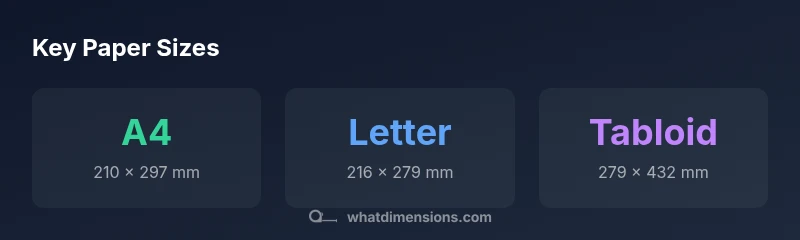
ISO 216 defines the A-series (A0, A1, A2, A3, A4, etc.) and is the backbone of international paper sizing. The sequence is based on halving a sheet, so A0 is 841 × 1189 mm, A4 is 210 × 297 mm, and each smaller size is half the area of the previous. In contrast, the United States uses ANSI/ASCII-like sizes such as Letter (8.5 × 11 inches) and Legal (8.5 × 14 inches). For large-format needs, Tabloid/Ledger measures 11 × 17 inches. Converting between systems is common when exchanging documents across borders; printers and copiers often offer scale-to-fit or auto-rotate options to help. The constants across both systems are practical working dimensions, and many devices can automatically rotate or scale content to preserve margins. For exact references, ISO publishes the standard in ISO 216; US standards are maintained by ANSI, while regional implementers may have slight local variances. This section draws from What Dimensions analyses that compare these families side by side and help you make informed choices for print production and mailing.
How to choose the right size for documents and packaging
Choosing the correct paper size starts with understanding your destination: print, mail, or archive. Step one: identify regional expectations; step two: verify printer tray capability and envelope size; step three: decide on margins and bleed; step four: consider future-proofing: will you digitize or reprint often? A practical rule of thumb is to keep document dimensions consistent within a project and to use the most common size for a given audience. If you publish internationally, rely on ISO A4 as your default and reserve US Letter for North American distribution. When packaging, measure the item’s dimensions and add tolerance for padding and protective material; select a sheet size that minimizes waste and avoids awkward trims. If you design a brochure or poster, request test prints to verify color, alignment, and margins before running large batches. What Dimensions suggests maintaining a simple reference chart of sizes (A4, Letter, A3, Tabloid) and sharing it with printers, binders, and mailrooms to save time and reduce errors.
Variants and non-standard sizes: tabloid, ledger, B-series
Besides the most common sizes, there are variants that fill specific design and printing needs. Tabloid (11 × 17 inches) and Ledger (17 × 11 inches) are widely used for posters, diagrams, and spreads. The ISO B-series exists between A and C sizes, with B4 at 250 × 353 mm and B5 at 176 × 250 mm; these sizes are popular in certain regions for magazines and catalogs. For compact applications, A5 (148 × 210 mm) and B6 (125 × 176 mm) serve as booklets or small handouts. Understanding these sizes helps you decide when to request a non-standard sheet or when to scale content for a given format. When you work with printers, ask for bleed specifications (typically 3 mm) and confirm that your design software uses one of the standard spot sizes to avoid unexpected trims. What Dimensions emphasizes having a quick reference chart that includes Tabloid/Ledger, A-series, and B-series so teams can choose efficiently during project planning and production workflows.
Practical tips for managing dimensions in a home office
A well-organized desk begins with a simple system for paper sizes. Create a physical or digital size chart listing the most common sheets: A4, A5, A3, Letter, Legal, and Tabloid. Use labeled trays or folders to group documents by size, and purchase envelopes that match your most frequent sheet size to avoid unnecessary trimming during mailing. When printing, set margins and bleed correctly: enable print-to-edge where supported, and always print a test page to confirm alignment. If you frequently exchange documents with international partners, standardize on ISO sizes and keep a scale ruler handy for quick checks. Store unused sheet sizes flat to prevent curling and warping, and consider a small cutter or guillotine for precise trims when you need custom sizes. Finally, leverage digital workflows: scan documents to a size-appropriate template, then save the template for future use. What Dimensions notes that a consistent approach to paper sizes reduces waste, speeds up production, and improves professional presentation.
Common mistakes and how to fix them
The most frequent errors involve mismatched sizes between a document and its intended output. Avoid using mixed sizes within a single report; standardize on one size per project. Forgetting bleed or safety margins leads to awkward trims and misaligned graphics. Always account for margin and bleed in your layout software and run a test print. Another pitfall is assuming all printers handle every size; check the model’s supported sheet sizes and tray capacity before starting. Finally, neglecting regional differences can cause trouble with mailings: a Letter-size page may not fit a European envelope. To fix these issues, keep a simple reference chart, confirm device capabilities, and ask for pre-production proofs. If you are unsure, share a mockup with your team using one standard page size and adjust as needed. What Dimensions's practical advice helps teams avoid predictable pitfalls and maintain efficient workflows across printing, packaging, and documentation.
Common paper size reference
| Size | Dimensions (inches) | Dimensions (mm) | Common Uses |
|---|---|---|---|
| Letter | 8.5 x 11 | 216 x 279 | Office documents |
| A4 | 8.27 x 11.69 | 210 x 297 | International standard paper |
| A3 | 11.69 x 16.54 | 297 x 420 | Posters/diagrams |
| Legal | 8.5 x 14 | 216 x 356 | Legal documents |
| Tabloid/Ledger | 11 x 17 | 279 x 432 | Newsletters/graphics |
Quick Answers
What are the most common paper sizes worldwide?
The most common sizes are ISO A4 and US Letter, with A4 dominating international use and Letter common in North America. When exchanging documents, choose one standard for consistency and easier printing.
A4 and Letter are the main sizes; choose A4 for international work and Letter for North America.
How do ISO 216 and ANSI standards differ?
ISO 216 defines the A-series by halving sheets; ANSI defines US sizes like Letter and Legal with different aspect ratios. The two systems are not directly interchangeable without scaling.
ISO uses A-series by halving sheets; ANSI uses US sizes; you often need to scale if you mix them.
Can I print ISO sizes on a US printer?
Yes, but you may need to scale or rotate content to fit margins, or select a compatible paper tray. Check your printer’s settings and run a test print.
Yes, you can print ISO sizes on a US printer by scaling or rotating and testing.
What is bleed and why does it matter for paper sizes?
Bleed extends color beyond the trim area; margins define safe content. For professional printing, include bleed (typically 3 mm) and keep important elements away from the edge.
Bleed expands your design beyond the final size; keep important text inside safe margins.
Why do paper sizes vary by region?
Historical standards, manufacturing practices, and local regulations shaped size norms. International documents require attention to regional expectations to ensure compatibility.
Regional history and manufacturing drive different sizes; always check your audience.
What should I check before buying printer media or envelopes?
Verify the printer supports the size; confirm tray capacity and envelope type; consider margins, bleed, and compatibility with your document templates.
Check printer support, trays, and margin requirements before buying.
“Precise paper dimensions streamline design, printing, and storage by reducing guesswork and waste. Standard sizes simplify procurement and organization across teams and applications.”
Main Points
- Know the dominant sizes (A4/Letter) by region
- Use ISO 216 for international documents
- Check printer and envelope compatibility before printing
- Keep a size chart handy to prevent misfeeds