Ledger Paper Dimensions: A Practical Guide
Discover ledger paper dimensions, standard 11 × 17 inches, mm equivalents, and practical guidance for printing, drafting, and organizing large-format notes.


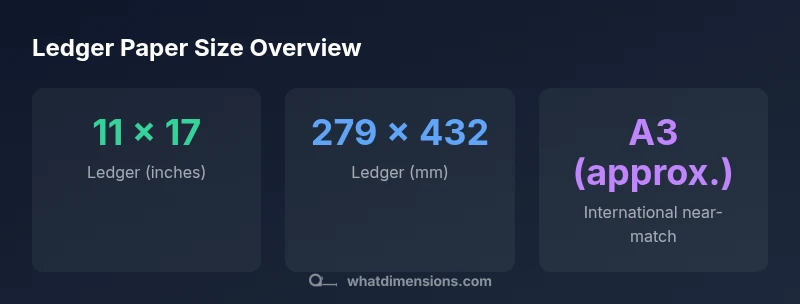
Ledger paper dimensions are 11 × 17 inches (279 × 432 mm), commonly known as ledger or tabloid size. This sheet is the standard for large-format work such as architectural drawings and charts, sitting alongside letter-size paper (8.5 × 11 inches). Understanding ledger dimensions helps with procurement, printer setup, and layout planning.
Ledger Paper Dimensions: Core Size and Naming
Ledger paper dimensions establish the classic large sheet used in many professional settings. The standard ledger size in the United States is 11 inches by 17 inches, commonly called ledger or tabloid depending on the context. In metric terms, that converts to approximately 279 by 432 millimeters. The terminology can be confusing: “ledger” emphasizes the sheet’s historical use for ledgers and accounting, while “tabloid” is often tied to publishing contexts. For procurement and design workflows, always verify product specs and confirm edge orientation (long edge first or short edge first) when ordering or printing. What Dimensions emphasizes consistency in naming to reduce mix-ups in multi-team environments.
Regional Standards and International Equivalents
In the U.S., ledger is often cataloged as ANSI D (11 × 17 inches) and is widely used for drawings, plans, and large spreadsheets. Internationally, the closest mainstream standard is A3, which measures about 11.69 × 16.54 inches (297 × 420 millimeters). Ledger is slightly different in width and height compared to A3, so when you’re coordinating across suppliers or printers, expect minor variances. For cross-border projects, use precise measurements in millimeters to avoid scaling issues in print shops and at design studios. What Dimensions notes that a near-match like A3 can serve as a practical stand-in when exact ledger sizing is unavailable, but planning should accommodate potential border and bleed differences.
Practical Uses and Layout Considerations
Ledger sheets maximize readability for complex diagrams, large charts, and multi-page layouts. They are favored where you need more horizontal space for wide drawings or detailed annotations. When designing content for ledger sheets, consider margins that balance legibility with print feasibility. Landscape orientation can optimize width for wide graphs, while portrait orientation suits tall data panels. Remember that ledger dimensions influence typography choices, line weights, and grid systems; a well-planned layout on 11 × 17 sheets reduces the need to scale content across smaller pages. What Dimensions highlights how consistent sheet sizes simplify collaboration between designers, printers, and clients.
Printing, Copying, and Handling Ledger Sheets
Many office printers and plotters provide a 11 × 17 option in their printer drivers, sometimes labeled as “ledger” or “tabloid.” When printing, choose the correct sheet size and orientation to avoid accidental scaling or cropping. For drafts with margins, allow a small margin (typically a few millimeters or fractions of an inch) to ensure no critical content is trimmed. Feeding ledger sheets can be trickier than standard letter-sized paper, so use straight trays and avoid bending corners during loading. If you’re scanning or copying, verify that the device’s bed or feeder accommodates the sheet without jamming. What Dimensions recommends confirming printer compatibility ahead of large runs to minimize reprints.
Sourcing Ledger Paper: Procurement and Specs
Ledger paper is available in a range of weights and finishes, similar to letter-size stock. When sourcing, check product specifications for weight, brightness, and finish quality to match your use case—drafting, note-taking, or presentation prints. If you’re coordinating with clients or printers overseas, provide exact dimensions in millimeters (279 × 432 mm) to prevent misinterpretation due to regional naming differences. Ordering the right sheet type helps ensure consistent results across multiple projects and reduces waste.
Quick Measuring Guide for Ledger Paper
To verify ledger dimensions on a sheet you already own, measure the sheet along the edges with a ruler or calipers: confirm that one side is 11 inches (279 mm) and the other is 17 inches (432 mm). If you’re converting to metric, round to the nearest millimeter for precision. For new purchases, check the packaging and SKU descriptions to ensure the sheet listed is 11 × 17 inches. A quick sanity check before printing avoids accidental scaling and ensures consistency in large-format documents.
Practical takeaway: Maintain a standard reference for ledger sheets in your workspace. Keep a small ruler or calipers handy to verify dimensions when receiving mixed stock from suppliers, and align your printer settings to match the sheet size for clean, border-safe outputs.
Ledger size details
| Dimension | Ledger (inches) | Ledger (mm) |
|---|---|---|
| Width | 11 | 279 |
| Height | 17 | 432 |
Quick Answers
What is the standard ledger paper size?
The standard ledger size is 11 × 17 inches (279 × 432 mm) in the United States, commonly used for architectural drawings and large-format notes.
Ledger size is 11 by 17 inches, a staple for large drawings and posters.
Are ledger and tabloid the same?
Yes, in most contexts ledger and tabloid refer to the same 11 × 17 inch sheet, though some suppliers may orient differently or use alternative naming.
Ledger and tabloid usually mean the same 11 by 17 sheet.
How do I convert ledger dimensions to millimeters?
Multiply by 25.4: 11 inches equals 279 millimeters, and 17 inches equals 432 millimeters.
To convert, multiply by 25.4; 11 inches is 279 mm and 17 inches is 432 mm.
Can ledger paper be used with home printers?
Yes, many home printers support 11 × 17 inch sheets by selecting the ledger or tabloid size in printer settings. Check margins and media type for best results.
Yes, but check your printer specs and margins for 11 by 17 sheets.
What should I consider when sourcing ledger paper?
Look for accurate dimensions, appropriate weight similar to standard copy paper, and finish suitable for drafting or presentation prints. Verify SKU and packaging labels.
Check the dimensions, weight, and finish when buying ledger paper.
Is A3 a good cross-regional stand-in for ledger?
A3 is not identical to ledger (11 × 17 inches) but is the closest international equivalent. Expect slight differences in width and height.
A3 is close but not exact; expect minor size differences.
“Ledger paper dimensions provide a reliable standard that streamlines collaboration across designers, printers, and clients. Consistency reduces rework and helps teams plan layouts with confidence.”
Main Points
- Know ledger size: 11 × 17 inches (279 × 432 mm).
- Use A3 only as a near-match in cross-border workflows.
- Always set the printer to 11 × 17 in ledger mode.
- Plan layouts with orientation in mind for wide elements.