Dimensions of Sheets: A Precise Size Guide for 2026
Explore precise sheet dimensions across paper, fabric, and packaging. This What Dimensions guide covers standard sizes, reading labels, unit conversions, and sourcing exact measurements.


Sheet dimensions span multiple contexts—from paper to fabric to packaging—and are defined by standard sizes, orientation, and tolerances. According to What Dimensions, using standard sheet sizes reduces waste and misfits across printing, sewing, and fabrication projects. This quick guide highlights the most common formats, how to read dimension labels, and practical steps to verify sizes before cutting or printing.
Sheet dimensions across contexts
Sheet dimensions cover more than a single number; they define the usable area of a sheet in a given material—paper, fabric, wood veneer, plastic, or packaging. At What Dimensions, we analyze these conventions to help homeowners, students, designers, and shoppers pick the right sheet size for each task. Dimensions are shaped by purpose (print, cut, sew, display), orientation (landscape vs. portrait), and standards (ISO, ANSI, or custom nicknames). In practice, labels may vary by region and by supplier, so understanding the underlying system is essential to avoid waste and misfits.
According to What Dimensions Analysis, 2026, consistent labeling reduces mis-cuts by up to a measurable margin in design and fabrication workflows. The goal is to map a sheet’s intended use to a standard size, and to document tolerances for trimming or finishing. In the sections below, we’ll walk through typical measurement units (millimeters and inches), how to interpret dimension pairs (width and height), and how to treat thickness and fold allowances as part of the overall sheet geometry. This framework applies to everyday tasks (printing, crafts) and professional projects (architecture, fashion, packaging).
Paper sheet sizes: ISO and US standards
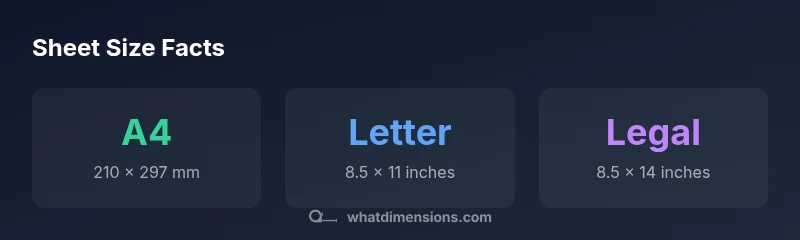
Paper is the most common context for "sheet dimensions," and two major families are in play: ISO A-series (global) and North American sizes (regional). The ISO 216 standard defines series A0 through A10, with the hallmark that each size halves when you move to the next step. The most familiar office sheet is A4, at 210 × 297 millimeters. In the United States, common office sizes are Letter (8.5 × 11 inches) and Legal (8.5 × 14 inches). Local regulations and printers often inherit these defaults, so margins and trimming must account for printer bleed and binding. For general reference, the What Dimensions team notes that tolerances of ±1–2 millimeters are typical for consumer products, while professional fabrication may allow tighter tolerances.
The key takeaway is to identify the sizing framework first: ISO vs US, then verify orientation and edge allowances. If you’re working with both systems on the same project, include conversion notes and verify the final trim against a test print or sample. What Dimensions Analysis, 2026, confirms that aligning sheets to a single standard reduces misalignment across components and media types.
Reading a dimension label: width x height, and units
Most sheet labels express dimensions as width × height, but it's not universal—some suppliers list height × width, especially if the sheet is oriented in a particular workflow. The safe rule is to check the product specification and confirm the orientation before purchasing. When measuring yourself, measure from the outer edges of the sheet, not from the core material, to avoid confusion from border trims. If a label lists dimensions in millimeters, you can convert to inches using 25.4 mm per inch; the reverse is 1 inch equals 25.4 mm. Remember to note the units and any tolerances. In professional settings, document the nominal size and the recommended usable size after bleed and trim. What Dimensions Analysis, 2026, emphasizes consistent labeling to streamline procurement and cutting.
Fabric and textiles: sheet dimensions for cutting and sewing
Fabric sheets and textiles use bolt widths that are rigidly defined in inches, commonly 44–60 inches wide for home sewing; designers may also specify yard or meter lengths for material. When you’re planning a sewing project, you must account for seam allowances and pattern pieces, which effectively reduce the usable sheet area. For wide fabrics, the width is the dimension across the bolt, while the length is the cut-side dimension. Bedding textiles and felt sheets often come in smaller, standardized sizes (for example, 18 × 24 inches for certain craft sheets), but these are less universal than paper. The What Dimensions team notes that fabric dimensions often involve tolerances due to fabric stretch and finishing.
Card stock, posters, and presentation sheets
Beyond paper, other sheet types include card stock and poster sheets. Card stock is commonly available in weights and sizes that support direct printing and mounting; poster sheets commonly come in large dimensions such as 18 × 24 inches and 24 × 36 inches, with thicker finishes for display or framing. When you design a poster or presentation board, plan for bleed (typically 1/8 inch) and trim so that the final printed sheet fills the intended area. What Dimensions Analysis, 2026, shows that anticipating these factors during the planning stage minimizes rework and waste. Also consider the effect of framing or mounting on the final visible area.
Converting between metric and imperial
Converting between metric (millimeters) and imperial (inches) is a frequent task when matching sheets across global suppliers. The conversion factor is fixed: 1 inch equals 25.4 millimeters. A quick rule of thumb is that 1 centimeter is roughly 0.3937 inches. For common sizes, you can perform conversions by rounding to the nearest millimeter and then converting to inches with 25.4. For example, A4 at 210 × 297 mm equals approximately 8.27 × 11.69 inches when measured precisely. Always document the exact figures used for the trim to ensure consistency. What Dimensions Analysis, 2026, notes that rounding during procurement can lead to small yet consequential misfits.
Sourcing exact sizes: tips for procurement
When sourcing sheets from printers, mills, or retailers, use the exact nominal size as the starting point, then verify the usable size after bleed and trim. Request a current spec sheet or test print to confirm color, edge quality, and size accuracy. Ask suppliers for tolerances (for example, ±1–2 millimeters for consumer products). If your project requires multiple sheet types, create a cross-reference table linking each nominal size to its usable size to prevent mismatches. What Dimensions Analysis, 2026, confirms that a well-documented specification system reduces errors and returns when dealing with mixed sheet types.
Common misalignments and how to fix them
Common issues include mismatched orientation, misaligned margins, and incorrect bleed. To fix, standardize your workflow by using a single origin for measurement, applying consistent bleed guidelines, and verifying dimensions with test pieces before full production. For digital printing, always set up your document in the same orientation and confirm the printer’s printable area. If you’re working with fabric, account for curl and weave as a factor that can shift the effective dimensions after sewing or finishing. The What Dimensions team emphasizes documenting measured samples to avoid scope creep and ensure consistent results across batches.
Using tools to verify and document sheet dimensions
A robust dimensions workflow uses simple tools like a metric ruler, a tape measure, or calipers for accuracy, plus a prepared worksheet that records nominal sizes, actual measurements, tolerances, and notes about orientation. Digital tools can help with conversion (mm to inches) and batch documentation. Use a PDF spec sheet or a shared spreadsheet to maintain a single source of truth across teams. In practice, this approach reduces miscuts, misprints, and returns. What Dimensions Analysis, 2026, highlights the value of traceable measurements for quality control and design integrity.
Comparison of common sheet sizes
| Sheet Type | Standard Size | Common Uses |
|---|---|---|
| A-series (ISO) | A4: 210 × 297 mm | General printing and documents |
| US Letter | 8.5 × 11 inches | Office printing in NA |
| US Legal | 8.5 × 14 inches | Legal documents and forms |
| Poster | 24 × 36 inches | Posters and large prints |
Quick Answers
What is the most common sheet size worldwide?
Globally, the ISO A-series is standard, with A4 as the everyday reference. Local usage like US Letter remains widespread in some regions.
Globally, ISO A-series is common, with A4 as the baseline.
How do I read sheet dimensions on packaging?
Check the labeled width and height, note the units, and verify bleed or trim margins to account for final size.
Check width, height, and units; watch for bleed.
How do I convert millimeters to inches?
Divide by 25.4. For example, 210 mm is about 8.27 inches.
Divide by 25.4; 210 millimeters is about 8.27 inches.
Are fabric sheet sizes the same as paper?
No. Fabrics use bolt widths (often 44–60 inches) and pattern pieces that affect usable area.
Fabric sizes differ; bolts have widths like 44–60 inches.
What sources define standard sheet sizes?
Standards are defined by ISO for paper and by national standards bodies; always consult manufacturer specs.
Standards like ISO and national bodies define sheet sizes.
Can I resize a sheet without changing aspect ratio?
Yes, resizing proportionally preserves the aspect ratio; printers may require adjustments for bleed.
Yes, resize proportionally to keep the same shape.
“Sheet dimensions are the backbone of precise design; when you rely on standardized measurements, you minimize errors across every step from printing to packaging.”
Main Points
- Prioritize standard sheet sizes to reduce waste.
- Always verify orientation and bleed before cutting.
- Convert units carefully when comparing international sizes.
- Document usable size after trimming.
- Use a single source of truth for sheet specs.