Truck Tires Dimensions Guide: Size, Fit, and Safety
A data-driven guide to understanding truck tires dimensions, reading sizing codes, and selecting the right tires for performance and safety.


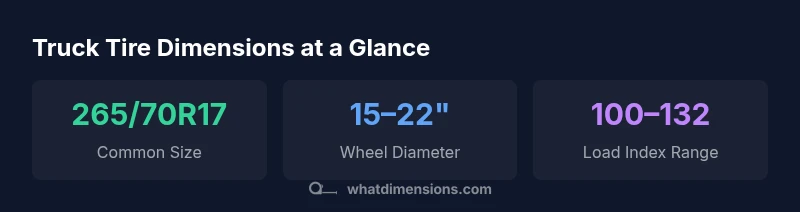
Truck tires dimensions determine fit, safety, and performance. According to What Dimensions, most truck tires follow a width/aspect ratio/diameter designator (e.g., 265/70R17) with a load index and speed rating that must match the vehicle spec. In practice, always verify the manufacturer’s recommended dimensions in your owner’s manual or door placard before buying.
Understanding the truck tires dimensions system
When we talk about the truck tires dimensions, we refer to a standardized sizing system that communicates width, profile (aspect ratio), and wheel diameter. This trio appears on the sidewall and determines how the tire fits your rims, how much clearance exists around suspension components, and how the tire interacts with the road. The What Dimensions team emphasizes that other critical factors include the tire’s load index and speed rating, which ensure the tire can carry weight and perform safely at highway speeds. By starting with the manufacturer’s recommended dimensions, you protect ride quality, braking performance, and overall vehicle balance. In practice, knowing the dimensions helps you compare options accurately and avoid choosing a tire that fits on paper but rubs on the fender or interferes with ABS sensors.
Reading sizing codes: width, aspect ratio, diameter
Tire sizing codes are designed to convey three core measurements in a compact format. The first number (width) is the tire’s cross-section width in millimeters. The second number (aspect ratio) represents the sidewall height as a percentage of the width. The final number is the wheel diameter in inches that the tire is designed to fit. For example, in 265/70R17:
- 265 = width in millimeters
- 70 = aspect ratio (sidewall height is 70% of 265)
- R = radial construction
- 17 = wheel diameter in inches
Understanding these codes helps you quickly assess fit on different truck models and trim levels. The “LT” designation (light truck) can appear in the size string to indicate a tire designed for heavier loads. Always cross-check with your vehicle’s load index requirements and the door placard for exact guidance.
Common formats used on pickups vs full-size trucks
Smaller pickups often run on sizes in the mid-200s to low-300s millimeters width with wheel diameters ranging from 15 to 17 inches. Full-size trucks commonly use wider tires and larger rims, often moving into 17–22 inch wheel diameters and widths in the 270–315 mm range. Light trucks may show LT prefixes indicating enhanced load-carrying capacities. In performance or off-road applications, you’ll frequently encounter skus that emphasize wider tread and taller sidewalls, but the sizing logic remains the same: width, aspect ratio, and wheel diameter, with load and speed ratings chosen to match the vehicle’s performance goals.
Why dimensions matter for load, safety, and performance
Dimensional accuracy affects several critical areas. Incorrect tire dimensions can distort speedometer readings, alter gearing effects, and reduce braking responsiveness. A tire that is too tall can cause suspension rubbing, while a tire too narrow may impact traction in wet or snowy conditions. Load index and speed rating set the ceiling for how much weight the tire can safely carry and how fast it can operate. The What Dimensions analysis notes that even small deviations from OEM specs can noticeably impact ride quality, steering feel, and overall safety, especially on heavy-duty trucks where weight distribution and towing loads are more variable.
How to choose the right size for your vehicle
Start with the vehicle manufacturer’s specifications printed on the driver-side door placard and in the owner’s manual. If you are considering aftermarket sizes, verify clearance in wheel wells, fenders, shocks, and braking components. Consider the impact on speedometer accuracy, gearing (which can slightly alter engine RPM and fuel economy), and the potential need for recalibration of traction control systems. When comparing tires, use the dimension trio (width, aspect, diameter) alongside load index and speed rating to ensure compatibility with the vehicle’s weight class and intended use, whether hauling heavy loads or navigating off-road terrain.
Practical steps to verify dimensions before buying
To avoid fitment issues, follow these steps:
- Check the door placard for the OEM size and ensure the new size falls within the acceptable range.
- Compare width, aspect ratio, and diameter side-by-side against OEM figures.
- Measure room clearance with the vehicle fully loaded and turned to full steering lock to avoid rubbing at full suspension travel.
- Confirm load index and speed rating meet or exceed OEM requirements.
- If changing width or diameter, consider the impact on the speedometer, ABS, and traction control systems, and plan for possible recalibration or alignment checks.
Reading the door placard and manufacturer specs
The door placard, typically located on the driver’s door jamb or inside the glove box, provides the exact tire size originally installed on your vehicle. This is your baseline specification. When shopping, use this reference to avoid guesswork. Online tire retailers often show variations, but your vehicle’s safety systems and warranty can hinge on matching the listed dimensions. If you are shopping for a different load class or off-road setup, ensure the chosen size remains within the acceptable window outlined by the manufacturer and your vehicle’s chassis design constraints.
What Dimensions' practical recommendations for truck tires dimensions
Based on our synthesis of automotive sizing conventions and safety considerations, the simplest path to reliable tire choices is to start with OEM specs, then explore sizes that stay within the same width/diameter envelope and meet the same load index and speed rating. For trucks that frequently tow or haul heavy loads, prioritize load capacity and properly matched overall diameter to preserve gearing and braking performance. Regularly inspect sidewalls for wear and re-check pressures to maintain consistent handling characteristics across seasons.
Common mistakes to avoid when selecting tires
- Ignoring OEM specifications in favor of aesthetics or price alone.
- Installing tires with a diameter that creates clearance issues on full lock turns.
- Overestimating speed capability without verifying the corresponding load rating.
- Mixing tire sizes across axles when not specified, which can affect traction, braking, and ABS behavior.
- Skipping professional alignment and balancing after installation, which can degrade handling and tire wear.
Representative truck tire dimensions and ranges
| Aspect | Typical range | Notes |
|---|---|---|
| Tire width | 205–315 mm | Depends on truck class and load needs |
| Aspect ratio | 60–85 | Lower numbers imply lower sidewall height |
| Wheel diameter | 15–22 inches | Larger wheels are common in full-size trucks |
| Load index | 100–132 | Represents weight capacity |
| Tread depth (new) | 10/32–12/32 inch | Higher depth = longer wear and traction |
Quick Answers
What does a tire size like 265/70R17 mean?
The number 265 is the width in millimeters. 70 is the aspect ratio (sidewall height as a percentage of width). R denotes radial construction, and 17 is the wheel diameter in inches. This code helps determine fitment and performance.
The size 265/70R17 means a tire 265 millimeters wide, with a sidewall height of 70% of that width, built radially, and fitting a 17-inch wheel.
Can I use a different size than the OEM?
You can, but proceed with caution. A non-OEM size can affect speedometer accuracy, loading, braking, and clearance. Always verify against the owner’s manual and consult a tire professional if in doubt.
Yes, but always check clearance, load rating, and speed rating with a professional.
How does changing tire size affect speedometer readings?
Wider or taller tires change the actual tire circumference, causing the speedometer to read differently than your true speed. This is more noticeable with larger diameter tires and can impact odometer accuracy and instrument cluster readings.
A different size can throw off your speedometer and odometer; bigger tires usually read slower than you’re actually traveling.
What is load index and why does it matter?
The load index indicates the maximum weight the tire can support. Using a tire with an insufficient load index can compromise safety, especially when towing or carrying heavy payloads. Always match or exceed the OEM load index.
Load index tells you how much weight the tire can carry—stick to or exceed the OEM rating.
Do all trucks use the same tire dimensions across trims?
Not always. Trim levels, drivetrain, and aftermarket configurations can affect recommended dimensions. Always verify the exact spec for your trim and any intended changes.
Check your trim’s exact spec before changing tires, as some variations exist.
How should I verify dimensions when shopping aftermarket tires?
Start with OEM numbers, compare width/sidewall/diameter, confirm load index and speed rating, and ensure clearance. Use official placards and manufacturer guidance as your baseline.
Use the OEM numbers as your baseline and double-check clearance and ratings.
“Accurate tire dimensions are foundational to a truck’s safety, performance, and reliability. Getting the sizing right minimizes brake bias changes, accelerates wear evenly, and keeps the vehicle’s handling predictable.”
Main Points
- Read the full size code: width, aspect, diameter
- Always match load index and speed rating to OEM specs
- Check clearances before changing wheel diameter
- Use OEM placard as your primary reference
- Consider towing and payload impacts on dimension choices