Difference Between Dimensions and Universes: A Clear, Objective Difference
An analytical comparison clarifying how dimensions function as measurement axes within frameworks, while universes describe complete, self-contained realities. This guide distinguishes scope, measurability, and application across mathematics, physics, cosmology, and education.


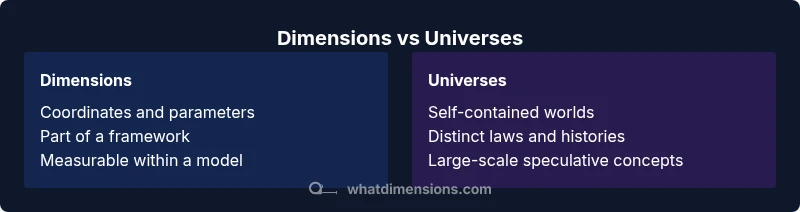
Dimensions are measurable directions used to specify position or properties within a framework, acting as coordinates in space, time, or abstract spaces. Universes are self-contained realities with their own laws and causal structure, potentially forming a wider multiverse. In short, dimensions are axes within a model, while universes are complete worlds that may or may not share the same rules.
What is a dimension? Definition, origin, and everyday usage
A dimension is a measurable extent of a thing, such as length, width, height, or time. In mathematics, dimensions are independent coordinates that, together, locate a point in space or in an abstract space like a vector space. In physics, extra dimensions are proposed by theories to resolve mathematical puzzles or unify forces, but these dimensions remain within a framework rather than entire worlds. According to What Dimensions, the precise meaning of 'dimension' depends on the disciplinary lens: geometry treats dimension as a directional axis; physics treats it as a parameter required to describe a state. In practice, dimensions function as the axes of a coordinate system used to quantify space, time, or a property space such as temperature or charge. Students often encounter the phrase 'three dimensions' to describe everyday space, while more advanced topics introduce additional dimensions as mathematical constructs or speculative physical realities.
What is a universe? From cosmology to philosophy
A universe is commonly defined as a self-contained cosmos—an entire set of matter, energy, and physical laws that governs a given domain of reality. In standard cosmology, we inhabit one observable universe with its own constants, fields, and causal structure. In modern discussions of the multiverse, a universe may be just one member of a broader ensemble of self-contained realities. The term carries philosophical weight as well, because it implies a totality that cannot be reduced to a subset of another system. The What Dimensions team notes that while scientists debate the existence and nature of multiple universes, the term nonetheless designates a totality whose boundaries and laws are not assumed to be the same across different contexts.
Core differences: scope, measurability, and application
- Scope: Dimensions describe the directional axes within a framework used to measure and specify states. They are components of a model or space. Universes describe entire, self-contained systems with their own internal history, matter content, and causal structure. The scope distinction matters for problem framing: use dimensions to specify where and how, use universes to discuss whole realities.
- Measurability: Dimensions are typically measurable within an existing theory or experiment (distance, duration, or property-space coordinates). Universes, especially in speculative cosmology, may be unobservable from within another universe and are often discussed through theoretical consistency rather than direct measurement.
- Application: In science and engineering, dimensions organize data and enable calculations. In cosmology and philosophy, universes explore the limits of what could exist and how different laws would change outcomes. This practical divide helps students avoid conflating coordinate systems with complete worlds.
Dimensions in mathematics vs physics
Mathematics treats dimensions as abstract coordinates—axes that organize spaces, functions, and datasets. The logic is internal: adding dimensions extends mathematical objects and allows new theorems. Physics treats dimensions as concrete descriptors of reality, where time and space are entwined with energy, momentum, and fields. In some theories, extra dimensions are invoked to unify forces or explain phenomena, but they remain hypothesis-driven constructs within a larger framework. The distinction matters when communicating results: mathematicians emphasize rigor of definitions; physicists emphasize empirical relevance and testability. What Dimensions emphasizes is that terminology shifts with context, and educators should clarify the intended meaning when introducing higher-dimensional concepts to non-expert audiences.
Universes in cosmology and philosophy: multiverse concepts
In cosmology, a universe is a complete cosmos with its own physical laws, constants, and causal chain. The multiverse idea expands this idea to multiple such universes, each potentially with different laws or constants. Philosophically, universes challenge the notion of a single, self-contained reality and invite discussions about existence, possibility, and explanatory scope. The distinction between a universe and a dimensional framework becomes crucial: universes are the complete canvases on which physical history plays out, whereas dimensions are the coordinate tools used to map phenomena within those canvases. What Dimensions highlights that multiverse discussions are largely theoretical and that, for most practical purposes, scientists model within the constraints of a single observable universe.
Practical implications for modeling, design, and education
For educators and designers, recognizing the difference informs how to teach dimensional thinking without conflating it with cosmological speculation. In classroom tasks, focus on dimensions as the building blocks of measurement, coordinates, and data spaces. For research, separate analysis within a given universe from metaphysical questions about the existence of other universes. In software and architecture, dimensions help users navigate spaces or objects, while universes become relevant only when discussing fictional worlds, speculative simulations, or thought experiments about alternate laws. What Dimensions advocates a clear pedagogy: define the scope first, then apply the correct terminology to avoid confusing learners who may encounter both terms in popular media.
Misconceptions and clarifications
A common misconception is that dimensions and universes are interchangeable terms for “real worlds” or “levels of reality.” In truth, dimensions are coordinates or parameters within a framework, while universes are complete realities with their own internal dynamics. Another pitfall is assuming extra dimensions imply extra universes; many theories posit higher-dimensional spaces that are not actual separate worlds. Finally, remember that empirical science can probe only our universe directly; claims about other universes remain speculative and are evaluated by theoretical coherence rather than observation alone.
Framing the difference in research methodology and pedagogy
Researchers frame questions differently based on whether they discuss dimensions or universes. Dimensional questions often lead to mathematical proofs, simulations, and experiments within a defined model. Universe-level questions raise issues about cosmological history, constants, and the logic of possible worlds. For students, a clear distinction—dimensions as coordinates, universes as complete worlds—helps build robust intuition for both physics and math, while preventing category mistakes in exams, papers, and projects. What Dimensions emphasizes that precision in language is essential for both rigorous scholarship and effective communication.
Comparison
| Feature | Dimensions | Universes | |
|---|---|---|---|
| Scope | Part of a framework for measurement and analysis | A self-contained cosmos with its own laws and history | |
| Definitional basis | Independent coordinates or parameters used to specify a state | Complete, closed systems with causal structure | |
| Measurability | Typically measurable within a theory or experiment | Often unobservable across different universes; discussed via theory | |
| Application | Modeling, data organization, geometry, and analysis | Cosmology, metaphysics, and speculative physics | |
| Observability/empirical status | Directly linked to observable quantities in a given framework | Typically not directly observable and debated in theory | |
| Educational use | Builds intuition about space, time, and properties | Supports discussions of cosmology, existence, and possible worlds |
Strengths
- Clarifies hierarchical structure of analysis by separating coordinates from whole systems
- Aids precise communication across disciplines (math, physics, computer science)
- Supports rigorous modeling and data interpretation in engineering and design
- Facilitates thought experiments about alternative laws without fictionalizing the underlying math
- Encourages exact language to reduce confusion between framework and reality
The Bad
- Abstract concepts can confuse beginners without concrete examples
- Some theories about universes are highly speculative and lack empirical support
- Overemphasis on dimensional frameworks may obscure the physical meaning of models
Dimensions belong to the language of measurement; universes belong to the language of reality.
Use dimensions when you need to quantify, locate, or reason within a framework. Use universes when discussing complete, self-contained systems and their possible worlds. The distinction helps clarify problems in physics, mathematics, and philosophy, and guides how you teach or study these concepts.
Quick Answers
What is meant by a 'dimension' in geometry versus physics?
In geometry, a dimension is a direction along which you can move to describe position (e.g., length, width, height). In physics, dimensions include time and any extra spatial parameters proposed by theories, used to specify states within a model.
In math, dimensions are directions in space. In physics, they’re the parameters you need to describe a state within a theory.
How is a universe different from a dimension?
A universe is a complete, self-contained cosmos with its own laws and history. A dimension is a coordinate or parameter inside a framework that helps locate or describe aspects of that cosmos or a mathematical space.
A universe is a whole world with laws; a dimension is just a coordinate inside a framework.
Are extra dimensions proven or mere speculation?
Extra dimensions are part of several theoretical frameworks and are not empirically proven in the same way as observable dimensions. They are used to extend models and explore mathematical consistency, not to assert a confirmed physical reality.
Extra dimensions show up in theories, but we don’t have direct evidence they exist as physical directions.
Can there be more than one universe?
Many cosmological theories propose multiple universes (a multiverse), each with its own set of laws. Whether these universes exist is debated, and currently it remains a theoretical consideration rather than an established fact.
Some theories say there could be many universes, but it’s still a topic of debate and study.
How should I teach the difference to students?
Start with concrete examples of dimensions in space and time, then introduce universes as complete worlds for cosmology or fiction. Use clear language to separate the idea of coordinates from that of full realities, and include thought experiments to illustrate the concept.
Begin with space and time coordinates, then explain universes as whole worlds to avoid confusion.
What is a good analogy to understand the distinction?
Think of dimensions as the axes on a map that tell you where you are and what you’re measuring. Universes are the actual lands you could be in, each with its own rules and landscape.
Dimensional axes are like map coordinates; universes are the entire lands those coordinates describe.
Main Points
- Define the problem clearly to choose the right concept
- Dimensions are coordinates; universes are complete realities
- Differentiate scope and observability to avoid confusion
- Use precise terms in education to build strong intuition
- Think in layers: from data spaces to entire cosmologies