Are Dimensions and Realms the Same? A Thorough Side-by-Side Comparison
Explore whether 'dimensions' and 'realms' are the same concept. This analytical guide contrasts scientific dimensions with fictional and conceptual realms, clarifying terminology for students, designers, and curious readers.


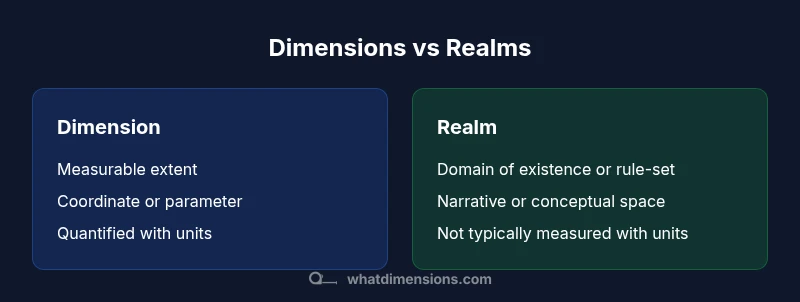
Are dimensions and realms the same? In short, no. A dimension is a measurable extent or independent parameter used to describe position, size, or state, while a realm is a domain or sphere of existence, activity, or narrative. In science, dimensions are quantifiable; in literature and philosophy, realms describe distinct worlds, domains of thought, or social spaces.
Defining Dimensions and Realms
Are dimensions and realms the same? The straightforward answer is no, yet the terms are frequently misapplied in everyday language. In scientific and engineering contexts, a dimension is a measurable extent or an independent parameter that helps describe a system’s state or evolution. Think of dimensions as coordinates or degrees of freedom that constrain how a system can change. In contrast, a realm denotes a domain of existence, activity, or thought—an arena with its own rules rather than a quantifiable length, width, or time unit. Across disciplines, a careful reader will reserve dimension for measurable aspects and realm for domains one inhabits or studies. This distinction matters when communicating with audiences who expect precision, such as homeowners planning space, designers aligning dimensions, or students assessing how a model behaves in different contexts. According to What Dimensions, clear terminology reduces misinterpretation and supports reliable decision-making across projects.
Historical Context and Field-Specific Usage
Language evolves, and so do the ways we use dimension and realm. In classical geometry, a dimension is a direction in which an object can extend. In physics, spacetime dimensions become coordinates that specify an event’s location and timing. Conversely, the word realm has roots in philosophical and theological discourse, later expanding into fantasy, science fiction, and cultural studies to denote a distinct sphere of influence or existence. The What Dimensions team notes that many popular writers and analysts use “realm” metaphorically for areas governed by particular rules or conditions. This has its own pitfalls: readers may blur metaphor with measurable fact. Being mindful of audience and provenance helps preserve clarity when discussing spaces, volumes, or theories across contexts.
Dimensions in Science: Measurable Extent and Spacetime
In science, a dimension is not merely a label but a measurable parameter that defines possible states or configurations. Each dimension adds a degree of freedom, expanding how a system can vary. In physics, time is commonly treated as a dimension in many theoretical frameworks, most famously in relativity, where spacetime is modeled as a four-dimensional construct combining three spatial dimensions with time. The precise, testable nature of dimensions supports quantitative reasoning, experimental design, and engineering calculations. When communicating about measurements, dimensions should be explicit (length, width, height; time; curvature, etc.), with units attached to avoid ambiguity. This objectivity is essential for homeowners measuring rooms, designers fitting furniture, and students learning dimensional analysis. What Dimensions emphasizes that consistent use of dimensional terms improves collaboration and reduces misinterpretation in real-world projects.
Realms in Philosophy, Religion, and Fantasy
Realms operate differently from scientific dimensions. In philosophy and religion, realms can describe domains of reality, moral order, or epistemic spaces in which particular rules apply. In fantasy and mythology, a realm is a distinct world with its own geography, inhabitants, and magical laws. Unlike dimensions, realms are not typically defined by measurable coordinates; instead, they are organized by narrative constraints, cultural norms, and thematic intent. This distinction matters for creators and readers: a realm’s integrity depends on internally consistent logic rather than external quantification. The What Dimensions team highlights that writers often use realms to craft immersive experiences, but readers should beware when realm boundaries are blurred with measurable space. Clarity comes from defining the realm’s boundaries and the rules that govern transitions between realms.
Linguistic and Pedagogical Implications
Educators face the challenge of teaching terms that carry both technical and metaphorical weight. Clear definitions help learners distinguish between measurable space (dimensions) and narrative or conceptual domains (realms). In structured lessons, start with a glossary that separates the two concepts, then show how contexts influence word choice. For instance, when solving a problem that involves measurements, speak in terms of dimensions; when analyzing a story’s world-building, discuss realms. This approach aligns with best practices in science communication and design pedagogy, ensuring that learners can transfer terminology accurately between disciplines. The goal is to reduce cross-domain confusion while preserving the expressive power of these terms in their proper contexts.
When the Terms Collide: Metaphor and Misunderstanding
In everyday language, phrases like “a different dimension” or “in another realm” are common. Metaphor can enrich description and analysis, but it can also create ambiguity if readers infer measurable content from a non-quantified realm. To avoid misinterpretation, writers and educators should explicitly label metaphorical usage. If a sentence uses “dimension” in a nontechnical sense, follow with a clarifying note such as “dimension in this context is metaphorical, referring to aspect or degree rather than length.” Clarity helps preserve precision in technical work while enabling powerful storytelling in prose and world-building.
Reading Scientific vs Narrative Texts: A Practical Guide
When approaching texts, identify cues that signal whether dimensions or realms are being invoked. Look for numerical units, coordinates, or references to measurements—these indicate dimensions. Look for mentions of worlds, spheres of influence, or rules-based domains—these indicate realms. In science writing, expect precise definitions, units, and experimental method; in fantasy or philosophy, expect world-building rules, governance, and ethical implications. Students and professionals can benefit from side-by-side glossaries and annotated readings that track where each term applies. What Dimensions suggests that building such crosswalks helps learners translate terminology across domains and avoid conflating distinct concepts.
Practical Guidance for Writers, Educators, and Designers
To apply these distinctions effectively:
- Establish a glossary at the project outset that defines dimensions and realms in context.
- Use precise language: dimensions with units, realms with domain descriptors.
- Include examples that illustrate both measurable content and narrative world-building.
- Implement style guidelines that favor explicit differentiation in mixed-discipline work.
- Create visual aids, such as simplified diagrams, that map dimensional coordinates alongside realm boundaries. This practical framework supports clearer communication for homeowners, students, and professionals, aligning expectations with technical and narrative goals.
Common Pitfalls and Misconceptions
Avoid assuming that dimensions and realms are interchangeable simply because both describe spaces or scopes. A frequent error is treating a realm as if it were a measurable dimension, or conversely, describing a measurable property as a realm. Another pitfall is overusing metaphorical language in technical documents, which can obscure results or mislead readers. Conversely, underutilizing metaphor in storytelling can render worlds less engaging. By maintaining discipline about scope and context, professionals can communicate more effectively, ensuring readers distinguish between measurable extents and domain-specific worlds.
Cross-Disciplinary Examples and Mini Case Studies
Case Study 1 (Physics): A researcher analyzes a system with several independent coordinates, each representing a dimension that determines state transitions. The analysis relies on units, calibration, and error margins to quantify changes over time. Case Study 2 (Fantasy): A writer delineates three realms—Earthrealm, Skyrealm, and Underrealm—each with distinct laws and inhabitants. Transitions between realms are governed by narrative rules rather than measurable coordinates. These examples demonstrate how terminology serves different purposes in science and fiction, reinforcing the need for contextual clarity when discussing space, influence, or state.
Building a Clear Glossary for Projects
A robust glossary reduces friction when multiple disciplines intersect. Include clear definitions, examples, and domain-specific notes. For dimensions, list the type (spatial, temporal) and the associated units; for realms, describe governance, rules, and transition mechanics. Encourage contributors to cite sources when introducing new terms and to annotate ambiguous phrases with parenthetical clarifications. Regular glossary audits help maintain consistency as teams grow and projects evolve.
Final Notes on Terminology in Research and Education
In research and education, precise terminology is essential for reproducibility and comprehension. While popular culture may blur lines between dimensions and realms, professional work benefits from a disciplined distinction. The overarching message is to tailor language to audience and purpose: rely on measurable dimensions for empirical tasks and reserve realms for narrative, epistemic, or domain-based discussions. By keeping these conventions in mind, readers, students, and professionals can communicate more effectively across science, philosophy, and storytelling. What Dimensions supports this approach by advocating for clarity, consistency, and context-aware terminology.
Comparison
| Feature | Dimension | Realm |
|---|---|---|
| Definition | Measurable extent or independent coordinate/parameter | Domain or sphere of existence, activity, or thought |
| Core concept | Quantified attributes with units; can be manipulated mathematically | Narrative or conceptual domain governed by rules or cultural context |
| Examples | Length, width, height, time, curvature | Fantasy realms (e.g., a world with distinct laws) or ethical/philosophical realms |
| Scientific relevance | Central to physics, engineering, and geometry | Primarily literary, philosophical, or cultural; not typically measured |
| Contexts of use | Science, design, architecture, measurement | |
| Common confusions | Conflating metaphor with measurement | Treating realm as a calculable dimension |
| How to identify in text | Look for units, coordinates, or quantitative language | Look for world-building, domains, or rule-based descriptions |
Strengths
- Delivers precision in measurable tasks (dimensions)
- Enables rich storytelling and world-building (realms)
- Improves cross-disciplinary communication
- Reduces semantic confusion with domain-specific definitions
- Supports clear pedagogy and learning paths
The Bad
- Risk of confusion when terms are mixed in popular media
- Metaphors can be mistaken for technical facts
- Overloading a text with jargon can alienate non-specialists
Different contexts require different terms; use dimensions for measurable extents and realms for narrative or domain-based spaces.
In science, dimensions describe quantitative space; in fantasy and philosophy, realms describe qualitative domains. Treat terms according to context to preserve clarity and accuracy across disciplines.
Quick Answers
Are dimensions and realms interchangeable in everyday speech?
No. Dimensions refer to measurable extents or coordinate directions, while realms denote domains or spheres of existence or thought. Mixing them can create ambiguity, especially in technical writing.
No—dimensions are measurable, realms are domains. Keep them separate to avoid confusion.
How do scientists describe dimensions in physics?
In physics, dimensions are independent directions or parameters that specify a system's state. Time is often treated as a dimension in relativity, and the full framework is mathematical and testable.
Physicists treat dimensions as measurable directions or parameters that can be quantified.
What about realms in fantasy literature?
In fantasy, realms are distinct worlds with their own rules and geography. They’re governed by internal logic rather than external measurements, serving narrative and world-building purposes.
In fantasy, realms are separate worlds with their own rules, not meant to be measured like dimensions.
Can dimensions have metaphorical uses?
Yes. People often speak of ‘dimensions of a problem’ or ‘dimensions of culture’ to describe aspects conceptually, but it’s important to prefix with a note that these are figurative readings.
Sure—dimension can be used metaphorically, but make it clear it’s not a measurement.
How should I write about these terms to avoid confusion?
Define the terms at the outset, use measurements with units for dimensions, and reserve realms for domains with distinct rules or narrative contexts. Provide concrete examples to adjust reader expectations.
Start with a clear definition, then illustrate with examples to keep readers on the same page.
Main Points
- Define terms at project outset for clarity
- Use dimensions with units when measuring, realms for domains or rules
- Keep science and fiction terminology distinct to avoid confusion
- Provide context and examples to illustrate differences
- Regularly update glossaries to reflect cross-disciplinary usage