Table with Dimensions: A Practical Size Guide for Spaces
Learn how a table with dimensions guides space planning, shopping, and layout decisions. This What Dimensions guide covers height, length, width, leg clearance, and room flow to ensure your table fits perfectly in any space.


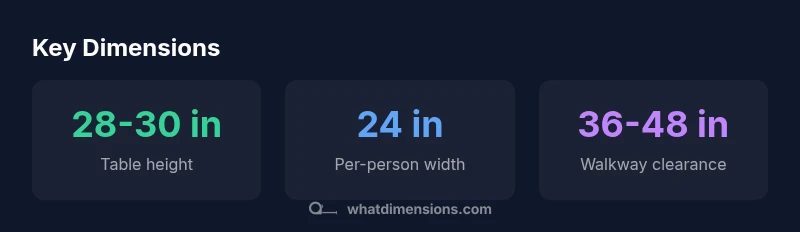
According to What Dimensions, a table with dimensions is a furniture specification listing exact measurements for length, width, height, and often leg clearance. This precision helps homeowners plan spaces, compare products, and avoid buying pieces that don’t fit. For dining setups, standard heights run about 28-30 inches, with roughly 24-30 inches of knee clearance per person. Always measure your space before buying.
What a table with dimensions really means
Dimensions are not just numbers; they are the architecture of a room. A table described by its length, width, height, and sometimes leg clearance helps you translate space into usable layouts. The phrase 'table with dimensions' implies a listing you can trust for fit, scale, and harmony with seating. For homeowners, designers, and students, precise dimensions save time and prevent mismatches when purchasing furniture online or in-store. In practice, these measurements guide everything from the initial room plan to the final assembly. What Dimensions's approach emphasizes the practical interplay between form and function, ensuring products align with real-world spaces and human ergonomics. When you start with dimension data, you can estimate how many guests you can accommodate, how much space to leave for circulation, and whether the table will work with adjacent storage or seating. A well-dimensioned table is the backbone of a comfortable, usable room.
Measuring accurately: essential steps
Accurate measurements start with a tape measure, a level surface, and a clear plan of the room. Begin by measuring the longest wall where the table will stand, then map the space for chairs to ensure their clearance does not collide with doors, cabinets, or windows. Record length, width, and height, then add leg clearance under the apron to ensure comfortable knee space. For a graphical sense of scale, sketch an overhead map of the room and mark where chairs and people will sit. This helps you validate the proposed dimensions against real-world use. A table with dimensions should translate directly to a printable plan: you’ll know exactly how much space the table consumes and how much remains for traffic flow.
Standard size ranges for common table types
While plenty of designs exist, certain dimension ranges recur across table types. Dining tables typically sit at a height of 28-30 inches to align with standard chair heights. Coffee tables are shorter, usually around 16-18 inches, to match sofa seating. Console tables often run 28-32 inches high, designed for entryways and hallways. Desks tend to be 28-30 inches tall, balancing writing comfort with monitor placement. When thinking about a table with dimensions, keep these ranges in mind as a baseline, then tailor them to your space and ergonomic needs. Material thickness, leg style, and leg clearance will adjust the perceived size without changing core dimensions.
Spacing and circulation: planning for chairs and movement
A key element of sizing is ensuring there’s enough room to move around the table. Plan for at least 36-48 inches of walkway clearance around each side of a standard dining table to accommodate chairs in use and room to walk by. If you’re in a tight room, consider a narrower table or an oval/round shape to improve flow. For smaller spaces, a drop-leaf or extendable design can maximize seating while preserving floor area when not in use. In all cases, a table with dimensions should enable easy access to all sides without creating bottlenecks.
Extending flexibility: extendable and convertible designs
Extendable tables offer the most practical way to adapt to different gatherings. With leaf extensions or sliding panels, you can move from a daily 4-person layout to a 6-8 person setup with minimal effort. When evaluating extensions, check the thickness and weight of the leaves, the stability of the table in both configurations, and how the extended length interacts with room features. Remember to account for extra clearance when leaves are deployed to avoid crowding against walls or cabinets.
Reading product dimensions: shopping tips
Online listings often list inches or metric measurements. Always compare the same unit and verify tolerances or manufacturing variances. If a product lists a height of 29 inches, confirm the base and leg thickness to ensure the seating clearance isn’t compromised. Ask about assembly tolerances, especially for tables with wooden legs that may shrink or expand with humidity. A table with dimensions gives you a precise framework for evaluating whether the product will fit your room and meet ergonomic needs.
Custom tables for awkward spaces: strategies
In irregular rooms, consider custom dimensions for a perfect fit. You can commission a table with nonstandard lengths, widths, or heights, or opt for modular designs that let you reconfigure later. For example, an L-shaped corner area may benefit from a corner-smithed table or a bench seating arrangement that preserves leg space. When space is at a premium, balance dimensions with movement, ensuring every inch serves a function. A well-planned table with dimensions makes a room feel more open and purposeful.
What Dimensions recommends for sizing projects
For design projects, begin with a clear goal: how many people should sit, how much legroom is needed, and what the room will allow for movement. Create a dimension-driven checklist: measure space, simulate seating, account for door swing, and verify clearance around fixed furniture. Document the exact length, width, and height (and leg clearance) in one place so all stakeholders can reference the same numbers. This disciplined approach reduces back-and-forth and speeds up decision-making, especially when shopping across multiple retailers.
Dimension guidelines for common table types
| Dimension Type | Typical Range | Notes |
|---|---|---|
| Table Height | 28-30 inches | Standard dining height |
| Per-Person Length (seat space) | 24-30 inches | Estimated length per guest |
| Walkway Clearance | 36-48 inches | Space for movement around table |
| Chair Depth | 18-20 inches | Average seating depth |
| Table Capacity (6 feet) | 4-6 chairs | Common seating in a 6' table |
Quick Answers
What is considered a standard dining table height?
Most dining tables fall in the 28-30 inch height range to align with typical dining chairs. If your chairs are taller or shorter, adjust the table height accordingly to keep knee space comfortable.
Most dining tables are about 28 to 30 inches tall to match standard chairs.
How many people can a 6-foot table seat?
A typical 6-foot table seats about 4-6 people, depending on chair width and comfort preferences. Allow 24 inches of width per person for comfortable seating.
A 6-foot table usually seats 4 to 6 people.
What if my room is narrow or awkward?
In tight spaces, consider a narrower table, oval/round shapes, or a drop-leaf that can fold away when not in use. Ensure at least 36 inches of walkway on all sides.
In narrow spaces, use a slender or extendable table and keep 3 feet of walkway around it.
Do I need legroom specifications when buying?
Yes. Look for leg clearance data and measure from the floor to the underside of the table to ensure comfortable seating. This helps avoid cramped knees and restricted movement.
Legroom data helps ensure knee space and comfort.
How should I read dimensions on product listings?
Always note units (inches vs cm) and tolerances. Compare the same unit across listings, and confirm the final assembled height or length after any extensions.
Read units and tolerances carefully; compare the same units.
Are there standards for desk or table heights beyond dining?
Desk and console heights typically align with 28-32 inches depending on usage. For ergonomic comfort, test with your chair height and monitor setup if appealing to workspaces.
Desks usually stay in the 28-32 inch range; test with your setup.
“Precise dimensions are the essential groundwork for successful furniture planning; without them, layouts feel cramped or misaligned.”
Main Points
- Measure your space before selecting a table
- Prioritize standard heights for seating comfort
- Allow 36-48 inches of clearance for movement
- Choose extendable designs for flexibility
- Check leg clearance to ensure knee room
- Read product dimensions carefully and compare units