Standard Pool Dimensions: A Practical Guide
Explore standard pool dimensions to plan backyard design, safety clearances, and efficient layouts. Learn typical length, width, and depth ranges, plus practical tips for measurement and planning.


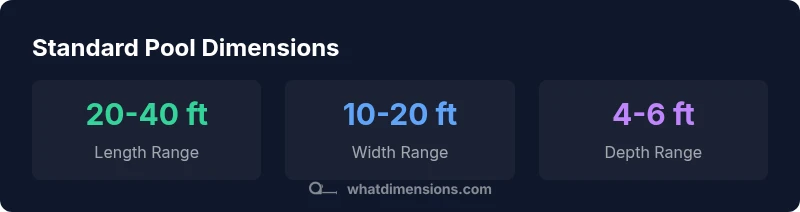
The standard pool dimensions most homeowners plan around are a rectangular footprint of about 20–40 feet long and 10–20 feet wide, with a depth range of roughly 4–6 feet. These ranges cover most residential in-ground and above-ground pools. Always verify local regulations and usable space before finalizing a layout. Consider site constraints, safety margins, and access for maintenance.
What counts as standard pool dimensions
Defining what constitutes a standard pool footprint helps designers, builders, and homeowners set realistic expectations. In practice, the term usually refers to a rectangular footprint with a length of roughly 20–40 feet and a width of about 10–20 feet, paired with depths commonly ranging 4–6 feet. When planning, dimensions are often presented as length × width × average depth to approximate volume and deck area. The key caveat is variability: sites vary, regional codes apply, and pool shapes differ, so standard dimensions act as a starting point rather than a fixed rule. When measuring, use exterior dimensions along the longest axes and include built-in steps or ledges if they are part of the usable footprint. For irregular shapes, many professionals simplify the outline into rectangles to estimate area and volume. Always document tolerances for decks, coping, and safety margins, since these influence the final size.
Regional variations and measurement standards
Regional norms differ significantly. In the United States and Canada, many homeowners plan around 20–40 ft in length and 10–20 ft in width, with depths commonly 4–6 ft. In metric-focused markets, footprints often measure roughly 6–12 meters in length and 3–6 meters in width, with depths around 1.2–1.8 meters. These regional patterns reflect plot sizes, climate, and construction practices. Always convert between feet and meters as needed and confirm with local authorities about setback requirements, fencing rules, and permit processes before settling on final dimensions. The goal is a design that fits the site while meeting safety and code criteria.
Calculating capacity and surface area from dimensions
Volume estimates start with length × width × average depth. To convert a volume in cubic feet to gallons, multiply by 7.48 (US gallons per cubic foot). For metric calculations, multiply the cubic meter volume by 1000 to obtain liters. Example: a 20 ft × 40 ft pool with an average depth of 5 ft has a volume of 4000 cubic feet, about 29,900 gallons. This kind of calculation helps with water treatment planning, pump sizing, and maintenance scheduling. Remember to account for steps, benches, and any irregular features, which affect usable volume.
Design implications of standard dimensions
Standard dimensions influence deck size, entry points, equipment placement, and circulation space. A common practice is to allocate a minimum deck clearance around the pool to facilitate maintenance and safety. Practical guidance suggests 4 feet (1.2 meters) of clearance on all sides as a baseline, though local codes may mandate greater distances. Consider traffic flow for hot days, shading, and storage for toys and cleaners. If your lot is tight, prioritize longer, narrower footprints or dead-end layouts that maximize usable surface without compromising access.
Adapting standard sizes for narrow plots or irregular shapes
Many plots are long and narrow, or irregularly shaped, which challenges a traditional 20×40 ft rectangle. Solutions include designing a tapered rectangle, a kidney or L-shaped footprint, or splitting the pool into two connected rectangular zones. In tight lots, you can prioritize depth variance to maximize play areas or build-in seating. Irregular shapes require careful measurement and a modular approach to ensure that safety zones around coping and decks remain compliant with local rules.
Safety, fencing, and maintenance around footprints
Around residential pools, safety and maintenance considerations are essential. Fence height and gate requirements vary by jurisdiction, but many places require 4 feet of fencing with self-latching gates. Permit timelines may demand additional barriers, alarms, or visibility requirements. Plan for non-slip decking, appropriate lighting, and dedicated space for equipment such as pumps and filters. Good maintenance practices—easy access to panels, clear walkways, and labeled shutoffs—help keep the footprint functional and compliant.
Example layouts and planning checklist
Layout examples help visualize standard vs. adapted footprints. Example A features a 30 ft × 15 ft rectangular pool with a 4 ft deck surrounding three sides, leaving space for a lounge area. Example B shows a tapered 18 ft × 12 ft footprint that fits a narrow yard while maintaining safe clearance. Planning checklist: measure site accurately; verify setbacks and exclusivity zones; map access for maintenance; check fencing and gate requirements; draft a deck plan; and confirm equipment location before permit submission.
Common footprint dimensions for residential pools and planning considerations
| Dimension | Typical Range | Notes |
|---|---|---|
| Length | 20-40 ft | Residential to light commercial |
| Width | 10-20 ft | Narrow to standard |
| Depth | 4-6 ft | Shallow to moderate |
| Deck Clearance | 4 ft min | Safety and maintenance |
Quick Answers
How do you measure the length and width of a pool?
Measure the exterior length along the longest straight side, then measure the width at the widest point. Include built-in steps or ledges if they are part of the footprint. For irregular shapes, map the outline and calculate the total area.
Measure the outside edges along the longest sides, include steps if they’re part of the footprint, and map irregular shapes for total area.
What is a typical residential pool width?
Most residential pools fall within 10 to 20 feet in width, with the exact size depending on site space and design goals. This range accommodates a variety of layouts while leaving room for decks and access.
Common widths range from ten to twenty feet, depending on space and design.
Do standard pool dimensions vary by region or code?
Yes. Local building codes set minimum setbacks, fencing, and allowable depths. Regional climate, lot size, and pool type also influence the final footprint. Always check with the local authorities before finalizing dimensions.
Yes—codes vary by region and affect the footprint and safety features.
Can irregular-shaped pools use standard dimensions?
Irregular shapes can still align with standard ranges by planning with a modular approach. Break the footprint into simple rectangles for planning and then combine them for a final layout.
Irregular pools can fit within standard ranges by planning with modular rectangles.
How do I convert feet to meters for pool dimensions?
To convert, multiply feet by 0.3048 to get meters. For example, 30 ft is about 9.14 meters. Use this for planning with metric plans or international teams.
Multiply by 0.3048; 30 feet is about 9.14 meters.
“Understanding standard pool dimensions helps ensure safety, efficient maintenance, and a layout that fits your site.”
Main Points
- Begin planning with baseline ranges for length, width, and depth.
- Account for regional code variations early in the design process.
- Use modular rectangles for irregular shapes to simplify calculations.
- Allocate safe deck clearance around the pool footprint.
- Consult local authorities to verify permit and fencing requirements.