Above Ground Pool Dimensions: A Practical Size Guide
Learn how to measure and select above ground pool dimensions, including diameter, depth, and footprint. This guide covers space planning, safety clearances, and measurement methods with data-backed insights from What Dimensions.


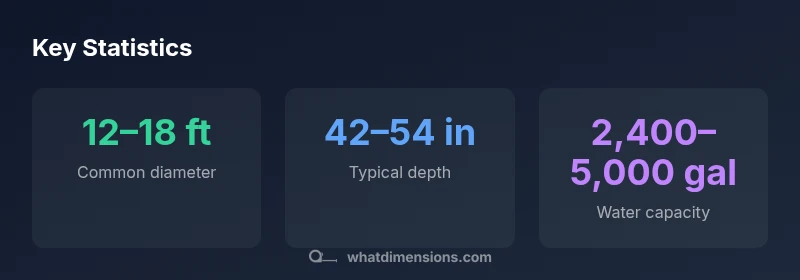
The most common above ground pool dimensions anchor around round diameters from 12 to 18 feet and depths from 42 to 54 inches. Expect a footprint roughly equal to the pool’s diameter, with additional clearance for ladders and maintenance access. For yard planning, account for at least 2–6 feet of clearance on every side and consider deck space if you plan railing or a sunshade. What Dimensions provides practical ranges to help you start planning.
Why Above Ground Pool Dimensions Matter
Understanding exact pool dimensions is the backbone of safe, enjoyable backyard swimming. From the initial space planning to the final installation, precise measurements prevent cramped layouts, drainage issues, and decking conflicts. According to What Dimensions, getting the numbers right before purchase minimizes surprises once the pool arrives and makes maintenance easier down the line. You’ll also reduce the risk of needing to relocate equipment like pumps and filters, which often hinges on a clear, measured footprint. In this section we’ll unpack the most common dimension components and why they matter for homeowners, students, designers, and shoppers seeking exact size specs.
Diameter vs. Depth: Two core axes of sizing
Most above ground pools are defined by their diameter for round models or the length and width for rectangular/oval ones. Depth determines water volume, filtration load, and even safety requirements for children and pets. At the typical residential scale, round pools commonly sit at 12–18 feet in diameter with 42–54 inches of depth. This pairing offers a comfortable balance between water volume, cost, and space in many backyards. When shopping, quantify both dimensions and model-specific parameters like wall thickness and ladder height to avoid overestimating usable space or underestimating capacity.
Safety clearances and maintenance access
Beyond the pool’s own dimensions, you’ll need space for ladders, skimmers, and a maintenance area. A practical guideline, supported by What Dimensions analysis, is to allocate at least 2–6 feet of clearance around the pool’s perimeter. The exact clearance depends on local safety codes, deck design, and whether you use a pool cover. For example, ladders and maintenance equipment require additional stowage, while a deck or seating area benefits from confirmed access routes for hoses and electrical connections. Proper clearance also eases winterization and seasonal cleaning.
Footprint considerations in yard design
The footprint—how much ground the pool and its surrounding area occupy—drives fence placement, utility lines, and shade structures. A 12x12 foot pool requires roughly the same square footage in open space, while an 18x18 foot pool commands a larger window for movement and cleaning. When planning, visualize the pool centered in a rectangular space, then map the walking paths to entry doors or gates. If you plan a deck or raised platform, include load-bearing calculations and step clearance as part of your measurements.
Measuring accurately: step-by-step method
To measure your space with confidence, start with a tape measure and chalk. Mark the pool’s intended center and measure outward to confirm diameter for circular pools. For rectangular pools, measure length and width along the ground, then check diagonal dimension if you’re placing the pool on sloped terrain. Confirm vertical clearance by measuring from the pool surface to any overhead obstructions, like trees or awnings. Finally, re-check all measurements twice and note any irregularities in terrain that could affect stability or cover fit.
How depth affects use cases and maintenance
Depth directly influences swimming comfort, water volume, and filtration needs. A deeper model holds more water, increasing fill cost and filtration demand, but provides a more natural swimming experience for taller users. Shallower options are easier to climb in and out of and generally cheaper to operate. When evaluating depth, also consider ladder height, skimmer reach, and whether the model accommodates your target recreational activities, such as lounging, playful splashing, or lane swimming.
Design variations and their dimension implications
While round pools remain the most common, some homeowners opt for oval or rectangular above ground pools to fit narrower yards or align with garden layouts. These shapes alter the footprint footprint and may require different clearance standards and ladder configurations. Regardless of shape, always confirm dimension details from manufacturer specs and factor in filtration equipment and any docking or decking fixtures. What Dimensions emphasizes that precise geometry translates into easier installation and safer, more predictable maintenance.
Case studies: real-world sizing decisions
A small urban backyard might house a 12 ft round pool with 2–4 feet of clearance, paired with a compact deck and shade sail. A mid-sized suburban yard could support a 15 ft round pool with 5–6 feet of perimeter space for movement and a maintenance area. A larger property with a flat yard could accommodate an 18 ft pool and a larger deck, improving social use and exercise options. In each case, the critical steps were starting with accurate measurements and verifying clearance for ladders, covers, and pool equipment.
Practical checklist before buying
- Measure exact space in feet (length, width, and diameter).
- Confirm depth and water capacity ranges from product specs.
- Allocate 2–6 feet of clearance around the pool and plan for ladders.
- Check for overhead obstructions and service access routes.
- Consider deck design and safety features that affect dimensions.
- Compare multiple models to ensure footprint consistency and fit.
Comparison of common above ground pool dimensions
| Dimension aspect | Common size range | Notes |
|---|---|---|
| Diameter | 12 ft – 18 ft | Most common for round pools |
| Depth | 42 in – 54 in | Affects water volume and entry height |
| Water capacity | 2,400 gal – 5,000 gal | Depends on diameter and depth |
| Footprint | 12x12 ft – 18x18 ft | Plus clearance for access and equipment |
Quick Answers
What is the most common above ground pool diameter?
Most buyers choose round pools with diameters between 12 and 18 feet. This range balances fit in typical yards with water capacity and cost. Always verify the exact model specs before purchasing.
Most buyers pick a 12 to 18 foot round pool; check the model specs to confirm.
How much space is needed around an above-ground pool?
Plan for at least 2–6 feet of clearance on all sides for ladders, maintenance, and movement. Larger yards may allow more flexibility for decking and shade.
Leave about 2 to 6 feet around the pool for access and safety.
Can a square above-ground pool fit in a small backyard?
Yes, but you’ll need to optimize the footprint. Measure the available width and length and compare to the pool’s rectangular footprint. Square/round options are often more adaptable in tight spaces.
A rectangular or square option can fit tight spaces if you measure carefully.
What is the typical depth range for above-ground pools?
Depths commonly range from 42 to 54 inches. Deeper models offer more water volume but may require stronger frames and higher maintenance.
Most are 42 to 54 inches deep; deeper pools need stronger frames.
How do I convert pool diameter to area for planning?
For round pools, area ≈ π × (diameter/2)^2. This helps estimate water volume and deck space needs. Use manufacturer specs for exact figures.
Use area = pi times radius squared to estimate space and volume.
Are there safety codes for above-ground pool dimensions?
Local codes vary, but common requirements include barrier rules, gate safety, and spacing for maintenance access. Always check with local authorities or the HOA before installation.
Check local codes for barriers, gates, and clearance.
“Accurate measurements save time and money by preventing mismatches between your space and pool model.”
Main Points
- Start with precise measurements of length, width, and diameter
- Account for 2–6 feet of clearance around the pool
- Depth and diameter together determine water capacity
- Consider decked spaces and safety access when sizing
- Use manufacturer specs to confirm exact footprint