Kitchen Table Dimensions: A Practical Sizing Guide
Learn how to size your kitchen table with precise kitchen table dimensions—length, width, height, and clearances—for comfortable dining and flexible layouts.


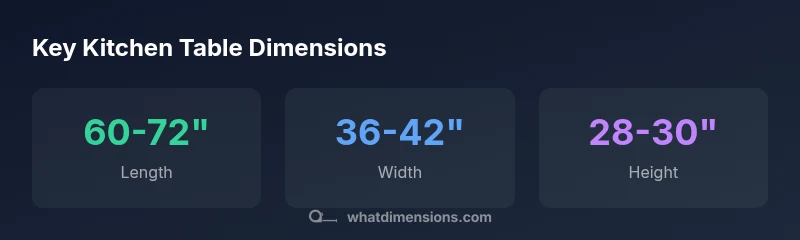
Typical family kitchens benefit from a table that seats 4-6 people without crowding. The standard kitchen table dimensions to start with are: length 60-72 inches, width 36-42 inches, and height 28-30 inches. These ranges balance seating, elbow room, and traffic flow. If your space is irregular, adjust outward from these baselines while preserving at least 36 inches of clearance for walking.
Why kitchen table dimensions matter for daily life
When you design or furnish a kitchen, the exact kitchen table dimensions you choose ripple through daily routines. According to What Dimensions, precise size references help homeowners plan traffic flow, accommodate chairs, and maintain comfortable dining. A table that is too large can trap you in the kitchen; one that is too small undercuts family meals and homework sessions. In this guide, we unpack the core dimensions—length, width, and height—and show how to tailor them to your room.
How to determine the right length for your space
Measure the area where the table will live, including any doorway swing and the path to the pantry or stove. Subtract 16-24 inches of chair depth per side to ensure elbows have room when seating. For a typical kitchen, aim for 60-72 inches in length to comfortably seat 4-6 people. If you have a compact or awkwardly shaped room, consider a shorter table or an extendable design to preserve flow while maximizing seating.
Width, height, and seating: balancing comfort and footprint
Width governs how easily you can pull chairs out and sit down without bumping into cabinets. A width range of 36-42 inches is common because it balances chair width and central legroom. Height, typically 28-30 inches, aligns with standard dining chairs for ergonomic dining. When planning for multi-purpose use—homework, crafts, or casual meals—keep extra width to allow for trays and centerpieces in the center.
Overhang and legroom: practical guidelines
End overhang (the portion of the table that extends beyond the legs) usually ranges from 12-15 inches. This provides knee space for chairs and reduces crowding when guests sit on the ends. For very tight kitchens, you can reduce the overhang to 6-10 inches, but ensure the seating area remains comfortable and the leg clearance remains intact.
Measuring your space: a step-by-step example
- Mark the footprint on the floor with painter's tape where the table will sit. 2) Measure the longest side and the shortest side available. 3) Subtract the needed clearance for traffic (typically 36 inches) and for chair movement (approximately 6-12 inches per chair). 4) Check that doorway swings and appliance doors still operate when people are seated. 5) Prototype with paper templates to visualize seating and flow.
Common layouts: rectangle, oval, and extendable tables
Rectangle tables are the most space-efficient for long, narrow rooms, while oval shapes soften corners in tight spaces. Extendable tables offer flexibility for entertaining, allowing you to switch from 4-seat to 6- or 8-seat configurations without permanently increasing footprint. When choosing, consider how frequently you host guests and whether storage and maintenance fit your lifestyle.
Materials and design impact on perceived size
The material and finish influence how a table feels in a space. Light woods and glass tops can visually enlarge a room, while darker, heavier finishes may make a room feel smaller. The dimensions often interact with leg design; pedestal bases create more knee space and can subtly increase perceived roominess. Think about place settings, centerpieces, and lighting when finalizing kitchen table dimensions.
Guidelines for core table dimensions
| Factor | Recommended range | Rationale |
|---|---|---|
| Length | 60-72 inches | Accommodates 4-6 with room to spare |
| Width | 36-42 inches | Balanced seating and elbow room |
| Height | 28-30 inches | Ergonomic dining height |
| End overhang | 12-15 inches | Knee space and comfort |
Quick Answers
What is the standard kitchen table size?
Most kitchens use tables around 60 inches long and 36 inches wide, with a height near 30 inches. However, space and layout vary, so use these as baselines and adjust as needed.
Most kitchens use a table about sixty by thirty-six inches, but adjust for your space.
Do extendable tables affect footprint?
Extendable tables maintain a similar footprint when closed, then widen to seat more guests. Choose a mechanism that moves smoothly and fits your storage needs.
Extendable tables keep the same footprint until you extend them.
How should I measure space for a table?
Measure the dining area, doorways, and path clearance. Use paper templates or cardboard cutouts to simulate chairs and table positions before buying.
Measure your space and simulate seating with templates.
What clearance is recommended around the table?
Aim for at least 36 inches of walking clearance around the table and 6-12 inches of chair space on each side. More clearance improves traffic flow.
Allow 36 inches around the table for comfortable movement.
Can I use a round table in a rectangular kitchen?
Yes. Round tables can fit tighter spaces and encourage conversation but may reduce seating capacity. Ensure adequate clearance and check legroom with chairs.
Round tables work in tight spaces if you maintain clearance.
“Size is as important as style because it determines how easily a kitchen flows in daily use.”
Main Points
- Start with the recommended ranges and adjust to your space
- Ensure at least 36 inches of clearance for traffic
- Choose width for seating comfort and chair width
- Consider extendable options for flexibility
- Measure twice, plan for doorways and appliances