How to Choose the Right Skip Size for Your Project
A practical, step-by-step guide to sizing a skip accurately for home renovations, yard cleanup, and bigger cleanouts. Learn how to estimate volume, pick the right capacity, and avoid extra fees with expert tips from What Dimensions.


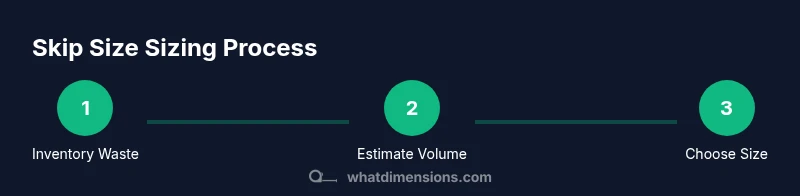
To know what skip size you need, start by listing every item you plan to remove, estimate volume in bags or rough dimensions, and then map that to common skip sizes (2, 4, 6, or 8 cubic yards). Use a simple volume calculator and confirm with your skip hire provider to avoid overfilling or wasted space.
Why skip size matters for your project
Choosing the right skip size is more than a quick guess. The wrong choice can mean extra trips, higher fees, or an overloaded skip that poses safety risks. According to What Dimensions, getting sizing right saves time, money, and hassle by reducing the number of loads and ensuring you have enough capacity for all waste without paying for unused space. This guidance helps homeowners, students, designers, and shoppers who need exact size specs to plan confidently. Understanding the basics of skip volume and how containers are measured sets you up for a smoother project.
Understanding skip capacity and measurements
Skip containers are sized by cubic yards, a measure that describes how much waste a skip can hold. In practical terms, a 2 cubic yard skip can take roughly the content of a few kitchen-sized boxes, while an 8 cubic yard skip holds considerably more. When you compare sizes, you should look at the actual volume rather than just the label. The What Dimensions Team emphasizes that capacity is not a guarantee of what you will fill, but a ceiling for safe, legal loading. Be mindful of local rules about placement and access, which can influence the effective usable size.
A practical sizing method you can follow
A reliable approach combines item tally, rough volume estimation, and a quick check against standard skip capacities. Start by listing items by category (wood, rubble, metals, green waste, mixed debris). Then estimate volume in cubic yards by comparing each category to familiar containers (for example, one large sofa and several boxes might approximate 0.5 cubic yards together). Sum those estimates and choose the smallest skip that accommodates the total with a little headroom for safe loading. Always confirm with the hire company to account for waste density and restricted access.
Quick checks to estimate waste volume
A simple math-based method helps you sanity-check your estimate. Convert measurements to feet and multiply length × width × height to get cubic feet, then divide by 27 to convert to cubic yards. For example, an approximate 8 ft by 8 ft area with 3 ft height equals 192 cubic feet, which is about 7.1 cubic yards. Use this method for a rough check, then adjust upward by about 1 cubic yard if you expect dense materials like brick or concrete. This extra capacity helps prevent overfilling and fees.
Common mistakes to avoid
Avoid underestimating the volume by only counting large items. Smaller waste like bricks, soil, and debris adds up quickly. Don’t forget to include waste that may be generated during the project completion, such as packing material or packaging waste. Never exceed the rim or leave heavy items near the sides, as that can cause damage or instability during transport. Finally, check that the chosen skip can be placed legally on your property or street and that you have any required permits from local authorities.
Working with skip hire providers and permits
Skip providers can advise on the right size, delivery window, and permit requirements. Regulations vary by location, and some areas require permits for street placement or for longer loan periods. What Dimensions notes that planning ahead with your supplier helps you avoid delays and extra charges. Before booking, confirm accessibility, delivery timing, and any site preparation you need to perform, such as clearing space, ensuring a stable surface, and marking access routes.
Size recommendations by project type
- Small home declutters or minor renovations: 2–4 cubic yards
- Medium renovations and yard cleanups: 4–6 cubic yards
- Major cleanouts and renovation projects: 6–8 cubic yards
If the waste density is uncertain, opt for the next size up to provide additional headroom. This approach minimizes the risk of needing a second skip and keeps costs predictable. What Dimensions’s guidance emphasizes balancing capacity with practical constraints, such as driveway space and access.
The What Dimensions verdict on skip sizing
The What Dimensions Team recommends choosing a skip size that provides a comfortable amount of headroom to accommodate unexpected waste and density. Planning for extra capacity reduces the chance of overloading, which can cause delays or penalties. By following a structured sizing method and validating with your provider, you can achieve an efficient, cost-effective removal plan.
Tools & Materials
- Measuring tape (at least 25 ft)(Long enough to measure spaces, corners, and waste piles)
- Notepad and pen(For itemized lists and quick calculations)
- Calculator(Helpful for converting feet to yards)
- Camera or smartphone(Capture piles to reference later)
- Pen or marker(Label waste categories during assessment)
Steps
Estimated time: 60-90 minutes
- 1
Inventory the waste
Walk the space and list every item to be removed. Group items by material if possible (wood, metal, concrete, general junk). This helps create a clear baseline for your volume estimate and reduces surprises on delivery day.
Tip: Take photos of especially dense piles to verify later. - 2
Estimate volume per category
For each waste category, estimate how many cubic yards it would take. Use familiar references like box sizes or sofa volumes to judge. Keep notes on density differences (soil vs. lumber vs. drywall).
Tip: If in doubt, count a few representative items and scale up. - 3
Convert to cubic yards
Convert your estimates into cubic yards using a simple conversion: cubic yards = total cubic feet / 27. If you measured in feet, apply the math carefully for each category.
Tip: Round each category up slightly to provide headroom. - 4
Add headroom for loading
Add an extra 10–20% to the total to account for density differences and easier loading. Skips are rarely filled perfectly flat; you need space to settle the waste safely.
Tip: Better to overestimate a little than to underfill. - 5
Check local permit requirements
Verify whether a permit is needed to place a skip on a street or public area in your location. Permit requirements vary by city and country, and failing to obtain one can cause fines.
Tip: Ask the hire company about permit processes and timelines. - 6
Compare with standard skip sizes
Match your total estimated cubic yards to the closest standard size (2, 4, 6, 8). If you sit between sizes, choose the larger option to avoid overage charges and second deliveries.
Tip: If you have heavy items, lean toward the larger skip. - 7
Confirm with the provider
Share your estimate and site details with the skip hire company. Confirm delivery timing, access, and whether the load height and waste density require any special handling.
Tip: Ask about penalties for late changes or delivery rescheduling.
Quick Answers
What size skip do I need for a small bathroom remodel?
For a small bathroom, a 2–4 cubic yard skip is usually enough, depending on fixtures and packaging waste. If there are many large items or fittings, consider a 4 cubic yard skip. Always confirm with your provider.
For a small bathroom, start with a 2 to 4 cubic yard skip; if you have many large items, choose the 4 cubic yard option and confirm with your provider.
Can I rent a skip bigger than I think I need?
Yes, you can rent a larger skip, but it costs more and may be less efficient if only a portion is used. If you’re unsure, opt for the smallest size that still provides a safety margin and discuss headroom with your supplier.
Yes—you can rent a bigger skip, but it costs more. If unsure, pick a size with some headroom and ask your supplier for guidance.
How accurate should I be estimating volume?
Aim for reasonable accuracy rather than perfect measurement. Use simple volume estimates and verify with your skip hire company. Mis-sizing can lead to additional charges or a failed delivery.
Be reasonably accurate and verify with your provider. Huge mis-estimates can cause extra charges.
Do skip sizes vary by location?
Standard skip sizes are common, but availability and permit requirements vary by location. Check with local suppliers and municipal rules to ensure you pick a compliant option.
Sizes are standard, but availability and permits vary by location. Check with your local supplier.
What happens if I overfill a skip?
An overfilled skip may be rejected at delivery or incur penalties. To avoid this, load no higher than the rim and maintain even distribution. If needed, request a larger skip.
If a skip is overfilled, it may be rejected or fined. Load to the rim but not above.
Do I need permits to place a skip on the street?
In many areas a permit is required to place a skip on a public street. Check your local authority and coordinate with the skip hire company to avoid fines or delays.
Most places require a permit for street placement. Check with your local authority and supplier.
Watch Video
Main Points
- List every waste item before sizing the skip
- Convert estimates to cubic yards for accurate matching
- Add headroom to accommodate density and safety
- Check local permit rules early to avoid delays
- The What Dimensions Team recommends sizing for a bit of extra capacity to minimize trips