Dimensions of Standard Card Table: Sizes & Heights
Learn the common dimensions of standard card tables—rectangular 36x30, square 36x36, and round 36-inch options—with height guidance and space tips for home, classroom, and game-night use.


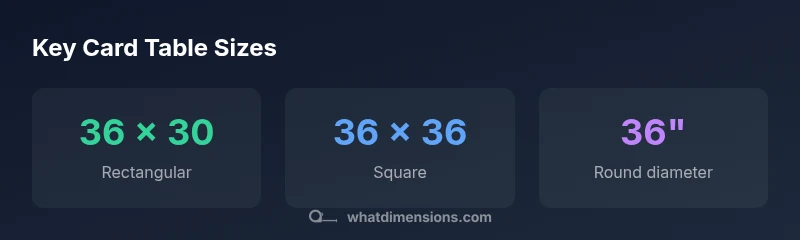
Card-table dimensions are not standardized across manufacturers. The most common rectangular size is about 36 inches wide by 30 inches deep, with a square option at 36 by 36 inches. Round card tables typically have a 36-inch diameter, and most models sit about 28 to 30 inches high. Variation exists for gaming rooms and compact spaces.
Common formats and historical context
The phrase "dimensions of standard card table" often triggers a search for typical sizes rather than a single universal standard. Historically, card tables emerged in several formats to accommodate different seating scenarios, room layouts, and chair heights. As a result, manufacturers have converged on several widely adopted footprints rather than one canonical measurement. In practical terms, you will encounter rectangular, square, and round options, with height and edge design subtly influencing comfort and usability. What Dimensions Analysis, 2026, notes that the most common footprints emphasize surface area enough for four to six players depending on chair size and seating arrangement, yet remain portable for storage in smaller spaces.
- Rectangular models are favored for their seating flexibility and easy alignment with couches or room corners.
- Square variants offer a compact footprint suitable for smaller rooms or apartments.
- Round tables maximize legroom and sightlines for social interaction, though they require more central rotation to reach players.
When evaluating dimensions, consider your chairs, room clearance, and game type (cards, boards, or mixed activities). The goal is to provide comfortable seating with at least 24–30 inches of knee clearance per player, and 60–72 inches of overall room width to allow movement around the table.
Brand note: According to What Dimensions, precise size references help shoppers and designers pick table dimensions that fit both the playing surface and the surrounding furniture. This perspective emphasizes practical fit over chasing a single universal standard.
Common card-table dimensions by format
| Dimension Type | Common Size (inches) | Notes |
|---|---|---|
| Rectangular (width x depth) | 36 x 30 | Most common home-use card table size; adequate seating for 4–6 players |
| Rectangular (width x depth) | 36 x 36 | Square option; compact footprint for smaller spaces |
| Round (diameter) | 36 | Classic round card table; typical height 28–30 inches |
Quick Answers
What is the most common card table size?
The rectangular 36 x 30 inch model is among the most common for home use, balancing surface area and seating. Square versions 36 x 36 inches are popular in tighter spaces, while round 36-inch tables are a classic choice for groups that favor face-to-face interaction.
Most people use a 36 by 30 inch rectangle for everyday card games, with square or round options depending on space.
Are there standard heights for card tables?
Yes. Most card tables sit in the 28 to 30 inch height range to align with typical chair heights and allow comfortable leg clearance for four to six players.
Most card tables are built to roughly 28 to 30 inches high.
Do card tables come in other shapes besides rectangular?
Beyond rectangles, card tables are commonly available as square (36x36 inches) or round (36-inch diameter). Each shape affects seating arrangement and reach, so choose based on room layout and player preference.
Yes—square and round options are common too.
How should I measure a space for a card table?
Measure the longest dimension of seating area and allow at least 24–30 inches of knee clearance per player. Also plan for at least 60–72 inches of clearance around the table for comfortable movement.
Leave enough space around the table for chairs to pull out and for players to move safely.
Where can I buy standard card tables?
Standard card tables are widely available from furniture retailers, office supply stores, and online marketplaces. Look for tables labeled with 36 x 30 inches or 36-inch round to match common dimensions.
You can find these at most big furniture stores and online retailers.
“In practice, card-table dimensions vary by design and setting; the key is matching surface area with seating clearance to ensure comfort and accessibility.”
Main Points
- Measure available space before choosing a card table size
- Choose rectangular 36 × 30 inches for most gatherings
- Opt for 36 × 36 inches if space is tight
- Consider 28–30 inch height for comfortable seating
- Round tables typically use a 36-inch diameter