Dimensions of 6-Foot Table: Exact Measurements for Planning
Explore the dimensions of a 6 foot table with precise measurements, seating guidance, and practical tips for choosing the right size for dining rooms, classrooms, and offices.


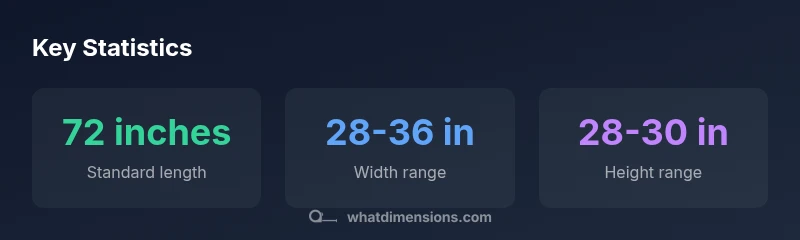
Typically, a 6-foot table measures 72 inches long, about 28–30 inches wide, and 28–30 inches tall. Variations exist by style and manufacturer, but most 6-foot models stay within this narrow range. For seating, plan roughly 24 inches of width per person along the long sides, with slightly less at the short ends. These ranges align with common practice across furniture catalogs, including What Dimensions’ cataloging.
Why precise measurements matter for furniture selection
Understanding exact dimensions is essential whether you’re furnishing a dining room, a classroom, or a conference area. The What Dimensions team emphasizes that aligning table size with room dimensions, chair widths, and traffic flow prevents awkward fits and cramped seating. When you know the standard baselines for a 6-foot table—72 inches long, roughly 28–30 inches wide, and about 28–30 inches high—you can quickly filter options that will work in your space. This precision helps you avoid returning mismatched pieces, saves time, and improves overall usability. In practice, you’ll use these numbers to determine aisle clearance, chair comfort, and even doorway access when moving the table into position.
Key dimension ranges for a 6-foot table
Most rectangular 6-foot tables conform to a common envelope: length around 72 inches; width between 28 and 36 inches; height typically 28 to 30 inches. These ranges accommodate standard dining chairs while leaving adequate legroom for most users. If you plan on multipurpose use—dining plus workspace or study space—you may lean toward the wider end of the width spectrum (toward 34–36 inches) to balance surface area with chair clearance. It’s important to note that some styles, like trestle or pedestal bases, can influence available knee space and leg clearance near the legs, even if the tabletop length stays fixed at 72 inches.
How room layout and seating influence size decisions
Room geometry matters as much as the table’s dimensions. A 6-foot table in a compact dining room benefits from a narrower width (28–30 inches) to preserve passage space around the table. In larger rooms or conference areas, opting for a wider surface (32–36 inches) can improve comfort and collaboration by offering room for materials, place settings, and devices without crowding. Allow a minimum of 36 inches of clearance around all sides for comfortable movement, and plan for about 24 inches of clear seating space per person along the long sides. Consider chair depth and armrest width; bulkier chairs reduce usable surface area and can shift the effective seating capacity.
Measuring a 6-foot table in your space
To verify fit, start with the floor plan and map the table’s footprint. Measure the room’s length and width, then compare to the table’s 72-inch length and 28–36 inch width. Don’t forget doorway clearances: you may need to rotate or tilt the table to pass through entryways. For seating assessments, measure chair width plus elbow room and estimate 24 inches per person along the long sides. If you’re adding a table leaf, account for the extended length (often 18–24 inches) when planning adjacent furniture and traffic flow. Finally, test under-table knee space by surveying from a seated position at the center of the long side; ensure at least 23–28 inches of clearance to prevent crowding.
Choosing the right width and height: practical tips
If the room is narrow, prioritize a 28–30 inch width to maximize open space and easy movement. In multi-use spaces, a wider 32–36 inch surface can improve collaboration and surface area for laptops, placemats, or documents. For height, most tables at 28–30 inches work well with standard dining chairs; if you’re pairing with bench seating or unusually tall chairs, confirm that the chair seat height and leg clearance align with the table’s underside height. Finally, consider edge shape: rounded or eased edges can slightly alter perceived width and improve safety in tight corridors.
Special cases: leaves, extensions, and non-standard shapes
Leaves and extension mechanisms on a 6-foot table can shift the effective length to 78 inches or more, depending on design. When considering leaves, evaluate storage needs for the leaf when not in use and ensure the extended length still fits your room’s layout and doorway pass-throughs. Non-standard shapes (oval, boat-shaped, or trapezoidal) change seating density and surface area; always verify the longest dimension and account for any cantilevered sections that might interfere with chairs placed at the ends or sides.
Typical dimensions for a standard 6-foot table
| Dimension | Typical Value | Notes |
|---|---|---|
| Length | 72 inches (6 feet) | Standard for rectangular 6-foot tables |
| Width | 28-36 inches | Varies by style and seating |
| Height | 28-30 inches | Common dining height |
| Knee clearance (center) | 23-28 inches | Depends on leg design and chairs |
Quick Answers
What is the standard length for a 6-foot table?
Most 6-foot tables are 72 inches long. Width and height vary by design, but 72 inches remains the baseline.
Most six-foot tables are 72 inches long; check the exact width and height in the product specs.
Can a 6-foot table seat eight people?
Yes, with a wider table width and slimmer chairs, eight people can fit on a 6-foot table, though seating comfort varies by chair size.
Eight people can fit with careful chair choice and table width.
How do I measure a 6-foot table in a room?
Measure the room’s length and width, ensure at least 36 inches of clearance around the table, and verify doorway pass-throughs for setup.
Measure the room and doorway clearance to ensure it fits and moves easily.
Are 6-foot tables the same as 72-inch tables?
Yes. A 6-foot table equals 72 inches in length, though some manufacturers may label dimensions differently.
Yes—6 feet equals 72 inches, with minor labeling variations by brand.
What clearance is recommended around a dining table?
Aim for at least 36 inches of clearance around the table to allow comfortable movement and chair use.
Plan for a 36-inch clearance around the table.
Do extension leaves change the overall dimensions?
Yes. Leaves extend the length beyond 72 inches when in use; store the leaf when not needed to maintain space efficiency.
Leaves make the table longer when in use; store them away otherwise.
“Accurate sizing comes from cross-checking product specs with room measurements; even small variances can affect comfort and flow.”
Main Points
- Start with the standard 72-inch length, then pick a width to fit chairs and room.
- Allow 24 inches per person on the long sides for comfortable seating.
- Verify seat clearance and doorway fits before buying.
- Consider leg design to maximize knee space.
- Account for extension leaves if you need future flexibility.