Dimensions of a 3-Seat Sofa: Size Guide
A comprehensive guide to the dimensions of a 3-seat sofa, including typical width, depth, and height ranges, measurement tips, and how to compare styles for accurate room planning.


Why accurate dimensions matter for space planning
Dimensions of a 3 seat sofa are more than numbers on a spec sheet; they determine how furniture fits through doorways, how people move around a room, and how a rug, coffee table, or side chairs relate to one another. According to What Dimensions, planning with precise numbers helps prevent moving sofas twice, minimizes traffic bottlenecks, and ensures purchases align with existing architectural constraints. In practice, knowing the exact footprint of your sofa at this scale lets you map seating zones, sightlines, and lighting without guesswork. Reading the dimensions for width, depth, and height together reveals the true footprint and guides decisions about placement next to walls, windows, or built-ins. When you search for dimensions of 3 seat sofa, you are comparing baselines that support accurate room layouts and furniture layouts.
Standard dimension ranges for a three-seat sofa
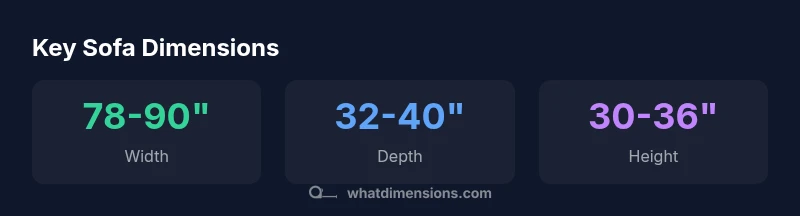
Across most manufacturers, a typical 3 seat sofa spans roughly 78–90 inches in width, 32–40 inches in depth, and about 30–36 inches in height. These ranges are useful benchmarks when you shop or plan a floor plan. Details vary by arm style (track vs. rolled arms), cushion depth, and seat height. Variations in foam density and seating geometry can add 1–3 inches to depth or widen the overall footprint. When evaluating options, compare the same configuration (e.g., straight arms with standard cushions) to keep measurements consistent. The dimensions of 3 seat sofa units influence how many people can sit comfortably and how closely furniture can be placed to create effective traffic flow.
How arm style affects footprint
Arm design matters for overall width and perceived footprint. A sofa with slim track arms may measure closer to the low end of the width range, while rolled or substantial shoulder arms can push the total width toward the high end. For dimensions of 3 seat sofa, always check whether the arm is included in the stated width — some listings measure the inner frame, others include arms. Additionally, cushion depth adds depth to the footprint, especially when cushions are plush. If you curate space around a wall, account for arm projection to avoid wall contact or crowding.
Depth and seat cushions: comfort vs clearance
Depth affects both seating comfort and the space needed in a room. Deeper sofas (toward the upper end of 32–40 inches) offer more lounging area but require more clearance from coffee tables and walls. Seat height (roughly 17–20 inches) influences ergonomics; taller seated adults may prefer higher seats for ease of standing up. When thinking about dimensions of 3 seat sofa, balance the desire for comfort with the realities of your room: a very deep sofa can overwhelm small spaces, while a shallow seat can feel uncomfortable for longer sessions.
Measuring methods: from wall to back
Accurate measurement starts with a wall and a tape measure. Measure from the wall to the outermost point of the front edge (usually the cushions or front rail) to capture width, and measure the deepest point from the wall to the furthest back edge. Don’t forget to include legs if they raise the sofa off the floor. When shopping online, compare the sofa’s external dimensions, not just the seat width, to ensure it fits through doors and around corners. For dimensions of 3 seat sofa, a precise approach reduces surprises at delivery and helps you visualize a final layout.
Room layout scenarios: small apartments vs living rooms
In compact rooms, prioritize models with lower width and depth to maintain flow and allow passage. In larger living rooms, you can opt for wider sofas with deeper seating and still maintain comfortable clearance around tables and end chairs. Use the width to plan the seating capacity, but verify doorway widths and hallway clearance to prevent misfits. The ability to anchor a sofa against a wall while preserving window access often dictates the choice between a traditional three-seat sofa and a sectional variant.
Sofa variants: sectional, chaise, and modular
Three-seat sofas are often flexible when paired with sections or modular components. A standard 3 seat sofa sits within the commonplace width range, but a sectional configuration can extend home layouts significantly. When evaluating dimensions of 3 seat sofa in a modular family, consider how units connect and the resulting depth, width, and overall footprint. If you value easy reconfiguration, modular sofas may change the measurement equation, especially when add-ons or chaises are included.
Practical recommendations: how to verify in-store vs online
Always measure your space before you buy and compare the exact exterior dimensions listed by the retailer. Bring a measuring tape to stores or use augmented reality room planners to test fit virtually. For dimensions of 3 seat sofa, translate the measurements into a scaled floor plan so you can test seating arrangements, walking paths, and clearance around coffee tables. When in doubt, order fabric swatches or chair-scale cutouts to visualize depth and width on the actual floor.