What Dimensions Queen Duvet: Size Guide and Tips
Explore exact queen duvet dimensions, insert vs cover sizing, and practical tips to ensure a perfect fit. What Dimensions breaks down typical ranges and brand variations.


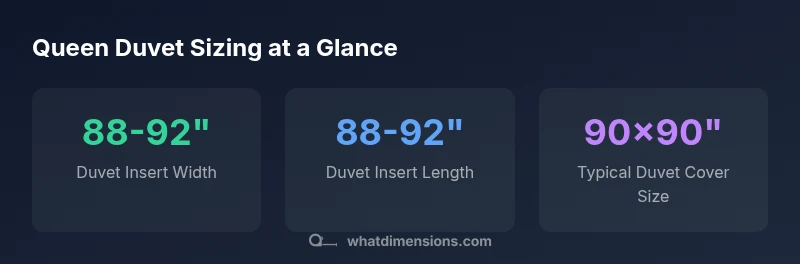
According to What Dimensions, the term 'queen duvet' typically refers to the insert size and the cover size that fit standard queen beds. Standard queen duvet inserts commonly measure about 88-92 inches wide and 88-92 inches long, while queen duvet covers usually run around 90x90 inches, with some brands offering wider or longer options.
What Dimensions Queen Duvet Sizing
When you begin exploring what dimensions queen duvet refer to, it helps to separate two core concepts: the duvet insert (the filling that goes inside) and the duvet cover (the outer shell). Across regions, naming and standardization differ, so the same label can refer to slightly different measurements depending on the brand or country. What Dimensions emphasizes that accurate sizing hinges on pairing the insert with a cover that matches those dimensions, while acknowledging that you may encounter regional variations in naming and actual measurements. For homeowners, students, designers, and shoppers, the goal is to map your bed size to a complementary duvet insert and then select a cover that accommodates your preferred level of fullness without bunching or sagging.
Insert versus Cover: The practical sizing framework
A queen bed typically accommodates a duvet insert around the 88–92 inch square range, while duvet covers marketed as “queen” often align with a near-square footprint, commonly around 90x90 inches, with some brands extending to 92x96 or larger. The essential relationship is not the label alone but the actual dimensions printed on the product. If your insert is 90x90 and your cover is 90x90, you’ll likely experience a snug fit; if your cover is significantly larger or smaller than your insert, you may notice excess fabric or tight corners. Always verify the exact measurements and compare them to your preferred bed configuration.
Regional and brand variations you should know
In the United States, the term “queen” generally aligns with inserts near 88–92 inches in width and length, but European and UK sizing can diverge by several inches. European cover sizing often uses European metric measurements, which may translate differently in inches. What Dimensions notes that such regional differences are common, so a universal standard cannot be assumed for every product. Before purchasing, review the specific product label and, if possible, measure an existing duvet and its cover to ensure compatibility across brands and regions.
How to measure for a perfect fit
To achieve a precise fit, start with your bed’s dimensions and the intended mattress depth. Measure your current duvet insert’s width and length, then compare those figures to the cover you plan to buy. If you want a looser look, you can choose a cover slightly larger than the insert, but avoid excessive slack that causes internal shifting. For layered or oversized comforters, consider covers that offer extra depth or expandable corners. A simple rule of thumb is to match the cover’s inner dimensions to the insert’s outer footprint while allowing a small margin for stuffing and movement.
Practical sizing scenarios by bed type
- Queen bed on a standard frame (60 inches wide, 80 inches long): aim for an insert near 88–92 inches square; covers typically 90x90 inches or close. This pairing is common and works well for most bedrooms.
- Deeper mattresses or platform beds: you may want a cover that’s slightly larger than the insert footprint to accommodate extra fabric at the corners.
- Lightly filled inserts: opt for a cover that’s on the standard size or just a touch larger to avoid excessive slack. This helps maintain a neat, tailored appearance.
Common pitfalls and how to avoid them
- Assuming all brands use the same queen size: always check the exact measurements on the label.
- Mixing insert and cover brands without verifying compatibility: verify both dimensions before buying.
- Overstuffing a cover: choose a slightly smaller cover than the maximum allowed by the label if you plan to stuff the insert, to prevent ruffles and shifting.
Quick fit checklist
- Verify insert and cover dimensions on product labels.
- Measure your bed, mattress depth, and current bedding to inform decisions.
- Consider regional differences if you shop across brands or countries.
- Favor a cover that mirrors the insert’s footprint with a small tolerance for movement.
Queen duvet sizing at a glance
| Dimension Type | Typical Range (inches) | Notes |
|---|---|---|
| Queen Duvet Insert | 88-92 x 88-92 | Varies by brand |
| Queen Duvet Cover | 90-92 inch square | Alias of queen but check the label |
| Oversized/Alternative | Varies widely | Confirm actual inner dimensions |
Quick Answers
What is the standard queen duvet insert size?
There isn’t a universal standard; most inserts labeled ‘queen’ fall in the 88–92 inch square range, but exact measurements vary by brand. Always check the product specs and compare with your current insert.
There isn’t a universal standard; sizes vary by brand—check the label.
How do I determine the right queen duvet cover size?
Choose a cover that matches your insert’s dimensions, or select one slightly larger if you want a looser look. Always verify inner dimensions on the product label and ensure it corresponds to your insert.
Match the cover to your insert, or go a bit larger for a looser feel.
Are UK/European queen sizes different from US sizes?
Yes. Regional sizing practices differ, so the same label can refer to different dimensions. Always read the exact measurements on the product label and convert if needed.
Yes, sizes differ by region—check the label for exact numbers.
What if my duvet is too small or too large for the cover?
If the duvet is too small, switch to a larger insert or use a cover designed for bigger dimensions. If it’s too large, choose a smaller cover or a cover with adjustable corners.
Try a bigger insert or adjust the cover size.
How can I measure my duvet accurately?
Use a soft tape measure to record the width and length of both the insert and the cover. Include corner attachments or baffles if present. Record in inches for consistency.
Measure width and length, including any extra features.
Do oversized queen options exist for bigger beds?
Some brands offer oversized queen options that approach king dimensions. If you have a king bed but want a 'queen' look, verify the exact inner dimensions and choose accordingly.
There are oversized queen options—check the product label.
“Exact bedding sizing matters for comfort and utility; always measure your bed and compare insert and cover specs rather than assume a standard size.”
Main Points
- Measure both insert and cover for the perfect fit
- Expect brand-to-brand variation in exact numbers
- Always verify product specs before purchase
- Match cover inner dimensions to insert footprint
- Consider mattress depth and bed frame when sizing