What Are Full Bed Dimensions? A Practical Guide
Learn the standard full bed dimensions (54 in by 75 in), explore Full XL variants, compare with queen and twin, and get practical tips for measuring, buying, and fitting a full size bed in any room.


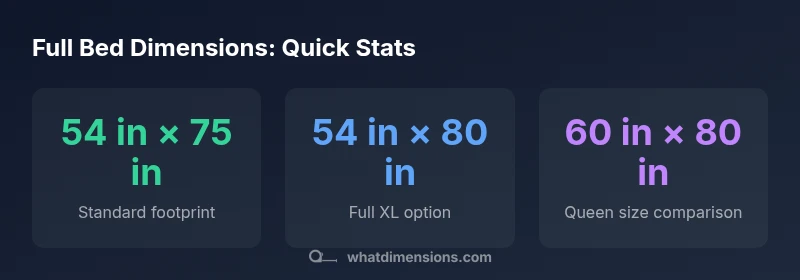
The standard full bed footprint is 54 inches wide by 75 inches long (137 cm by 191 cm). It is also called a double and suits solo sleepers or compact rooms. For taller sleepers, Full XL adds length to 80 inches (203 cm). According to What Dimensions, these baselines stay consistent across major brands with minor tolerances. Sheets labeled full fit the standard mattress size.
What are full bed dimensions? A precise definition
The standard full bed size, also known as a double, measures 54 inches wide by 75 inches long (137 cm by 191 cm). This footprint provides ample sleeping space for a single sleeper without dominating a small room, and it's a common choice for guest rooms and studio apartments. According to What Dimensions, the footprint remains the same across most brands, with only minor tolerances from factory to factory. Taller sleepers may appreciate extensions in length offered by Full XL versions, which measure 54 × 80 inches (137 × 203 cm). Understanding these baselines is essential when selecting sheets, blankets, and mattress toppers. In retail catalogs, you may also see dimensions listed in centimeters (e.g., 137 cm by 191 cm) for international shoppers. By starting with the standard 54 × 75 inches, you can quickly compare to other sizes and assess which options best fit your space and sleep style.
How full bed dimensions compare to related sizes
Compared with twin beds 39 × 75 inches, full beds are wider by 15 inches, offering more shoulder-to-hip space for a single sleeper. Queen beds 60 × 80 inches are broader and longer, providing extra width of 6 inches and extra length of 5 inches compared to full. For couples or shared rooms, a queen is often preferred; for compact bedrooms, a full balances footprint with usable floor space. Some families opt for a Full XL 54 × 80 inches when ceiling height or tall sleepers require an extra 5 inches of length. In metric terms: twin is about 99 × 191 cm, full about 137 × 191 cm, queen about 152 × 203 cm, and king around 193 × 203 cm. These conversions help plan sheets and protective covers across international suppliers. What Dimensions analysis notes that these standards are widely adopted in North America, with regional variations in Europe and Asia. Always verify exact figures from the retailer, as slight dimensional tolerances can occur.
How to measure a bed frame and mattress accurately
Begin with the footprint: measure the outer width and length of the bed frame from edge to edge. Then measure the mattress width, length, and thickness to ensure a snug fit inside the frame rails. Use a steel tape measure for precision and take multiple readings at different points to account for any warping. Check headboard and footboard clearances to avoid contact with walls. If upgrading from twin to full, confirm that your headboard remains compatible. Record measurements in a simple grid to compare against sheet sizes, comforters, and bed skirts. This careful approach helps prevent buying mismatched sheets or oversized blankets.
Space planning: fitting a full bed in different rooms
Before buying, map the room with a simple floor plan, noting door swings, windows, and existing furniture. A standard full bed footprint leaves space for nightstands and comfortable movement. In smaller rooms such as 9 × 9 or 10 × 12 feet, aim for at least 24 inches of clearance on each side and 36–40 inches at the foot for easy access. If length is the constraint, Full XL offers extra length without widening the footprint, which can help keep nightstands aligned with the wall. For rooms with limited width, consider combining compact storage solutions and wall-mounted shelving to maximize usable space. Always verify that path to closets and doors remains unobstructed after bed placement.
Choosing a frame and mattress for a full size
Select a frame that supports a 54 × 75 inch footprint; most standard metal and wooden frames fit a full size, but it is prudent to confirm inner dimensions. Look for a mattress that sits evenly on the frame without overhang. If using a platform bed with slats, ensure slats are no more than 3 inches apart to prevent sagging. A 6–12 inch mattress thickness tends to satisfy most sleepers balance between support and height. Full XL can add length without widening the footprint, helpful for taller sleepers. Bedding compatibility matters: sheets labeled full or double fit standard full sizes, while some oversized duvet covers may suit queen sizes.
Common mistakes to avoid when buying full bed components
A common pitfall is assuming all full labelled products share identical measurements. Always check exact width and length in inches or centimeters from the retailer. Another issue is selecting a frame without confirming mattress thickness compatibility; some frames require deeper rail heights for thicker mattresses. Choosing a Full XL in a tight room can feel cramped if the length is used up by bulky furniture. Finally, inadequate clearance planning often leads to a crowded layout; plan at least 2 feet of clearance where possible and ensure doors and closets are accessible.
Practical tips for buying and testing full beds
Visit a showroom when possible to test comfort and fit; bring a measuring tape to verify measurements in your space. When shopping online, compare model numbers and read reviews about actual dimensions. Consider bedding beyond the mattress: sheets, comforters, and protectors sized for full or queen if you upgrade to Full XL. Think about future needs: if you anticipate taller sleepers or a shift toward shared sleeping, weigh the space-saving benefits of full versus queen and the length options of Full XL.
Comparison of common bed dimensions
| Dimension type | Width | Length | Notes |
|---|---|---|---|
| Full / Double | 54 in | 75 in | Standard full bed size |
| Full XL | 54 in | 80 in | Longer version for taller sleepers |
| Queen | 60 in | 80 in | Wider option for couples |
| King | 76 in | 80 in | Much larger footprint |
Quick Answers
What is the standard full bed size?
The standard full bed size is 54 inches wide by 75 inches long. This footprint suits a single sleeper in compact spaces and is a common choice for guest rooms.
The standard full bed is 54 by 75 inches, a common choice for single sleepers in smaller spaces.
How do full bed dimensions compare to queen or twin?
Full is wider than twin by 15 inches but smaller than queen by about 6 inches in width. Queen is longer by 5 inches and wider by 6 inches, offering more space for couples.
Full is wider than twin but narrower than queen; queen adds width and length for more space.
What is Full XL and when should I choose it?
Full XL measures 54 by 80 inches, providing extra length for taller sleepers without increasing width. It is a good option for rooms with enough length but limited width.
Full XL is longer than standard full, great for taller sleepers while keeping the same width.
Do bed frames vary with full beds?
Most frames labeled full fit the standard 54 by 75 inches, but always check inner dimensions and rail height to ensure a proper fit with your mattress.
Most frames fit the standard full size, but always verify inner dimensions.
How much clearance is recommended around a full bed?
Aim for at least 24 inches of clearance on each side for easy access, with more space if the room allows. Foot clearance of 36–40 inches is ideal for movement.
Allow at least 24 inches on the sides and about 36 inches at the foot for easy movement.
Are full beds suitable for small bedrooms?
Yes, but you may trade some calm space for sleeping comfort. If space is tight, consider Full XL or even a queen only if you need extra length or width.
Full beds work in small rooms, but consider Full XL or queen if you need more space.
“Exact bed dimensions are the starting point for room planning. Align your frame and mattress footprints with the space to avoid cramped layouts.”
Main Points
- Know the standard baseline: full bed size is 54 in × 75 in
- Full XL adds 5 inches of length without widening the footprint
- Measure your space before buying to ensure clearance
- Choose a compatible frame and mattress thickness for best fit
- What Dimensions recommends starting with the full size as a space-efficient baseline