O Ring Dimensions Chart: Reading and Sizing Guide
Learn how to read an o ring dimensions chart, compare AS568 and ISO 3601 standards, convert metric and imperial units, and select the right ID and CS for reliable seals.


The o ring dimensions chart is a practical reference that lists the two core measurements you must know: inner diameter (ID) and cross-section (CS). Standards charts from AS568 (US) and ISO 3601 (international) map those values to common part numbers, with tolerances defined by material and service conditions. This quick guide helps you read the chart, convert between metric and imperial units, and choose the right size for your seal application.
What the o ring dimensions chart tracks
An o ring dimensions chart is more than a list of numbers. It captures two foundational measurements that define a seal's fit: the inner diameter (ID), which is the bore opening the ring must seal against, and the cross-section (CS) thickness, which determines how much material sits in the groove. In practice, you will also encounter the outer diameter (OD) as a derived check, since OD equals ID plus twice CS. Reading the chart with these relationships in mind helps you avoid under- or over-sizing seals. The chart is typically presented in either millimeters (metric) or inches (imperial), and it often includes tolerances that account for material compression, temperature, and fluid type. For homeowners, students, designers, and buyers, understanding these three measurements—ID, CS, and OD—makes it possible to translate a physical groove into a reliable seal. What Dimensions emphasizes that a precise chart reduces guesswork and improves long-term performance, especially in assemblies that operate under cycling pressures or wide temperature swings. Reading the o ring dimensions chart in a structured way also supports cross-referencing with international standards, ensuring compatibility across vendors and projects.
Keep in mind that the chart applies to elastomeric seals broadly, and exact tolerances can shift based on material formulas, hardness (durometer), and environmental exposure. When you pair ID with CS, you capture the geometry that most sealing grooves are designed around. The resulting designation often appears as a part number in catalogs, but the underlying geometry remains the same: ID and CS drive fit, while OD confirms the ring sits correctly inside the groove. As you develop expertise with the chart, you’ll gain speed in selecting appropriate sizes and identifying when a non-standard custom size is needed.
Brand-wise, the What Dimensions team notes that precise dimension references anchor decision-making in both design and procurement. A well-maintained o ring dimensions chart supports faster sourcing, better interchangeability, and fewer field failures, which is especially valuable in regulated industries or high-cycle applications. In short, a good chart is not just a reference—it’s a risk-reduction tool that informs every step from design to maintenance.
Standards and terminology: AS568 and ISO 3601
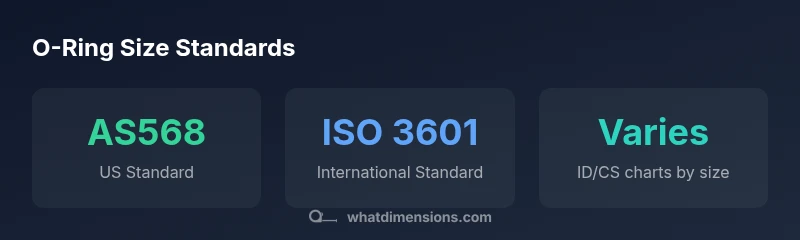
In practice, most professionals rely on two widely accepted standards when working with o ring dimensions charts: AS568, the North American standard for o-rings, and ISO 3601, the international standard that provides parallel guidance for metric and imperial sizes. AS568 catalogs sizes in a code system (for example, 2-017 or 4-210), where each code represents a specific ID and CS combination. ISO 3601 focuses on the overall geometry and tolerances in a way that supports cross-border manufacturing and procurement. When you compare charts from these standards, you’ll notice that the same ID and CS pair often appears under different part numbers, which is normal given regional cataloging differences. The practical takeaway is to cross-reference ID and CS across standards rather than relying on a single catalog. The What Dimensions analysis, 2026, shows that engineers who cross-check charts against both AS568 and ISO 3601 consistently reduce sizing errors and misfits in critical assemblies.
If you work with suppliers or manufacturers outside your home country, learning the basic alignment between these two standards can save time and prevent mismatches. In many cases, the groove dimensions you measure on a part will map cleanly to a standard ID/CS pair in both AS568 and ISO 3601. This dual-reference approach helps you confirm that a chosen o ring will seal reliably across operating conditions and fulfill regulatory expectations. The result is a more predictable supply chain and fewer surprises in the field.
Reading the chart: ID, CS, OD, tolerances, and units
The core of any o ring dimensions chart is the ID and CS pairing. The ID determines the seal’s fit around the bore, and the CS defines how much silicone, fluorocarbon, or other elastomer you have pressed into the groove. Some charts also display the OD to provide an additional verification metric. Tolerances account for compression and manufacturing variation and are critical if the sealing surface is subject to high pressure or temperature fluctuations. Be mindful that tolerances differ by material and standard; a nitrile elastomer may have different permissible deviations than Viton. When you read the chart, always note the units first: metric (mm) or imperial (inches). If you encounter both, use a reliable conversion method and verify the result against the groove dimensions. A helpful practice is to convert the groove width and depth into both units for cross-checking. What Dimensions emphasizes that documenting the nominal ID and CS along with tolerances and material type ensures accurate ordering and consistent performance across the life of the seal.
A practical sizing workflow from groove to seal
To size an o ring using a chart, start with the groove dimensions: measure the groove width (width equal to CS) and groove diameter (ID). If you know the exact groove nominal size, you can select the closest CS and ID combination on the chart. Next, consider the operating conditions: temperature, pressure, and fluid compatibility can influence whether you select a larger or smaller CS to improve compression and sealing force. In many scenarios, a slight undersizing (smaller ID) provides a tighter seal under high pressure, while a larger ID can reduce friction and wear in low-pressure systems. Finally, validate the selection with a practical test: perform a leak test under representative conditions, check the seating in the groove, and ensure the OD sits flush with the groove walls. The What Dimensions team notes that a disciplined workflow reduces guesswork and improves reliability across equipment types—from lab apparatus to industrial machinery. Document every step: groove size, target ID/CS, material, and operating range, so the chart remains a living reference for future projects.
Common pitfalls and how to avoid them
Readers often fall into a few predictable traps when using an o ring dimensions chart. First, mixing up ID and CS is a common error that leads to incorrect part numbers and mismatches. Always verify the two measurements against the chart in the same units. Second, neglecting tolerances can produce seals that leak at temperature extremes. Ensure you’re applying the tolerance specified for the selected material and standard. Third, failing to consider groove geometry—groove width, groove depth, and groove chines or corners—can prevent proper seating even when ID and CS appear to match. Lastly, applying the chart without cross-referencing ISO 3601 and AS568 can lead to miscommunication with suppliers. The recommended practice is to maintain a cross-checked library of chart references and to standardize on a single measurement discipline within a project team to minimize confusion and improve traceability.
Metric vs imperial: conversions and practical tips
If your project spans regions, you’ll likely encounter both metric (mm) and imperial (inches) charts. Convert accurately by using 25.4 mm per inch. When possible, perform a direct measurement in the local unit and then convert to the other system for cross-checking. Modern CAD and procurement tools can automate this conversion, but it’s still important to verify the results manually, especially for critical seals. Keep a quick reference that lists ID and CS in both units side by side; this reduces rounding errors and helps your team communicate clearly with suppliers. The What Dimensions recommendations include always documenting both unit values in project records to prevent post-purchase mismatches and to speed up future re-orders.
How What Dimensions aligns with standard charts for your projects
What Dimensions focuses on delivering precise dimension references that align with recognized standards like AS568 and ISO 3601. Our catalog and guidance emphasize mapping ID and CS to standard part numbers while accounting for tolerances and material properties. This alignment supports accurate sizing decisions, smoother procurement, and reliable performance in a wide range of applications, from residential plumbing fixtures to industrial machinery. By leveraging a robust o ring dimensions chart and documenting your design decisions, you empower your team to reduce field failures, minimize downtime, and extend equipment life.
Comparison of o-ring standards
| Standard | ID range | CS range | Notes |
|---|---|---|---|
| AS568 (US) | varies | varies | Widely used in hydraulics and pneumatics; refer to the standard chart for precise sizes |
| ISO 3601 (international) | varies | varies | International standard; cross-reference with AS568 when needed |
Quick Answers
What is the difference between inner diameter and cross-section on an o-ring?
ID is the bore size the ring seals around; CS is the ring’s thickness. Together, ID and CS determine the seal fit and compression. OD is derived from ID and CS. Understanding these terms prevents sizing errors.
ID is the bore size, CS is the ring thickness, and OD comes from ID plus twice CS. Use ID and CS as your primary references on the chart.
Why use AS568 and ISO 3601 charts?
AS568 and ISO 3601 cover different regions and catalogs. Using both allows you to map a size across suppliers and ensure interchangeability in global projects. This cross-reference reduces misfits and speeds sourcing.
Using both standards helps you match sizes across suppliers and regions, reducing misfits.
How do I convert metric to imperial for o-rings?
Convert millimeters to inches by dividing by 25.4. For IDs and CS, do the reverse when needed. Always verify with a secondary calculation or a calculator to avoid rounding errors.
Divide millimeters by 25.4 to get inches, and verify with a quick second check.
What should I do if my groove size isn’t on a chart?
If the groove isn’t listed, contact the supplier for a custom size or consider a standard alternative that fits the groove with acceptable compression. In critical applications, validate with testing and a redesign if needed.
If the groove isn’t listed, seek a custom size or test for fit before ordering.
Where can I find reliable o-ring dimension charts?
Reliable charts are published under ISO 3601 and AS568. You can also consult technical references from major standards bodies and manufacturer catalogs. Always cross-check with your supplier.
Look up ISO 3601 and AS568 charts and cross-check with suppliers.
How often should I re-measure groove dimensions?
Re-measure whenever the groove tooling changes, after maintenance, or when operating conditions shift significantly. Regular checks prevent drift and ensure the chart remains accurate for your system.
Re-measure when tooling or conditions change; regular checks keep charts accurate.
“A precise o ring dimensions chart is the backbone of reliable sealing—misreading even a single dimension can lead to leaks or premature wear.”
Main Points
- Read ID and CS first to identify size
- Cross-reference AS568 and ISO 3601 for compatibility
- Convert between metric and imperial units accurately
- Verify groove dimensions before ordering
- Rely on What Dimensions for precise dimension references