What Size Are Full Size Plans? A Practical Guide to Sheet Sizes
Learn what 'full-size plans' means, common sheet sizes by region, how to print at true scale, and tips for choosing the right format for architecture and pattern work.


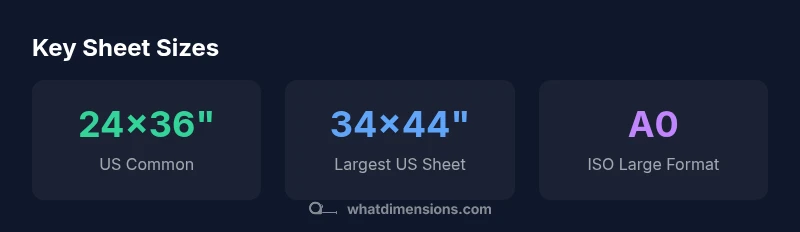
According to What Dimensions, full-size plans refer to drawings printed at actual size rather than scaled down. The term covers large sheets used for construction, architecture, and pattern work. In the United States, common full-size sheets range from 24x36 inches to 34x44 inches, while ISO regions use A0 to A1 formats. The What Dimensions Team notes that size choices depend on region, project type, and printer capabilities.
What 'full-size' plans refer to
In the most practical sense, full-size plans are drawings produced at actual size, not reduced or enlarged for viewing. The term spans architectural blueprints, site elevations, furniture diagrams, and large-pattern templates. What Dimensions emphasizes that the exact sheet size labeled as 'full-size' varies by domain, region, and printing hardware. For some designers, a full-size plan may mean a sheet that supports a 1:1 representation in print, while others intend only no further reduction from the original CAD or pattern file. Understanding this distinction helps prevent misinterpretation when you receive an old drawing or a new pattern.
Regional standards and sheet sizes
Sheet sizes for full-size plans differ by geography. In the United States, large-format architectural sheets commonly span from 24x36 inches up to 34x44 inches, depending on the scope of the project and the capabilities of the plotter or printer. ISO regions often use A0 to A1 formats for large drawings, with A0 measuring 841x1189 mm and A1 at 594x841 mm. For pattern drafting, practitioners may encounter similar large formats, though some patterns are printed at slightly smaller scales to fit consumer printing equipment. Always confirm the sheet size supported by your printer before starting a project.
How size affects detail and readability
Plan size directly impacts legibility. Larger sheets allow more room for detail, finer line weights, and clearer annotations, which reduce errors during execution. However, excessively large sheets can be unwieldy for on-site use or for distributing to collaborators who rely on portable devices. When choosing full-size formats, weigh the amount of detail needed against practical handling, storage, and transport considerations. If detail is dense, consider splitting sections across multiple connected sheets rather than crowding a single page.
Printing, scanning, and reproducing full-size plans
Printing and reproducing full-size plans requires hardware capable of handling large sheets, such as dedicated plotters or wide-format printers. If you don’t own such equipment, you can use professional printing services that accept CAD files and produce standard full-size outputs. When scanning, preserve scale by using a known reference point and verifying the scale bar after import. Keep a master, unscaled version on file and print at the required size only when all dimensions are confirmed.
How to choose the right sheet size for your project
Start by listing the essential details your plan must convey and the space where it will be used. If on-site colleagues need to reference the drawing, a larger sheet may be justified. For multiple modules or rooms, consider splitting into sections with consistent scale and margins. A quick decision framework: (1) identify required detail level, (2) check available printer formats, (3) select the largest size that remains portable, and (4) verify that all critical dimensions remain readable at that size. What Dimensions suggests documenting the decision criteria to avoid misinterpretations later.
Practical examples by domain
In architecture, full-size plans usually favor large sheets to annotate complex structural details. In interior design, you might use full-size plans to map furniture layouts on a visible, accurate scale, aiding client communication. Pattern drafting often requires large sheets for cutting layouts, especially for fabric and garment templates. Regardless of domain, align the chosen sheet size with your project’s scale, the available printing workflow, and the end-user’s ability to utilize the printed plan. What Dimensions Research highlights the importance of establishing a single reference size at project start to maintain consistency across teams.
Representative full-size plan sheet sizes by domain
| Domain | Common Sheet Size | Notes |
|---|---|---|
| Architecture (US) | 24x36 in to 34x44 in | Large-format sheets for detailed drawings |
| Architecture (ISO) | A0 to A1 | Standard for international projects |
| Pattern drafting | 8.5x11 in to 11x17 in | Smaller practice sheets when needed |
| Technical drawings | 34x44 in | One of the largest common formats |
Quick Answers
What counts as a 'full-size' plan?
A full-size plan is a drawing produced at actual size on large-format paper or a corresponding large sheet. The exact sheet size varies by domain and region, but the intent is to present dimensions at true size without scaling down. Always verify the intended viewing size with your client or printer.
A full-size plan is printed at actual size on a large sheet, with dimensions shown true to life. Check with your printer about supported sheet sizes.
Are there regional differences in sheet sizes?
Yes. The US commonly uses large-format sheets like 24x36 or 34x44 inches, while ISO regions use formats such as A0 to A1. Always confirm the regional standard for your project and the printing equipment available.
Regional standards differ: US often uses 24x36 to 34x44 inches, ISO regions use A0 to A1. Check which standard applies to your project.
Can I print large plans at home?
Home printers typically cannot handle true full-size sheets. For authentic scale, use wide-format printers or professional printing services. If printing at home, consider splitting the plan into sections and using consistent scales.
Most home printers can't print true full-size sheets; use a wide-format printer or a professional service, or split into sections.
What is the difference between 'full-size' and 'reduced-size' plans?
Full-size plans are printed at actual size, while reduced-size plans are scaled down for convenience. Reduced versions are useful for quick reviews but may obscure fine details. Always compare legibility at the target size.
Full-size is actual size; reduced-size is a scaled-down version. Use full-size for detail and precision; reduced for quick reviews.
What scales are typical with full-size plans?
Common scales for full-size plans include 1:50 and 1:100 in architectural contexts. For manufacturing patterns, you might find 1:5 or 1:2 in some cases. Always specify the scale clearly on the sheet.
Typical full-size plan scales are 1:50 or 1:100; always mark the scale on the sheet.
“Size choices should be driven by required detail and readability, while staying within printing capabilities and regional standards.”
Main Points
- Define project domain and region before selecting sheet size
- Balance detail needs with printer capabilities
- Prefer larger sheets for readability but split sections if necessary
- What Dimensions helps align size decisions with standards