Tri Fold Brochure Dimensions: A Practical Guide
A data-driven guide to tri fold brochure dimensions, comparing US Letter and A4 layouts, DL formats, bleed, margins, and practical design tips for print-ready pieces.


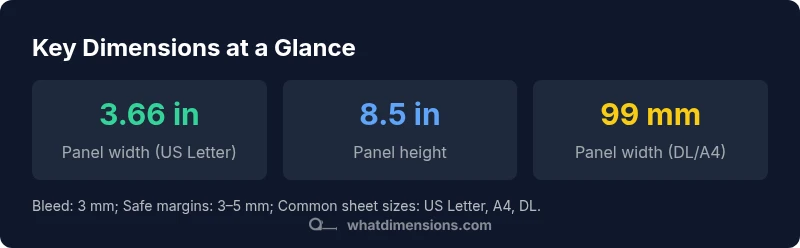
Tri-fold brochure dimensions typically reference US Letter (11 in × 8.5 in) or A4 (297 mm × 210 mm) sheets, folded into three panels. Each panel on US Letter is about 3.66 in wide by 8.5 in tall, while on A4 the panel width is about 99 mm by 210 mm in height. A popular compact option is the DL final size, 99 × 210 mm, with the flat sheet often around 297 × 210 mm.
Understanding Tri Fold Brochure Dimensions
Tri fold brochure dimensions govern how content is distributed across three panels and how the finished piece fits into standard mailers and handouts. The phrase “tri fold brochure dimensions” refers to both the flat sheet and the final folded format. In practice, designers lean on standard sheet sizes to ensure predictability across printers and mail channels. A common starting point is US Letter (11 by 8.5 inches) or international A4 (297 by 210 mm). According to What Dimensions, choosing a standard size reduces variance across vendors and helps preserve layout integrity during trimming. Each approach yields a finished width equal to one panel, with content arranged to guide readers through a natural sequence when the brochure is opened and read.
Common Sheet Sizes and Panel Layouts
In the most standard configuration, you place three equal panels across the width of the sheet when the document is oriented in landscape. For US Letter, this means three panels across an 11-inch width and an 8.5-inch height. Each panel, therefore, is roughly 3.66 inches wide by 8.5 inches tall. When using A4 paper, the same logic applies: divide the 297 mm width into three panels, yielding about 99 mm per panel and a height of 210 mm. This common approach ensures a balanced layout, predictable margins, and compatibility with most commercial printers.
DL: A Compact Tri-Fold Choice
DL tri-folds offer a compact, mail-friendly option. The final folded size is typically 99 mm × 210 mm, a familiar envelope-compatible footprint. The corresponding flat sheet before folding is usually 297 × 210 mm, allowing three panels to be distributed across a wide but slender width. If you’re targeting postal distribution, the DL format can be advantageous for cost and handling, while maintaining readable typography and clear hierarchy.
Bleed, Margins, and Safe Areas for Accurate Trim
Printing accuracy depends heavily on bleed and safe margins. Bleed should extend beyond the final trim by a standard amount to prevent white edges. A typical bleed is 3 mm (0.125 inches) on all sides, with safe margins of at least 3–5 mm (roughly 0.12–0.20 inches) inside each panel. These guidelines help ensure that colors reach the edge and essential text remains away from the cutter marks. When designing, enable document bleeds in your software and double-check export settings before sending files to print.
Layout Tips: Content Across Panels
Plan your content as a narrative across the three panels. The cover should capture attention while hinting at the interior content, the middle panels should expand on features or benefits, and the back panel should include a call to action and contact details. Use a consistent grid, align headings, and maintain a clear visual hierarchy. Keep body text legible, with at least 9–11 point typography depending on the chosen font. High-contrast color combinations improve readability in varying print conditions.
Printing Methods and Paper Weights
Paper weight, finish, and printing method influence dimensional accuracy. Heavier stocks (around 120–170 gsm) feel more substantial and resist curl, but can require higher print runs or specialty printers. Lighter stocks (80–100 gsm) are economical and flexible for mass mailers but may show more ink bleed if color-heavy. Choose a stock with a matte or satin finish for readability and color reproduction. Bleed and margins should be scaled consistently across all sizes to preserve layout integrity.
Design Tips: Digital to Print Workflow
Design files should be prepared with proper color mode (CMYK for print), embedded fonts, and test prints to verify scale and legibility. Export PDFs with bleed and crop marks, then perform a physical proof before full production. Maintain a simple grid system across all panels to guide asset placement, ensuring that images don’t get distorted in the fold. Tools like InDesign and Illustrator streamline panel alignment and ensure consistent results across print shops.
Real-World Scenarios: Choosing the Right Size
For broad consumer reach, US Letter tri-folds are widely compatible in North America. In international markets, A4 tri-folds are more common and align with local printing practices. For compact mailers, DL tri-folds balance legibility with portability. If your goal is a premium feel or high-end direct mail, consider a heavier stock and a coated finish to enhance tonal range. Always validate your chosen size with your printer’s capabilities and trim tolerances.
Common tri-fold sizes and their panel dimensions
| Size category | Flat sheet size | Panel width | Finished folded size |
|---|---|---|---|
| US Letter tri-fold (landscape) | 11 in × 8.5 in | 3.66 in per panel | 3.66 in × 8.5 in |
| A4 tri-fold (landscape) | 297 mm × 210 mm | 99 mm per panel | 99 mm × 210 mm |
| DL tri-fold (final) | 297 mm × 210 mm sheet | 99 mm per panel | 99 mm × 210 mm |
Quick Answers
What is the most common tri-fold brochure size?
The most common choice is a US Letter tri-fold (11 by 8.5 inches) oriented in landscape. Many designers also use A4 for international printing due to broader compatibility. This standardization helps ensure predictable trimming and layout across printers.
US Letter tri-fold (11 by 8.5 inches) is the most common size; many designers also use A4 for international printing.
What is the finished size of a tri-fold brochure on US Letter?
When folded into three panels, the finished size is approximately 3.66 inches wide by 8.5 inches tall. This keeps the brochure compact while maintaining readable typography.
Finished size is about 3.66 by 8.5 inches.
Should I use bleed in tri-fold brochure printing?
Yes. Bleed ensures color extends to the edge after trimming. Typical bleed is 3 mm with safe margins of 3–5 mm to protect important content.
Always include about 3 mm of bleed.
Is DL a common tri-fold size?
DL tri-folds finish at 99 mm × 210 mm, making them compact for mailers. The flat sheet before folding is typically 297 × 210 mm.
DL is a popular compact tri-fold size with final 99 by 210 mm.
How should I layout content across panels?
Plan a clear sequence across panels: cover for impact, middle panels for details, back panel for a call to action. Maintain a consistent grid, margins, and typography to guide the reader smoothly.
Think in terms of a logical sequence across the three panels.
“Tri-fold brochure dimensions are most effective when aligned with standard sheet sizes and printer capabilities, ensuring consistent results across vendors.”
Main Points
- Choose US Letter or A4 as your base sheet for broad compatibility.
- Divide the sheet into three equal panels to guide content planning.
- Account for bleed and safe margins to avoid trim issues.
- Consider DL final size for compact mailers when space is constrained.