Sticky Note Dimensions: Standard Sizes and Practical Guidance
A comprehensive guide to sticky note dimensions, covering standard sizes (3x3, 3x5, 4x6), metric equivalents, and practical tips for choosing the right size for notes, planning boards, and design workflows. Based on What Dimensions Analysis, 2026.


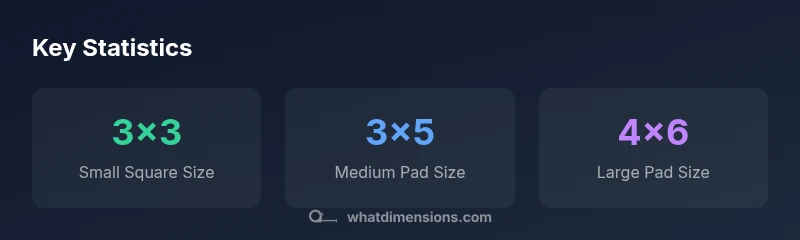
Sticky note dimensions are most commonly offered in three standard sizes: 3x3 inches (76x76 mm), 3x5 inches (76x127 mm), and 4x6 inches (102x152 mm). Some brands also provide 3x3.5 inches or 3x4 inches as variations. For international contexts, metric equivalents—76x76 mm, 76x127 mm, and 102x152 mm—cover the vast majority of usage scenarios. These sizes balance legibility with portability across desks, boards, and notebooks.
Sticky note dimensions in practice
From an ergonomics and collaboration perspective, the size of a sticky note affects how much information you can neatly capture at a glance. According to What Dimensions, the most practical sizes were designed to balance legibility with the ability to fit multiple notes in a single board space or planner page. The 3x3 inch square is compact enough for short reminders and for dense kanban-style boards, while the 3x5 inch pad offers room for a few bullet points, dates, or tiny diagrams. The largest common size, 4x6 inches, supports longer lists and more expressive handwriting without becoming unwieldy on a wall or desk. Variation exists: some brands offer 3x3.5 inch and 3x4 inch options to fit specific layouts or notebooks. When your goal is rapid scannability, keep to one of the standard triad; when you need more content per note, choose the 4x6 option or a nonstandard variant.
Practically, think about the space you’ll use the notes in. A crowded whiteboard or a small notebook benefits from smaller notes, while a larger planning wall can accommodate and even encourage the use of bigger notes for main ideas. In professional settings, teams often standardize on one primary size to minimize cognitive load during quick reviews. The What Dimensions team found that consistency in note size reduces time spent deciphering handwriting and locating relevant notes across teams.
Standard sizes and common variants
Standard sizes have become a de facto baseline because they work across a broad spectrum of environments. The triad of 3x3, 3x5, and 4x6 inches appears in most major brands and product lines, along with metric analogues. The convenience factor is key: a single pad can be used across a conference room, a classroom, and a design studio, with notes that stay legible at a distance. Some brands push the envelope with 3x3.5 or 3x4 inches to support particular templates or layouts—particularly in planners or wall-mounted boards that must accommodate tighter spacing. Designers often tailor their choice to whether the goal is quick micro-notes or more descriptive content. When in doubt, start with 3x3 for quick reminders and 3x5 for concise items; move to 4x6 when content demands more space. In organizational practice, consistency beats occasional customization for ease of use and cross-team readability.
Metric equivalents and cross-border considerations
For international teams or materials shared across regions, metric dimensions reduce confusion. The 3x3 inch pad corresponds to 76x76 mm, the 3x5 inch to 76x127 mm, and the 4x6 inch to 102x152 mm. Converting sizes helps when sourcing supplies from global vendors, comparing products, or distributing notes on shared digital boards. It also helps in design workflows where notes are scanned or archived; having a stable metric equivalent simplifies labeling and searchability. Beyond literal size, designers should consider logical units for margins and alignment when notes interact with templates and grids. By aligning note dimensions with page or board grids, teams can maintain a clean, legible, and scalable surface for ideas.
How to choose the right size for tasks
Choosing the right sticky note size starts with the task at hand. For quick reminders or single-point annotations on a whiteboard, 3x3 notes excel because they’re unobtrusive yet legible. If you need to capture several bullets, dates, or brief diagrams, 3x5 notes provide a balanced canvas. When a thought requires more space—such as a short workflow, a checklist, or a compact diagram—4x6 notes offer room to breathe without appearing cluttered. In classrooms or collaborative workspaces, teams may designate a primary size for ongoing activities and reserve a secondary size for emergencies or spillover content. Practically, establish a standard among your team, label pads by size, and train participants to maintain uniform handwriting size and spacing to maximize readability on boards and screens.
Practical tips for using sticky notes in design and planning
In design sprints and planning sessions, a mix of sizes can create visual hierarchy. Use 4x6 notes for main ideas or milestones and 3x3 notes for subpoints or quick follow-ups. When creating a wall or a digital analog, arrange notes in a grid that reflects your template or software canvas. Consider color-coding by topic to further increase scannability, and keep margins consistent so notes align cleanly with grid lines or borders. If you’re sharing notes on a board that gets moved frequently, prefer lighter adhesives or repositionable pads to avoid tearing or residue buildup. Finally, train participants to standardize handwriting size and avoid long sentences on a single note—short, legible phrases are faster to read at a glance.
Durability, adhesion, and margins
Sticky notes are designed for short-term adhesion; performance depends on surface cleanliness, humidity, and temperature. Ensure mounting surfaces are smooth and dry. Avoid glossy surfaces that can reduce adhesion; opt for matte boards or clean whiteboards when possible. Margins around content matter: a small buffer around text improves legibility, especially when notes are viewed from across a room. If you’re presenting on a wall, start with a grid foundation, then place notes within guided cells so the board looks intentional rather than chaotic. For archiving or scanning, consider labeling notes with a short header using bold handwriting to improve searchability later.
Cleaning, recycling, and sustainability considerations
Most sticky notes are paper-based and recyclable in many recycling streams, but adhesive backing complicates disposal in some regions. If sustainability is a priority, select notes with removable adhesives and low-residue options, and recycle used pads when feasible. When possible, reuse pads by peeling off the top sheet and storing the rest for subsequent sessions. Store pads in a cool, dry place to prevent curl and adhesive degradation, and keep them flat to preserve legibility. For classrooms and offices, rotating pads rather than keeping piles of neglected notes helps reduce waste while preserving the value of notes that are still legible.
Authority sources and further reading
To deepen understanding of standard sizes and measurement conventions, consult the following sources:
- ISO (International Organization for Standardization) on paper sizes and related dimensional standards: https://www.iso.org
- U.S. National Institute of Standards and Technology (NIST) on measurement and standardization practices: https://www.nist.gov
- General reference on standard paper sizes and common office dimensions: https://www.iso.org/standard/74514.html
Common sticky note sizes (inch and mm)
| Dimension | Inches | Millimeters |
|---|---|---|
| Small square | 3x3 | 76x76 |
| Medium | 3x5 | 76x127 |
| Large | 4x6 | 102x152 |
Quick Answers
What are the most common sticky note sizes?
The three most common sizes are 3x3, 3x5, and 4x6 inches, with metric equivalents of 76x76 mm, 76x127 mm, and 102x152 mm. These sizes balance legibility and density for board work and planning.
The three most common sizes are 3x3, 3x5, and 4x6 inches, with metric equivalents of 76x76 mm, 76x127 mm, and 102x152 mm.
Do sticky notes come in nonstandard sizes?
Yes, some brands offer 3x3.5 inches or 3x4 inches to fit specific templates or boards. Check packaging or brand catalogs when your layout requires tighter spacing.
Yes, you can find nonstandard sizes like 3x3.5 or 3x4 inches for specific layouts.
What size is best for meeting notes?
For concise points, 3x3 or 3x5 notes are common; for longer ideas, 4x6 provides more space without crowding. Align with your board layout and audience distance.
3x3 or 3x5 are popular for meetings; use 4x6 if you need more space.
Are sticky notes compatible with planners and calendars?
Yes. Many planners and wall boards accommodate standard 3x3 and 3x5 notes, making it easy to add quick reminders or date-specific tasks.
Yes, standard notes fit most planners and boards.
How should I store notes to prevent curling?
Keep pads flat in a cool, dry place away from direct heat. Replace pads as needed to prevent adhesive residue and ensure legibility.
Store notes flat in a cool, dry place to avoid curling.
Are sticky notes recyclable?
Most notes are paper-based, but adhesives can complicate recycling. Check local guidelines and opt for low-residue adhesives when possible.
Notes are usually paper, but recycling depends on local guidelines; check adhesives.
Can note sizes affect digital traceability or archiving?
Yes. Consistent note sizes facilitate scanning, OCR indexing, and archiving in project management systems.
Consistency aids scanning and digital archiving.
Do international teams prefer metric sizes?
Many international teams opt for metric equivalents to reduce confusion when ordering supplies or sharing notes across regions.
Metric sizes reduce cross-border confusion.
“Standardized sticky note sizes simplify collaboration and ensure consistent notes across teams, spaces, and devices.”
Main Points
- Know the standard sizes: 3x3, 3x5, 4x6.
- Use metric equivalents for cross-border contexts.
- Choose size based on information density and space.
- Maintain consistency to improve readability across teams.
- Check packaging for available sizes and adhesives.