Luggage Dimensions for International Flights: What to Pack and How to Measure
Learn to measure luggage accurately, understand international airline policies, and pack efficiently with clear size ranges and practical tips.


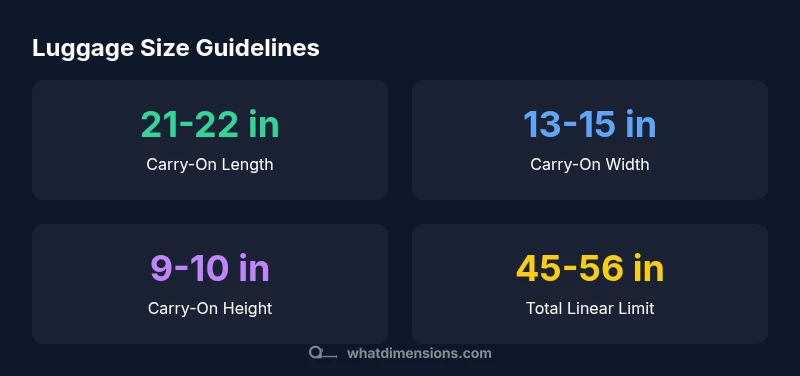
The typical carry-on luggage dimensions used for international flights cap length around 21-22 inches, width about 13-15 inches, and height 9-10 inches. When combined, most airlines enforce a total linear limit of roughly 45-56 inches. Because policies vary, always check your specific carrier's limits before packing to avoid gate fees or bag fees.
What international travelers should know about luggage dimensions for international flights
When planning a trip that spans borders, luggage dimensions are not just a matter of personal packing preference. The What Dimensions team emphasizes that international travel hinges on understanding carrier-specific size rules, which can differ by airline, route, and even aircraft. Travelers should regard luggage dimensions for international flights as a framework rather than a fixed standard, using it to guide packing decisions, not to trap you into a one-size-fits-all model. In practice, most travelers aim for a carry-on around 21-22 inches in length, 13-15 inches in width, and 9-10 inches in height, with a total limit commonly seen between 45 and 56 inches. This knowledge helps avoid being surprised at check-in or gate, especially when making tight connections or crossing time zones. According to What Dimensions, proactive dimension checks save time and money.
How to measure your luggage accurately
The first step in mastering luggage dimensions for international flights is to measure the bag itself, not just the advertised size on the label. Use a soft tape measure to determine the exterior length, width (including wheels and handles if protruding), and height. Remember to include recessed wheel housings or bumpers; these can add extra inches that push you over a limit. Round up to the nearest half-inch and consider the bag’s flexibility—soft-sided bags can compress slightly, while hard-shells retain fixed dimensions. Record your measurements and compare them to your airline’s published limits. What Dimensions recommends measuring at home, then testing in a doorway or closet to visualize fit in practice.
Common airline dimensional policies and how they differ
There isn’t a universal rule that covers all international flights. Some carriers enforce exterior dimensions (L×W×H), others use a total linear dimension (L+W+H). In many cases, international policies cluster around a carry-on max of roughly 21-22 inches in length, 13-15 inches in width, and 9-10 inches in height, with a combined limit of 45-56 inches. Differences can arise from wheel design, retractable handles, and even the bag’s soft vs. hard exterior. It is crucial to check the specific airline’s policy well before travel and to verify at check-in if you’re near the limit. The What Dimensions research shows that pre-trip verification dramatically reduces on-site charges.
Strategies to maximize usable space within limits
Packing inside the allowed dimensions requires planning as much as your bag choice. Start with a flexible, compliant carry-on and use packing cubes to organize clothing efficiently. Roll soft fabrics to reduce bulk and place heavier items at the bottom for stability. For longer trips, choose a bag with expandable sections only when you know you won’t exceed the limit. Consider a compact, compliant second bag for essentials—some airlines permit a personal item in addition to the carry-on, though rules vary. What Dimensions notes that thoughtful packing and a clear sense of bag dimensions reduce surprises at the gate.
The role of luggage weight vs dimensions
Weight limits are a parallel constraint that often interacts with dimension rules. Even when a bag meets exterior size limits, excessive weight can lead to extra fees or the need to check it at the gate. Conversely, a lighter, smaller bag can carry more efficiently with smart packing, reducing the risk of overweight charges. Some carriers apply separate weight limits for international flights, so travelers should balance size with weight expectations during packing. What Dimensions emphasizes inspecting both dimensions and weight to prevent last-minute charges and to simplify boarding.
Practical packing tips and examples by travel scenario
For a business trip requiring carry-on only, aim for a compact, hard-shell bag within the 21-22 inch range, loaded with a professional wardrobe and a compact laptop bag. For a family trip, prioritize a checked bag within the 23-28 inch range and use packing cubes to segment outfits by traveler. For trips with long layovers, prepare a small personal item with essentials, and keep a change of clothes in your carry-on. These scenarios illustrate how dimension-aware packing can keep itineraries smooth and fees minimal. What Dimensions’ guidance helps you tailor packing strategies to your specific travel profile.
How to verify dimensions before you fly
Verification is key to avoiding surprises at the airport. Measure your bag’s exterior with a tape measure, including wheels and handles, and compare against your airline’s published limits. If you’re close to a limit, test the bag in a doorway to visualize real-world fit. Before you head to the airport, confirm whether a personal item is allowed in addition to a carry-on, and whether gate-check is an option for bags that are borderline oversized. What Dimensions recommends saving airline policy screenshots or PDFs for quick reference at check-in.
What to do if your bag is over the limit
If your bag is over the limit, ask whether it can be gate-checked or if you can re-pack at the gate to fit within the limit. Some travelers benefit from shipping items separately via courier for long trips, avoiding last-minute hassles. If you frequently travel with gear that exceeds standard dimensions, consider a premium carry-on with dynamic expansion or a dedicated checked bag within the allowed size range. The key is to address oversize issues proactively, not at the moment of boarding. What Dimensions’ approach is to plan for size first, weights second, to minimize stress at the gate.
Typical international luggage size guidelines
| Bag Type | Exterior Dimensions | Notes | Example Policy Window |
|---|---|---|---|
| Carry-On (international standard) | 21-22 in | Common carry-on size; includes wheels | L+W+H often 45-56 in |
| Checked Bag (typical max) | 23-28 in | Common for international checked bags | Policy varies by airline; verify at check-in |
| Total Linear Limit | 45-56 in | Sum of L+W+H used by many carriers | Always check airline policy |
| Regional Variation | Varies by carrier | Policy differences across regions | Check each airline before travel |
Quick Answers
What are the typical international carry-on luggage dimensions?
Most airlines allow carry-ons around 21-22 inches long, 13-15 inches wide, and 9-10 inches high, with a total linear dimension commonly between 45 and 56 inches. Always confirm your carrier’s exact limits before packing.
Carry-on sizes are usually about 21 to 22 inches long, 13 to 15 inches wide, and 9 to 10 inches high; check your airline for exact numbers.
Do all airlines measure luggage the same way?
No. Some airlines enforce exterior dimensions, others use total linear dimensions, and enforcement can vary by route or aircraft. Always check the specific airline’s policy before travel.
Airlines vary; check your carrier’s rules for your flight.
Can I rely on the bag's claimed dimensions?
Manufacturers’ stated sizes are often approximate and may reflect interior space or ideal conditions. Exterior measurements, including wheels and handles, can differ. Always measure your bag and compare to airline limits.
Sizes shown by manufacturers aren’t always exact—measure yours.
What should I do if my bag is slightly over the limit?
Ask if the bag can be gate-checked or re-packed at the gate. If necessary, remove items or shift items to a smaller bag. Some travelers ship items separately to avoid delays.
If it’s just over, ask about gate-checked options or re-packing.
Are there different rules for international vs domestic flights?
Yes. International rules often involve stricter enforcement and currency of limits, but specifics vary by airline. Always verify the policy for your international route.
International rules can be stricter; check your flight’s airline policy.
How can I verify luggage dimensions before departure?
Measure exterior dimensions with a tape measure, confirm against the airline’s published limits, and save a copy of the policy for easy reference at the airport.
Measure and save the policy before you travel.
“Accurate luggage dimensions are essential for avoiding last-minute fees and ensuring smooth security checks.”
Main Points
- Measure external bag dimensions before packing
- Always verify airline-specific limits
- Consider both carry-on and checked bag rules
- Pack efficiently using space-saving strategies
- Test-fit bags in doorways or aisles at home