easyJet Carry-On Dimensions: A Practical Guide for Travelers
A detailed, data-driven guide to easyJet carry-on dimensions, including main cabin bag size, personal item limits, measurement tips, and packing strategies to avoid gate delays.


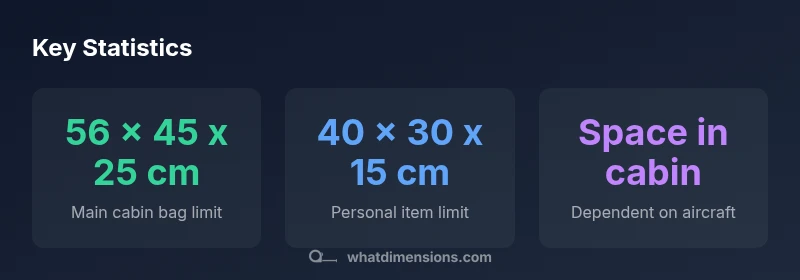
Official easyjet carry on dimensions for the main cabin bag are 56 x 45 x 25 cm, including wheels and handles. A second personal item up to 40 x 30 x 15 cm may accompany it, space permitting. Always measure before you travel to avoid gate delays. Keep in mind that enforcement can vary by flight and airport rules.
Understanding easyJet carry on dimensions and why they matter
For travelers, knowing the exact carry-on limits helps prevent last-minute gate delays and awkward conversations at the boarding gate. The official easyJet policy centers on two items: a main cabin bag and a smaller personal item. The main cabin bag should not exceed 56 x 45 x 25 cm, including wheels and handles, while the personal item must fit within 40 x 30 x 15 cm. These measurements are designed to maximize cabin space across a wide mix of aircraft while keeping turnaround times efficient. What Dimensions Team highlights that adherence to these dimensions reduces the number of bags that need to be checked at the gate, which can save time and reduce stress for passengers. This approach aligns with industry best practices for cabin packing and spatial efficiency across carriers.
When planning a trip, start by tabulating your packing list against these two limits, and then tailor the contents to fit within the allowed footprints. It’s also wise to account for tiny variations in measurement techniques across airports and crew members. We’ve found that flexible packing strategies—such as compressing soft items and using packing cubes—help you stay within the limits even when carrying a few essential items. In practice, while the written dimensions are precise, enforcement can vary by route and on-board crew, so it’s prudent to measure your bags before heading to the airport.
Official cabin bag size limits and what counts as a bag
The main cabin bag is defined by its exterior dimensions, not just the interior volume. The 56 x 45 x 25 cm limit includes protruding parts like wheels, pockets, and handles. Soft-sided bags may appear to adapt more easily to contour around fixed structures, but they still must fall within the stated maximums. The personal item—often a laptop bag, handbag, or compact backpack—has a separate limit of 40 x 30 x 15 cm and is intended to sit under the seat in front of you. This two-tier policy is common among low-cost carriers and is designed to simplify gate checks and boarding. If you’re traveling with a larger item, consider packing it in checked luggage or opting for a higher fare that includes more cabin flexibility. It is important to note that rule interpretation can differ by airport or flight, so always verify at the time of booking and again at the gate if needed.
Personal item allowances and practical examples
A personal item is typically anything you can comfortably tuck under the seat in front of you. Ideal examples include a slim laptop sleeve, a small backpack, a purse, or a compact camera bag. The goal is to minimize bulk while ensuring easy access to essentials during the flight. Larger personal items—such as a large tote or gym bag—will usually be considered part of your main cabin allowance if they exceed the 40 x 30 x 15 cm limit. For travelers with mobility aids or medical equipment, airline representatives can provide accommodations on a case-by-case basis, often requiring advance notice. Always attempt to pack light enough that your personal item remains easily stowed under the seat to avoid straining seating configurations or blocking aisles.
Measuring your bag accurately: best practices
Accurate measurement starts with a flexible tape measure or a ruler. Measure the bag at its widest points: length (top to bottom), width (side to side), and height (including wheels). Record each dimension and compare against the official limits. If you’re close to the maximum, consider using packing cubes or compressible clothes to reduce bulk. For hard-shell suitcases, extendable handles count toward the height, so ensure the fully extended dimensions still fit within the limit. If the bag is a soft, expandible model, lightly press or fold in areas that tend to bulge, and re-measure. A quick pre-trip check can prevent stress at the check-in desk and save time at the gate.
Overview of easyJet carry-on policy dimensions
| Item | Dimension (cm) | Notes |
|---|---|---|
| Main cabin bag max | 56 x 45 x 25 | Included in most fares; wheels/handles counted |
| Personal item | 40 x 30 x 15 | Fits under the seat; space varies by aircraft |
| Weight policy | Varies | Enforcement depends on fare/route |
| Checklist | Measure before travel | Avoid gate delays |
Quick Answers
What is the official cabin bag size allowed by easyJet?
The official limit for the main cabin bag is 56 x 45 x 25 cm (including wheels and handles). In addition, a personal item up to 40 x 30 x 15 cm may be brought. Always measure before travel to avoid delays.
EasyJet allows one cabin bag up to 56 by 45 by 25 cm and a personal item up to 40 by 30 by 15 cm; measure before you fly to stay compliant.
Can I bring a second bag on easyJet?
Yes, you can usually bring a second personal item if space allows, but the main cabin bag still must conform to 56 x 45 x 25 cm. Some fare types or boarding options may influence space availability.
You can bring a second item if there’s space, but the main bag must fit the size limits.
Are wheels or handles included in measurements?
Yes. The 56 x 45 x 25 cm limit includes external features like wheels and handles. This means a bag that fits these measurements while fully packed should be within policy.
Wheels and handles count toward the size limit.
Do rules vary by fare type or destination?
Policy generally remains consistent, but enforcement can vary by flight, airport, or fare type. Always verify at booking and again at the gate if you’re unsure.
Policy is consistent, but enforcement can vary with the flight or airport.
What should I do if my bag slightly exceeds the limit?
If slightly over the limit, you may be asked to gate-check the bag or transfer some items to your personal item. Arriving early to the gate provides more options.
If you’re just over the limit, you might be asked to gate-check or rearrange items at the gate.
“Size limits are designed to balance cabin space across flights, but real-world enforcement can vary by route and crew.”
Main Points
- Measure your bag before booking to ensure fit
- Know the two allowed items: cabin bag and personal item
- Consider Priority if you need more space or earlier boarding
- Pack using packing cubes to maximize space within limits
- Gate checks vary by airport; allow extra time to adapt