Check Bag Dimensions: A Practical Travel Guide
Learn how to check bag dimensions accurately before flights. This step-by-step guide covers measuring length, width, and height, and how to compare with airline limits to avoid fees.


Learn how to check bag dimensions accurately for travel: measure the bag’s length, width, and height, compare to your airline’s stated limits, factor wheels and handles, and verify carry-on vs. checked-bag allowances. This step helps avoid checked-bag fees or gate-check surprises.
Why accurate bag dimensions matter
Checking bag dimensions is a foundational step in smooth travel. Bags that look compact may still push against airline rules once real-world features are accounted for—wheels, corners, or protruding handles can push an otherwise compliant bag into a nonconforming size. The more precise you are with measurements, the fewer surprises you’ll face at check-in or the gate. According to What Dimensions, precise size references help shoppers choose bags that align with common airline policies and reduce friction during the boarding process. After all, a careful check bag dimensions approach isn’t just about length, but about the total envelope your bag presents when traveling.
In this guide you’ll learn a clear, repeatable method you can apply for every trip, regardless of your bag type or airline.
How to measure bag dimensions accurately
Accurate measurement starts with the right tools and a clean workspace. You’ll measure the external three-dimensional envelope of the bag (length, width, height) from the outside, including any bumpers, wheels, or protruding handles. Use a retractable measuring tape for flexibility and a rigid ruler for extra precision on flat edges. Record each dimension in both inches and centimeters to accommodate different airline policies. Keep your measurement session simple: place the bag on a flat, hard surface, compress soft items if needed, and make sure the bag is closed before reading the final numbers. What Dimensions recommends verifying both metric and imperial readings to avoid confusion when you compare against airline limits.
Accounting for wheels, handles, and external features
Wheels add length beyond the core panel, and tall handles can push a bag over the limit even if the main body is compact. Include these elements in your three measurements by measuring from the outermost edge in each direction. If your bag has extendable handles, fully extend and measure in the collapsed position as well. For soft-sided bags, padding or fabric bulks can affect measurements more than a rigid shell might. Keep a small tally of features that add to the envelope so you don’t overlook anything when checking your numbers.
Interpreting airline limits and policies
Airline dimensions can vary by carrier and fare class, so always consult the specific policy for your flight. Look for official size limits published by the airline and confirm whether they distinguish between carry-on and personal items. When you encounter ambiguous language (for example, a listed limit for “dimensions” without clarifying if wheels count), rely on the official policy page or contact customer service for confirmation. This is where a quick check bag dimensions routine saves time and potential fees before you head to the gate.
Packed vs empty: When to measure which version
Some travelers pack items tightly and wonder if the packed size matters for carry-on eligibility. In most cases, for airline carry-ons, you should measure the bag empty and then re-check after packing to ensure the outer envelope remains within limits when fully loaded. If your bag becomes noticeably larger after packing, consider trimming contents or choosing a smaller bag. If a bag barely fits empty, avoid packing to the brim, as contents will expand a bit and could breach the limit.
Practical measurement workflow for every trip
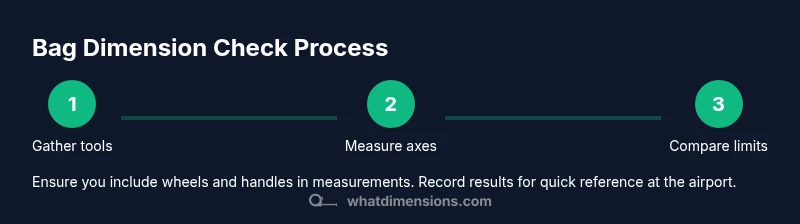
A consistent workflow minimizes mistakes: (1) gather tools and policy sources; (2) measure outer dimensions in three axes; (3) record both inches and centimeters; (4) compare each dimension to your airline’s published limits; (5) adjust packing or bag choice if needed; (6) document the results with a photo for reference. This repeatable routine reduces last-minute stress and helps you travel with confidence. The What Dimensions team emphasizes consistency and record-keeping as cornerstones of reliable bag sizing.
Common mistakes and how to avoid them
Common errors include measuring without including wheels, forgetting to use the outer envelope (edge-to-edge), and mixing up units. Always measure from the outermost points, and ensure the bag is fully closed when reading the height. Another pitfall is relying on a bag’s interior capacity rather than its exterior envelope—airlines check the outside dimensions, not the internal space. Finally, never assume all airlines use the same standard; policy checks should be done per airline and per itinerary.
Tools & Materials
- Retractable measuring tape (60 inches / 150 cm or longer)(For quick, accurate three-axis measurements)
- Rigid ruler or straightedge(Useful for confirming edge alignment on flat surfaces)
- Notebook and pen(Record dimensions in both inches and centimeters)
- Airline policy printout or official app(Reference the exact carry-on and checked-bag limits)
- Smartphone or camera(Take photos of measurements for easy comparison)
- The bag to test(Place on a flat, clean surface during measurement)
Steps
Estimated time: 15-25 minutes
- 1
Gather tools and references
Collect a retractable measuring tape, notebook, and the airline policy you'll use for comparison. Having everything in one place reduces back-and-forth and makes the measurement session efficient.
Tip: Place all items within arm's reach to keep momentum. - 2
Set the bag on a flat surface
Lay the bag on a hard, level surface with zippers closed and exterior pockets zipped. This ensures you measure the outer envelope precisely without interference from contents.
Tip: Avoid soft carpets or uneven ground which can skew results. - 3
Measure length, width, and height
Carefully measure length from the wheel to the tail end, width across the widest point, and height from the base to the topmost point, including wheels, handles, and any protrusions. Record each dimension in inches and centimeters.
Tip: Read each axis at eye level and note the exact reading to the nearest 1/8 inch or 0.5 cm. - 4
Account for wheels and external features
If your bag has wheels or an extended handle, measure with and without the handle extended to capture all potential envelope changes. Include any external pockets that add to the overall size when packed.
Tip: Mark which dimensions include wheels and which include handles for clarity. - 5
Compare against airline limits
Refer to the airline policy you brought and compare each dimension. If any axis exceeds the limit, note the specific axis rather than guessing which part of the bag causes the issue.
Tip: Document a quick yes/no verdict on fit to avoid last-minute uncertainty. - 6
Decide next steps
If it fits, you’re ready to travel with confidence. If not, consider repacking, switching bags, or removing nonessential items to stay within limits.
Tip: When in doubt, test the bag with contents you’ll actually carry.
Quick Answers
What exactly counts toward bag dimensions?
Bag dimensions refer to the outer envelope of the suitcase or bag, including wheels, handles, and any protruding components. Measure the three axes from edge to edge with the bag closed and empty of contents where possible.
Bag dimensions are the outer measurements, including wheels and handles. Measure edge to edge with the bag closed.
How should I handle irregular or soft-sided bags?
For irregular or soft-sided bags, use the largest possible external dimension. Soft materials can compress slightly, so measure with the bag fully closed and packed as you’ll travel. When in doubt, rely on the airline’s policy page.
Measure the outer size when the bag is closed, and verify against airline rules to avoid surprises.
Should I measure empty or after packing?
Carry-on limits generally apply to the bag’s outer envelope regardless of contents, but some airlines are more lenient when empty. Measure empty to establish baseline, then re-check after packing to ensure you stay within the allowed size.
Start with empty measurements, then re-check after packing to confirm fit.
Do wheels and handles count toward the limit?
Yes. Include wheels and extended or retractable handles in your measurements. If a bag’s dimensions are close to a limit, test both extended and collapsed configurations.
Wheels and handles contribute to the total size, so measure with them and without if possible.
How can I quickly verify airline limits for my trip?
Open the airline’s official policy page for your specific fare and route. If anything is unclear, contact the airline directly. A quick check before packing saves time at the airport.
Check the carrier's policy page for your exact flight or ask customer service for confirmation.
What if my bag slightly exceeds the limit?
If your bag is slightly over, you can try repacking to remove nonessential items or switch to a smaller bag. Some travelers opt for a compact carry-on sleeve or a bag with a more forgiving shape.
If it’s just over, try repacking or choosing a smaller bag to avoid penalties.
Watch Video
Main Points
- Check bag dimensions before you travel to avoid fees.
- Measure outer envelope (length, width, height) including wheels and handles.
- Always verify policy specifics for your airline and itinerary.
- Use a repeatable workflow for consistent results across trips.