What Size Needle for Blood Donation: A Gauge Guide
Discover typical needle gauges used in blood donation, why 16 gauge is standard, when 17 or 14 gauge needles appear, and how gauge choice impacts comfort, flow, and safety.


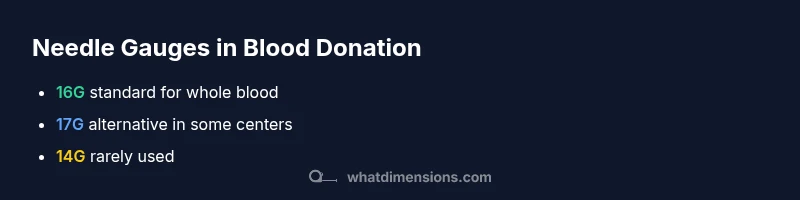
Most whole-blood donations use a 16-gauge needle (about 1.65 mm). Some centers use 17-gauge needles for improved comfort, and 14-gauge needles are rare and reserved for specific protocols. When apheresis or special cases are involved, gauge options can vary. Always follow your donation center’s standard practice. This quick guide summarizes the common gauges and what they mean for donors.
What size needle for blood donation: Key gauges
The needle gauge system uses a larger gauge number to indicate a smaller needle diameter. In blood donation, the gauge choice is focused on balancing flow rate, vein size, and donor comfort. For most donors, the standard needle is 16 gauge (approximately 1.65 millimeters in diameter). In some centers, a 17-gauge needle (about 1.47 millimeters) is used to reduce tissue trauma for some veins or anxious donors. A 14-gauge needle (about 2.1 millimeters) is rarely used for routine donations but may appear in select protocols or research settings. Understanding these numbers helps donors recognize the terminology staff will use and what it implies for draw time and comfort.
Common gauge sizes for standard donations
In routine whole-blood donation, 16 gauge is widely regarded as the default because it provides a reliable balance between rapid blood collection and vein tolerance. Some facilities may offer 17 gauge as an alternative if a donor has smaller veins or if staff are aiming to reduce insertion discomfort. A 14 gauge needle, while larger, is uncommon for standard donation and is typically reserved for specific clinical scenarios where rapid, high-volume sampling is necessary or when specific equipment requires it. Always expect the center’s standard practice and consult staff if you have a preference or a medical reason to request a different size.
How vein size and anatomy influence needle selection
Vein diameter, wall thickness, and venous return all influence gauge choice. A larger needle (lower gauge number) can improve flow for some donors but may increase insertion pain and tissue trauma in others. Conversely, a smaller needle (higher gauge number) can be gentler on the tissue but may reduce flow rate. Skilled phlebotomists assess vein quality, disability to hold still, and prior donation history to select the most appropriate gauge. If you have a known vein size concern, discuss it before your donation.
Donor comfort and procedural flow: balancing speed and safety
While 16 gauge is common, some donors report less discomfort with 17 gauge due to a slightly smaller bore, and staff can adjust the process by choosing different arrays of equipment and needle lengths. Flow rate matters because faster donations shorten the procedure but must not compromise safety. Centers optimize the combination of needle gauge and collection flow with monitoring for signs of vein irritation, infiltration, or excessive bleeding. Donors should report unusual pain or swelling immediately.
Center protocols and staff roles in gauge decisions
Needle gauge decisions are part of an established protocol at each center. Trained clinicians evaluate vein quality, patient history, and the planned collection method—whether whole blood or apheresis—to determine gauge and equipment. The goal is to maintain donor safety, ensure adequate donation volume, and minimize venous irritation. If you have a concern about gauge size,ask the staff to explain how their protocol aligns with your vein condition.
Practical questions for donors about needle size
Before or during donation, you can ask: What gauge will be used and why? Are there alternatives if I have small veins or prior adverse experiences? How does gauge affect the draw time and post-donation recovery? Staff can explain how the selected gauge balances comfort, flow, and safety and what to expect during the venipuncture and insertion.
Needle gauge options for blood collection
| Aspect | Gauge | Notes |
|---|---|---|
| Whole Blood Donation | 16 gauge (1.65 mm) | Most centers use this gauge for standard donation |
| Alternative Gauge | 17 gauge (1.47 mm) | Used in centers aiming for comfort with smaller veins |
| Larger Gauge | 14 gauge (2.1 mm) | Rarely used; reserved for specific protocols |
| Apheresis/Other | 15-16 gauge (1.83-1.65 mm) | Procedure-dependent; device-specific |
Quick Answers
Is 16 gauge always used for donated blood?
Not always. Many centers default to 16 gauge, but staff may choose 17 gauge or other sizes based on vein size and the specific donation protocol.
Most centers use 16 gauge as the default, but staff may select 17 gauge depending on the donor's vein and protocol.
Can I request a different gauge?
You can discuss gauge preferences with the donation staff, but final size depends on vein assessment and protocol. They will prioritize safety and efficiency.
You can mention your preference, but the staff will decide based on vein size and safety guidelines.
What factors determine gauge choice?
Vein size, venous stability, prior donation history, and the planned collection method (whole blood vs. apheresis) influence gauge selection.
Vein size, stability, and the type of donation determine gauge choice.
Does needle size affect pain?
Pain perception varies; some donors find larger gauges gentler in practice due to faster flow, while others prefer smaller gauges to minimize insertion discomfort. Staff balance these factors case by case.
Pain can vary; staff tailor gauge to balance comfort and flow.
Are gauge sizes different for apheresis?
Yes. Apheresis may use a different gauge range depending on device requirements and treatment goals, separate from routine whole-blood donation.
Apheresis uses gauge sizes that depend on the specific device and procedure.
What safety measures accompany needle sizing?
All procedures follow sterile technique, single-use needles, and trained staff oversight to prevent infection and ensure proper venous access.
Safety comes first with sterile equipment and trained personnel.
“Precise needle sizing matters not only for donor comfort but also for achieving steady flow and minimizing vein trauma during blood collection.”
Main Points
- Choose 16G as the default for most donations
- Alternate gauges (17G, 14G) occur for specific cases
- Vein size and comfort influence gauge choice
- Ask staff about gauge rationale and alternatives