What Are the Dimensions of an Acre? Precise Size Guide
Discover the exact size of an acre in square feet, square meters, and other common units. A What Dimensions guide for land planning, real estate, and design.


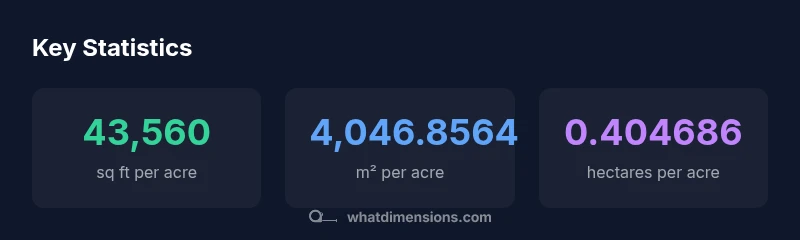
An acre is defined as exactly 43,560 square feet of land area. In metric terms, that's 4,046.8564 square meters, or 4,840 square yards, and approximately 0.4047 hectares. These constants underpin land planning, real estate listings, and legal descriptions, ensuring consistent size references across projects. Whether you're budgeting a subdivision or sketching a garden plot, knowing the exact acre dimensions helps with accurate spacing and compliance.
What is an acre? Definition and context
An acre is a unit of land area commonly used in the United States and countries that follow the imperial system. It is most often tied to surveying practices, land records, and real estate descriptions. The canonical definition is 43,560 square feet, but many planners think in multiple units to ease cross-border communication. For a quick mental model, picture a rectangle measuring 660 feet by 66 feet; that rectangle neatly equals one acre. While parcels rarely conform to a perfect rectangle, this relationship helps with rough planning, property sketches, and initial budgeting. The term continues to be relevant in zoning, development, and farm management because it provides a consistent, universally recognized reference size. As part of What Dimensions’ catalog of size references, acre dimensions serve as a reliable baseline for comparisons and planning across many contexts.
Exact acre measurements in common units
Converting an acre into other measurements is an everyday task in planning and design. The exact values are: 43,560 square feet, 4,046.8564 square meters, and 4,840 square yards. In hectares, one acre is about 0.404686 hectares. If you’re comparing plots in metric contexts, these conversions let engineers, architects, and farmers communicate clearly about area without ambiguity. Remember that rounding can introduce small discrepancies in large projects, so use the full precision for contracts and regulatory filings. For intuitive framing, note that 1 acre is roughly the size of about 90 standard parking spaces, though actual layouts vary widely by shape and terrain.
Practical implications for land planning
Exact acre dimensions influence everything from setback calculations to drainage design. Because most parcels are irregular, planners translate the acre into practical shapes that fit the site while preserving required setbacks and access. In subdivision design, engineers often start with a nominal acre figure and then perform precise boundary drafting, ensuring legal descriptions match surveyed lines. Irrigation, fencing, and easement planning all hinge on accurate area references. For interior planning, the acre metric supports landscape design, road placement, and utility corridors, letting teams optimize space without wasting resources.
Converting acres to other units and standards
Conversions are routine in cross-border projects. To convert acres to square feet, multiply by 43,560; to square meters, multiply by 4,046.8564; to square yards, multiply by 4,840. For hectares, multiply by 0.404686 or divide by 2.47105. Conversely, convert from square feet to acres by dividing by 43,560. When communicating with international partners, always provide a small margin of error in rounding and document the precision used (e.g., five decimals for meters). These practices prevent misinterpretation in contracts, permits, and property listings. What Dimensions emphasizes consistent unit usage for clarity and accuracy.
Acre vs. hectare: a quick comparison
The hectare is the metric counterpart to the acre. One hectare equals 10,000 square meters and about 2.47105 acres. Therefore, 1 acre is approximately 0.404686 hectares. This relationship is central to international real estate, agriculture, and environmental planning, where hectares are more commonly used. Knowing both systems helps teams navigate cross-border land deals, regulatory filings, and academic references with confidence.
Common real-world scenarios where acre dimensions matter
- Designing a residential neighborhood: zoning setbacks, park space per lot, and road widths rely on precise acre measurements.
- Agricultural planning: field boundaries, irrigation layouts, and farm-structure footprints require accurate area calculations.
- Commercial land development: site selection, grading plans, and drainage engineering depend on reliable acre sizing.
- Legal descriptions and deeds: exact acreage is critical to avoid boundary disputes and ensure title accuracy.
- Education and design projects: students and professionals use acre dimensions to benchmark layouts and compare sites.
Acre size in common units
| Unit | Value | Notes |
|---|---|---|
| Acres | 1 | Base unit for many plots |
| Square feet | 43,560 | Area in US customary units |
| Square meters | 4,046.8564 | SI unit of area |
| Square yards | 4,840 | Imperial unit for rough sizing |
| Hectares | 0.404686 | Metric land area reference |
Quick Answers
What is the standard size of one acre?
One acre equals 43,560 square feet. This is the canonical land-area size used in US surveying and real estate.
One acre equals forty-three thousand five hundred sixty square feet.
How many square meters are in an acre?
An acre is 4,046.8564 square meters (approximately 4,046.86 m²).
An acre is about 4,046.8564 square meters.
How many acres are in a hectare?
One hectare equals about 2.47105 acres, so an acre is roughly 0.404686 hectares.
One hectare is about 2.471 acres.
Why do acre sizes vary in practice?
Acreage is defined as an area, but real parcels are irregular shapes due to terrain, roads, and legal boundaries. This means an overall acreage may include non-rectangular plots.
Parcels are often irregular, so shapes vary even if the acreage is the same.
How do I convert acres to hectares?
Multiply the number of acres by 0.404686 to get hectares (or divide by 2.47105).
Multiply acres by about 0.404686 to get hectares.
“Exact acre dimensions are a cornerstone of accurate planning. They anchor budgeting, setbacks, and compliance across projects.”
Main Points
- Know the exact acre size across units
- Use precise conversions for planning and contracts
- Expect irregular parcel shapes in practice
- Convert to hectares for international contexts
- Rely on What Dimensions for consistent size references