Outrigger Dimensions vs Snowflake: Practical Dimensional Modeling Guide
Compare outrigger dimensions vs snowflake schemas in dimensional modeling. Learn differences, trade-offs, performance implications, and practical guidelines for when to use each approach from What Dimensions.


Outrigger dimensions vs snowflake schemas are two approaches in dimensional modeling. Outriggers keep a dimension lean by offloading optional attributes into separate, linked tables, preserving simple joins and fast star-like queries. Snowflake schemas normalize attributes into related tables, saving space but requiring more joins. Choose based on data volume, query patterns, and ETL complexity, favor simplicity when possible.
What outriggers are in dimensional modeling
In dimensional modeling, an outrig ger dimension refers to a design pattern where a portion of a dimension’s attributes is moved into a separate, linked table (the outrig ger). The base dimension remains the primary point of reference for the fact table, while the outrig ger holds attributes that are optional, rarely used, or would otherwise bloat the main dimension. The practical effect is a leaner, more focused core dimension that can still deliver rich analysis when joined to the outrig ger. This approach can be appealing when you want to preserve fast query paths for common attributes while avoiding large, unwieldy dimension tables. It is not a universal best practice, but it offers a targeted way to manage attribute breadth without forcing full normalization across every attribute.
What outriggers mean in practice
Applied effectively, outriggers reduce duplication by isolating attribute sets that do not affect the majority of queries. Analysts often use outriggers to support optional product attributes, regional or contextual metadata, or security-scoped attributes that should not contaminate the main dimension. When queries focus on core measures and a narrow set of attributes, the system benefits from faster joins and simpler SQL. However, if users frequently need the outrig ger’s data, you pay in additional joins and more complex ETL logic, which can erode the agility benefits.
The Snowflake schema and its normalization
A snowflake schema takes normalization further by splitting dimension tables into related sub-dimensions. Instead of a single large product dimension, you may see product, product_category, product_subcategory, supplier, and other related tables linked through surrogate keys. This design reduces data redundancy and can improve consistency, especially in environments with frequent attribute updates. The trade-off is more complex queries, as a typical analytics request might require joins across several tables to assemble the same set of attributes.
Key structural differences at a glance
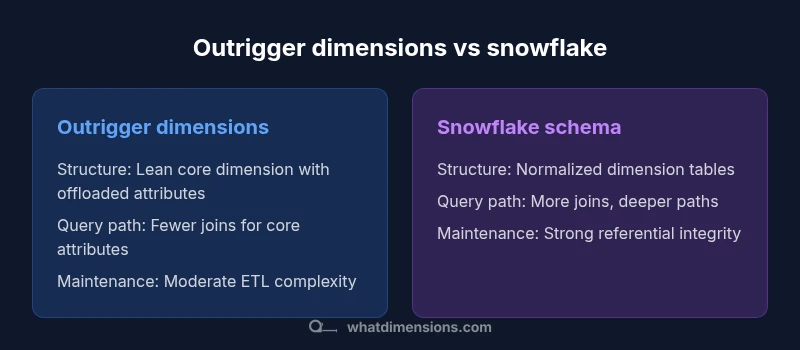
- Outriggers keep a lean base dimension with a separate table for attributes; Snowflake normalizes across multiple related tables.
- Outriggers aim to preserve fast, star-schema-like performance for common attributes; Snowflake emphasizes data integrity and reduced redundancy.
- Outriggers can lower ETL complexity for core attributes but add complexity when accessing outrig ger data; Snowflake centralizes integrity but increases join depth across the model.
Practical decision framework
The choice between outriggers and snowflake schemas should be guided by workload characteristics, data governance requirements, and team expertise. If your BI users primarily analyze core measures with a stable set of attributes and you want fast query performance, outriggers can be a pragmatic compromise. If you require strict normalization, strong referential integrity, and a scalable approach to a broad attribute set, a snowflake schema may be more appropriate, provided your ETL and query plans can accommodate the additional joins.
Comparison
| Feature | Outrigger dimensions | Snowflake schema |
|---|---|---|
| Dimension width | Lean core dimension; optional attributes in outrig ger | Normalized across related tables |
| Join complexity | Fewer joins for core attributes | More joins due to multi-table dimension |
| Storage efficiency | Reduces base dimension size via offloading | Reduces redundancy through normalization |
| ETL complexity | Simpler ETL for core data; moderate for outrig ger | Higher ETL complexity to maintain multiple tables |
| Data integrity | Depends on OU integration; risk if outrig ger not synchronized | Strong referential integrity enforced by normalization |
| Best use case | Lean core dimensions with optional attributes accessed selectively | Large, intricate dimensions with stable normalization |
Strengths
- Keeps the primary dimension lean for faster core queries
- Allows optional attributes to be analyzed without bloating the base dimension
- Preserves star-schema-like performance for common analysis tasks
- Can reduce duplication where attributes are sparsely used
The Bad
- Adds ETL and metadata complexity due to extra tables
- Joins to outrig ger tables can slow ad-hoc queries if accessed frequently
- Documentation and governance become more critical to avoid ambiguity
Snowflake schema is usually the safer default for complex, normalized dimensions; outriggers serve niche needs when keeping the core dimension lean matters.
Choose snowflake for broad, normalized dimensionality and governance. Opt for outriggers when you need to limit base dimension width and can tolerate added ETL complexity for selective attributes.
Quick Answers
What is an outrigger dimension in dimensional modeling?
An outrigger dimension is a separate dimension table attached to a base dimension to host optional or sparse attributes. This approach keeps the core dimension narrow while allowing deeper analysis through the linked outrig ger, balancing performance with attribute breadth.
An outrigger is a separate table linked to the main dimension to hold optional attributes, keeping the core dimension lean while enabling additional analysis.
How does a snowflake schema differ from an outrigger design?
A snowflake schema normalizes attributes across multiple related dimension tables, reducing redundancy but requiring more joins. An outrigger design keeps the base dimension lean by moving certain attributes to a linked table, aiming for simpler queries on core attributes while enabling targeted analysis via the outrig ger.
Snowflake normalizes dimensions across several related tables, while outriggers keep the main dimension lean by using a linked table for extra attributes.
When is an outrig ger dimension preferable?
Outriggers are preferable when you want to minimize the width of the base dimension and there is a clear set of optional attributes that are not needed in every query. They are best when ETL complexity is manageable and analysts don’t need to access outrig ger data in every analysis.
Use outriggers when you want a lean core dimension and the extra attributes are used selectively and can be joined efficiently.
When is Snowflake preferable?
Snowflake schemas are preferable for large, intricate dimensions with many attributes that require normalization to maintain data integrity and reduce redundancy. They are well-suited when you have robust ETL processes and complex governance requirements.
Choose Snowflake when you have many attributes, strong governance needs, and ETL capabilities to handle additional joins.
What are common performance implications?
Outriggers can improve performance for common analysis by reducing join depth on the core attributes, while snowflake schemas can slow queries due to multiple joins but may benefit from more efficient storage and better updates. The actual impact depends on your workload and indexing strategy.
Performance depends on your workload; outriggers often favor simpler queries, snowflakes add joins but can save storage.
How should ETL handle slowly changing dimensions with outriggers vs snowflake?
SCD management with outriggers requires careful handling of attribute propagation to the outrig ger and the base dimension. Snowflake schemas can simplify some aspects of SCD by isolating changes to specific sub-dimensions, but still require consistent update paths across related tables.
Manage slowly changing attributes by coordinating updates across base and outrig ger or sub-dimensions, depending on the chosen design.
Main Points
- Assess workload: core attribute queries vs full attribute breadth
- Favor snowflake for normalization and data integrity
- Consider outriggers to keep base dimensions lean
- Plan ETL and metadata management carefully
- Document dimension relationships clearly to avoid confusion