Dimensions of Soccer Ball: Official Sizes and Measurements
Explore official soccer ball dimensions, including circumference, weight, and inflation, plus guidance on selecting the right ball for age and level.


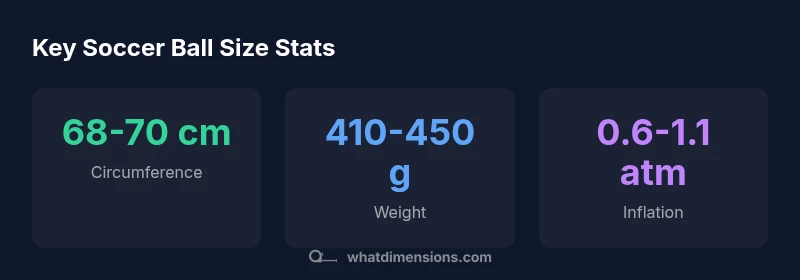
The official match ball is Size 5, with a circumference of 68-70 cm (27-28 inches) and a weight of 410-450 g; youth sizes are smaller (Size 3-4) and used for younger players, while many leagues maintain Size 5 for adults to preserve consistency across levels. Inflation should be maintained within the standard range.
Official dimensions and standards
Understanding the dimensions of soccer ball begins with the official standards. For most adult competition, the standard is Size 5, and the ball's circumference must be between 68 and 70 centimeters, weight between 410 and 450 grams. Inflation pressure is specified around 0.6 to 1.1 atmospheres (roughly 8.5 to 15.6 psi). These ranges come from FIFA guidelines and are widely adopted by leagues and manufacturers. The exact construction (double-ply bladder, synthetic leather panels) affects the ball's roundness and bounce, but the critical dimension is the overall girth and mass, which influence flight, control, and energy transfer when kicked. For players, coaches, and designers, knowing these numbers ensures consistent performance across fields and conditions. In practice, many games use the official Size 5 ball, but youth and beginner programs employ smaller sizes to suit developing players. The key idea: dimensions of soccer ball are not just numbers; they define how the ball travels through air, responds to touch, and interacts with equipment on the field.
Size categories and age guidelines
Soccer balls come in multiple sizes to match age and development. Size 5 is the standard for players aged roughly 12 and above and for most adult competition. Size 4 is common for players around 8–12 years old, with a circumference in the mid-60s range and lighter mass. Size 3 is usually for younger kids, typically under 8, with a smaller circumference (~58-60 cm) and lower weight. When selecting a ball, consider the player’s height, hand-eye coordination, and the league rules. Training on a ball with appropriate dimensions can significantly improve touch, control, and confidence. Always verify that the ball matches your league’s requirements before purchasing, as incorrect sizing can alter performance and safety.
How dimensions influence performance
Ball dimensions profoundly affect flight path, bounce, and contact feel. A slightly larger circumference increases drag, which in turn affects trajectory and arc through the air. Heavier balls retain momentum when struck, producing a crisper feel on kicks but potentially reducing control for beginners. Inflation pressure alters rigidity: underinflated balls have higher deformation and longer bounce times; overinflated balls feel stiffer and harder to control. Coaches emphasize consistent dimensions to ensure players learn with the same feedback mechanisms across drills. In windy conditions, the size and weight interact with surface texture to determine how quickly the ball drifts. For precision passing and shooting, matching the ball to age and level minimizes skill gaps and enhances safety.
Measuring dimensions accurately in practice
Accurate measurement starts with simple tools. To verify circumference, wrap a flexible tape around the ball's widest point and record the reading. Repeat at least three times, rotating the ball between measurements to account for any irregularities. Weight should be measured with a calibrated scale, inside a neutral environment, after the ball has stabilized from being stored at room temperature for several hours. Temperature and humidity can slightly alter material properties, so standardize measurement conditions whenever possible. For inflation, use a reliable pressure gauge and the ball’s valve; verify that the pressure remains within 0.6-1.1 atm under normal playing conditions, and recheck after a few minutes of kicking to account for heat from play. Properly measuring dimensions improves training consistency and matches quality.
Materials, panels, and their relation to size
The external surface and panel configuration can influence how the ball behaves in air and upon contact. Traditional 32-panel designs with synthetic leather surfaces are common in Size 5 balls, but newer models may use fewer panels or different textures to optimize grip and aerodynamics. While panel count can affect touch and bounce characteristics, the official measurements—circumference, weight, and inflation—remain the primary determinants of play quality. Some leagues test balls periodically, especially in youth divisions, to ensure manufacturing tolerances align with standardized dimensions. Players may notice slight differences in feel between brands, but consistent dimensions help preserve fairness and predictable performance during competition.
How to choose the right ball for training vs competition
For training sessions, durability and cost-effectiveness often guide selection. A Size 5 ball that meets standard measurements will still benefit from a slightly softer feel for technical drills. For competition, prioritize balls that strictly adhere to circumference, weight, and inflation specifications; the consistency reduces variables that could impact match outcomes. If your environment includes outdoor weather extremes, consider balls designed for all-season use, offering reliable performance in heat and rain. Portability and storage can also influence choice: semi-hard carry bags or light, compact packaging help teams stay organized. Always confirm league-specific rules before purchasing to avoid mismatches during play.
Global standards and variability by organization
International standards, like those set by FIFA, establish the baseline for Size 5 balls used in professional matches. Some national or regional associations may have additional requirements for youth divisions or school-level play, but the key dimensions remain consistent. In practice, equipment managers monitor ball performance, including roundness, bounce, and seam integrity, to ensure compliance with the official measurements. Advances in materials science continually refine ball performance, allowing for more consistent flight and touch across brands. Despite brand differences, the dimension ranges ensure fair competition and reliable training tools across countries and leagues.
Maintenance, care, and lifecycle
Proper maintenance helps preserve the dimensions and performance of any soccer ball. After training or match play, inspect the ball for visible wear or leaks; store it in a cool, dry place away from direct sunlight to prevent material degradation that could alter circumference or weight over time. Regularly check inflation pressure, especially after temperature fluctuations, and replace the ball if the bladder shows signs of leakage or if the outer cover becomes stretched or torn. Rotating between several balls in a training session can also help maintain consistent feel and performance across sessions. With proper care, a size-appropriate ball can meet official dimensions across many seasons.
Common misconceptions about ball size
A frequent misconception is that a slightly larger ball automatically improves touch. In reality, consistent dimensions are more important for predictable performance than marginal size differences. Another myth is that heavier balls always travel faster; actual performance depends on force, spin, and air resistance, all influenced by circumference and weight within the official ranges. Coaches should educate players on how even small deviations from standard measurements can affect dribbling, shooting accuracy, and ball control. Emphasizing dimension integrity fosters better skills transfer and reduces injury risk from mishandling over-sized or under-inflated equipment.
Key dimensions for official play and youth sizes
| Aspect | Official Range | Notes |
|---|---|---|
| Circumference (Size 5) | 68-70 cm | FIFA standard for official matches |
| Weight (Size 5) | 410-450 g | FIFA specification |
| Inflation Pressure | 0.6-1.1 atm | Pressure per league guidelines |
| Youth Sizes (Size 3-4) | 58-66 cm | Used for younger players |
Quick Answers
What is the official circumference of a Size 5 soccer ball?
Size 5 balls must have a circumference of 68-70 cm and weigh 410-450 g. They should be inflated to 0.6-1.1 atm to maintain proper bounce.
Size 5 balls are 68 to 70 cm around and weigh 410 to 450 grams, and should be inflated within 0.6 to 1.1 atm.
Do youth games use smaller ball sizes?
Yes, younger players typically use sizes 3 or 4, with circumference and weight scaled down. Check your league rules for exact requirements.
Yes, kids usually use sizes 3 or 4 depending on age and league.
How should I measure circumference accurately?
Wrap a flexible tape around the ball's widest point, keep the tape perpendicular, and record multiple readings for accuracy.
Wrap a tape around the widest part and read the measurement, repeating a few times.
What happens if the ball is underinflated or overinflated?
Underinflation reduces bounce and control; overinflation makes the ball stiffer and harder to control. Keep within 0.6-1.1 atm.
If it's not within the recommended range, performance suffers in bounce and control.
Are indoor balls the same size as outdoor balls?
Indoor balls generally follow standard sizes but are designed for different surfaces and may feel different. Always check league rules.
Indoor balls can be similar in size but are optimized for indoor surfaces.
Do ball dimensions vary across FIFA and non-FIFA leagues?
FIFA standards define Size 5 for competition play; some leagues allow variations for training or youth play. Always verify league rules.
FIFA standardizes Size 5 for competition; leagues may vary for practice.
“Precise ball dimensions influence control, flight, and safety on the field. Getting them right matters as much as technique.”
Main Points
- Know the official size: Size 5, circumference 68-70 cm.
- Check weight: 410-450 g for standard play.
- Inflate to FIFA-recommended range: 0.6-1.1 atm.
- Match age and level by choosing appropriate size.
- Measure regularly to ensure consistency.